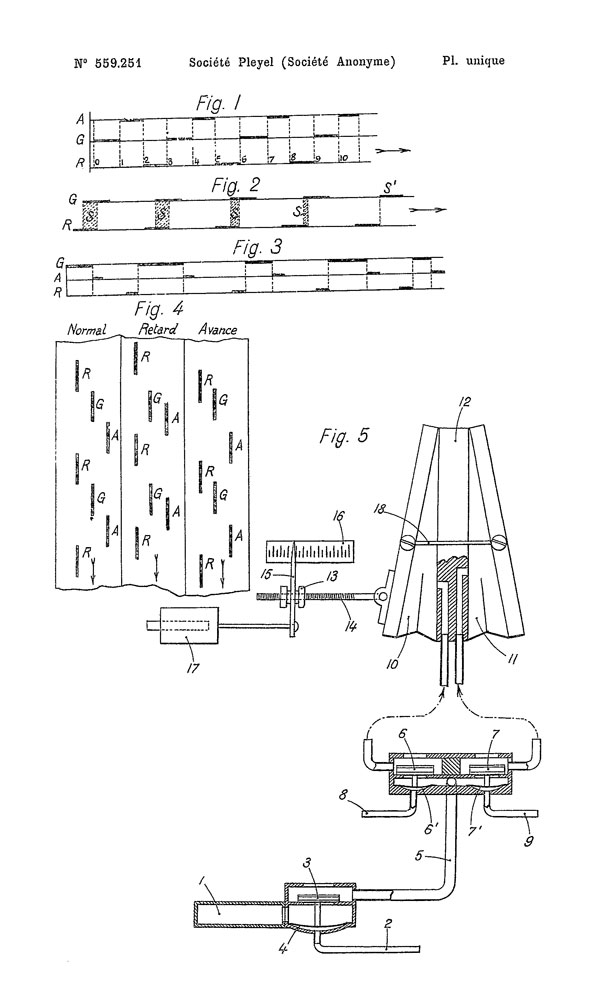
I have been reading "l'Age du rythme" by Laurent Guido, and my thanks to Jonah.77 for his suggestion. I've come across one particularly interesting snippet of information, in footnote 98 on page 482. It mentions a certain Monsieur Castillo in connection with Ciné-Latin, where he was apparently in charge of musical matters in 1928. The 55 rolls I found in Burgundy all belonged to F. Castillo, and the coincidence is at first glance too great for it not to have been the same man. The choice of repertoire on the rolls is so recherché that my first thought was that they were only part of a once larger collection, but now I'm not so sure. As well as the Grémillon, they also include music by Jacques Brillouin, Pierre-Octave Ferroud, Marcel Delannoy, Florent Schmitt and Artur Honegger, and they suggest to me someone who was a member of that social circle. There is a three-page article on Maurice Jaubert on the web, based on a biography by François Porcile, and it notes that in 1923 the young Jaubert very quickly made friends with the musicians Jacques Brillouin, Pierre-Octave Ferroud and Marcel Delannoy, with the help of Artur Honegger. Both Ferroud and Jaubert worked for Pleyel and the Pleyela, and as noted above by Jonah.77, Jaubert and Brillouin collaborated with Grémillon on the rolls of "Tour au Large."
Curiously, when I started looking for F. Castillo on the web a couple of weeks ago, I found that an oil painting by him had failed to sell at an auction house near London in mid-December, but it has not been re-listed, and the auctioneers either cannot or will not provide any more information. I'm certain that it was the same F. Castillo, because all his roll boxes are signed by him, and the signature is very characteristic. There was another painter called F. Castillo, a Mexican, just to make life complicated!
One of the rolls is of a piece of light piano music entitled "Syncopétude" by the American pianist and roll arranger, Adam Carroll, which was issued by Pleyel around 1927, played by Maurice Dumesnil. It is a factory roll, with no label, and F. Castillo has written the details and date of the recording, 25 June 1925, in blue pencil, and signed his name on the roll itself. One wonders whether he was perhaps there, since Pleyel never went as far as noting the dates of recording. All in all, it suggests someone in the same social milieu as Grémillon and his friends.
I said I would scan the roll leader and label for "Tour au Large", so here they are:
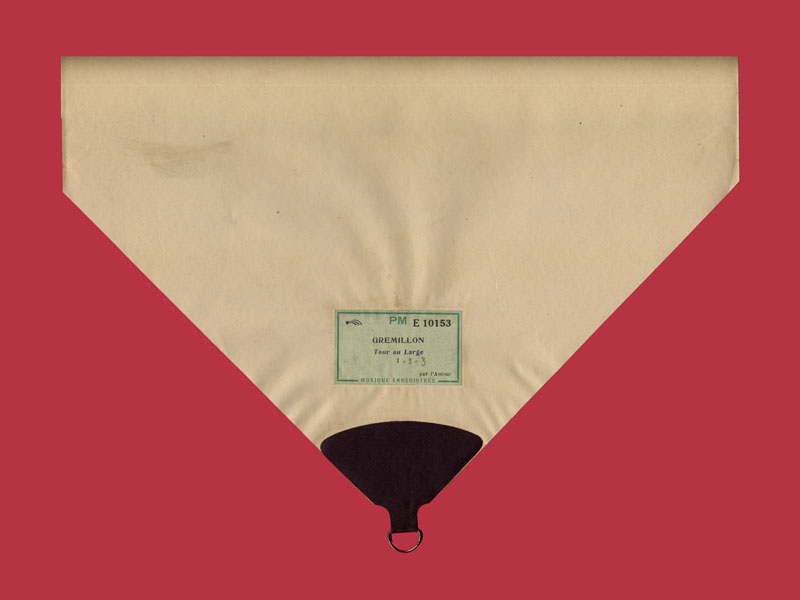
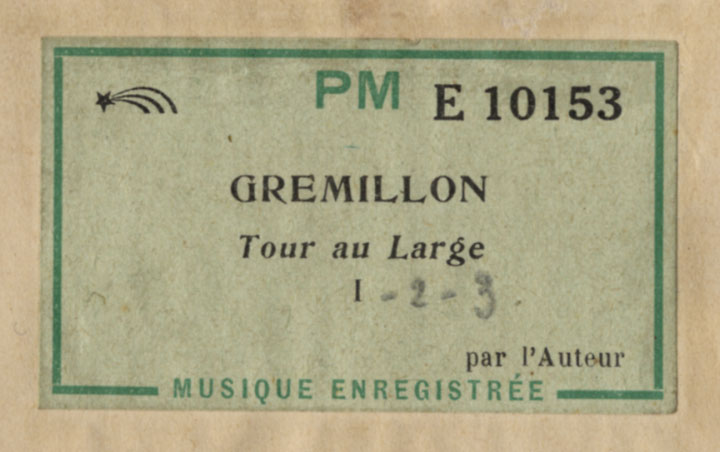
The details of the label will need a little explanation. By the late 1920s Pleyel was in some financial difficulties, caused in part by the disastrous fire at the new Salle Pleyel, at 252 rue du Faubourg St Honoré, and it seems to have divested itself of its music roll activities. Perhaps there was what the English call a "management buy-out", because the rolls continued to be made by the same organisation, which thereafter called itself "La Perforation Musicale". This was located at 22 rue Delambre on the Left Bank, next door to the workshops of Jules Carpentier, who had invented a roll-recording device as early as 1881. Probably this is where Pleyela rolls were always made. At any rate, "PM" stands for "Perforation Musicale".
The small icon at the top left of the label is meant to represent a comet, with its fiery trail, and it stands for the Pleyel trademark of "Perforation Comète". This was a style of perforation in which all notes began with a contiguous slot, but those which were long enough continued with chained perforations, like those on stamp margins. This was a style used throughout the player piano industry, because it helped to strengthen the paper, but Pleyel evidently felt like giving it a ritzy name!
E 10153 is obviously the roll number. The commercial release of "Tour au Large" was on three rolls, E 10153, 10154 and 10155. This roll uses the label for the first of the three, but you can see how someone (presumably F. Castillo) has added "-2-3" in pencil. "E" stands for "Enregistrée", but it doesn't necessarily mean that the roll was recorded by a pianist, and it doesn't mean that there were over 10,000 recorded rolls in the Pleyela/PM catalogue. Like many such companies, Pleyel added to its roll numbers on an ad hoc basis, allocating blocks as the necessity arose. It also published "Rouleaux Métronomiques", and the numbers alternate. 9,000 to 9,999 was a block reserved for accompaniment rolls, both vocal and instrumental, but nothing like that number was published. The "Rouleaux Enregistrées" therefore jumped from 8,999 to 10,000, and similar jumps had occurred previously.
"Tour au Large" is not the sort of music that could normally be played by a pianist, and it was obviously transcribed on to roll by an editor, probably Jaubert. The same process had occurred for Stravinsky's rolls, supervised by the head of Pleyel's roll editing department, Jacques Larmanjat, also a composer, who later became Director of the Conservatoire at Rennes. The fact that the Grémillon music appears in a recorded series simply indicates that the composer had given thought to questions of interpretation, as had Stravinsky, so that the roll can be played through without the need for any heavy manipulation of the tempo control.
I have found a good description of "Tour au Large" in a review for a couple of Dutch language newspapers, which I'll quote here, in a translation in which Google and I agreed to co-operate:
Mechanical Film Music
Our correspondent reports from Paris:
Is the question of film music an insoluble puzzle? . . .
Grémillon, an unknown filmmaker, who is also a musician, seems to have discovered the eye of Columbus.
His film, "Tour au Large", which is being shown at the Vieux Colombier, has no plot, no story-line: the starring role is taken by the sea, both calm and stormy, viewed from far and near, flowing slow and fast, interspersed with glimpses of lonely coastlines and fishermen at work.
To translate all this into music, Grémillon perforated rolls for the automatic Pleyela: exploding cataracts of notes, foaming and overflowing into strangely-marbled arabesques; one finds everything "à la minute" in relation to the images, for the Pleyela and the film projector are mechanically connected. The projected scenes, without subtitles, interspersed with restful moments of blackout, correspond exactly with the movements and rests of the music, so that the contrasting effects ("everything includes its opposite") are achieved in the most ingenious way. In the midst of these swirling arabesques, borne on high by the wailing wind (O Sacre du Printemps!), the melodies of a human voice reach out and are heard.
The best thing, since this could all be so close to a banale mimicry in sound - we are far from the sighing and howling of the futuristic orchestra - is that the music is already so carefully styled, that through its suggestions of the secrets of nature it makes for an often almost hallucinatory effect.
The motor car was first a horseless carriage, the film but a silent comedy, and cinema music a succession of nightclub tunes. Now at last the images on film can be accompanied, not "à peu près", but with unerring accuracy by the machine.
Het Centrum, Brussels, 14 April 1927
Nieuwe Tilburgsche Courant, Tilburg, 15 April 1927
Since I am going to wait before I record "Tour au Large", in the main because I need to practise it for a while, I'll give you another musical example for the time being. This is another roll from the Burgundy cache, an arrangement by Jacques Brillouin of the Bach Organ Prelude and Fugue in A minor, BWV 543. I have made several similar roll arrangements over the years, and it was really very moving to discover that someone else had hit on the same ideas of organ harmonics all those years ago. It comes from the "Compositeurs Associés" series of rolls, directed by Brillouin, which included some remarkable stuff, by Honegger, Milhaud, Ibert, Delannoy and so on.
http://www.pianolist.org/gremillon/CA61 ... llouin.mp3" onclick="window.open(this.href);return false;
The recording was made a couple of weeks ago, at a house concert organised by the Friends of the Pianola Institute, on a Steck grand Pianola Piano belonging to a friend of mine in south London. I've added a little reverberation, which I hope suits Brillouin's attempts to mimic a Cavaillé-Coll organ!
By the way, I'll assess the duration of "Tour au Large" and report back. There is no tempo indicated on this particular roll, but I have a friend in Holland with parts 1 and 2 of the published rolls. My guess is somewhere between 15 and 20 minutes, which I assume must be the whole work.