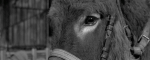
There's an even better Leonardo analogy to be made: the Last Supper. Leonardo painted the fresco in an experimental à secco technique of his own invention, but unfortunately it wasn't stable, and the painting began to deteriorate a few years after its execution.peerpee wrote:Brilliantly put! That's exactly it.zedz wrote:In that third example that Nick posted, there's already more detail in the original image than in the de-grained one, but in the next shot there will also be more detail, and moreover, it will be different detail, so in motion the detail of the image will be compounded twenty-four times a second, whereas in the smoothed-over one, the detail of every single image will be reduced to the same, slightly fuzzy and waxy, base level, with none of that rich cumulative detail. Instead, what will be compounded in motion (at least in my experience of viewing overly de-grained transfers) will be that waxy artificiality.
Now, if we take Lance's position that Marcel Carné would have shot Children of Paradise with better equipment if he could have, we can apply that logic to Leonardo's fresco and simply repaint the damn thing. Surely the master would never have experimented in the first place had he known the painting would not survive! And indeed, this is what so-called experts did until the second half of the twentieth century, which only caused more damage to the fresco.
I think film restoration firms could learn a lot from studying art history and contemporary conservation practices. They would find that many of the latest film restoration technologies and philosophies would be anathema in the world's greatest museums.