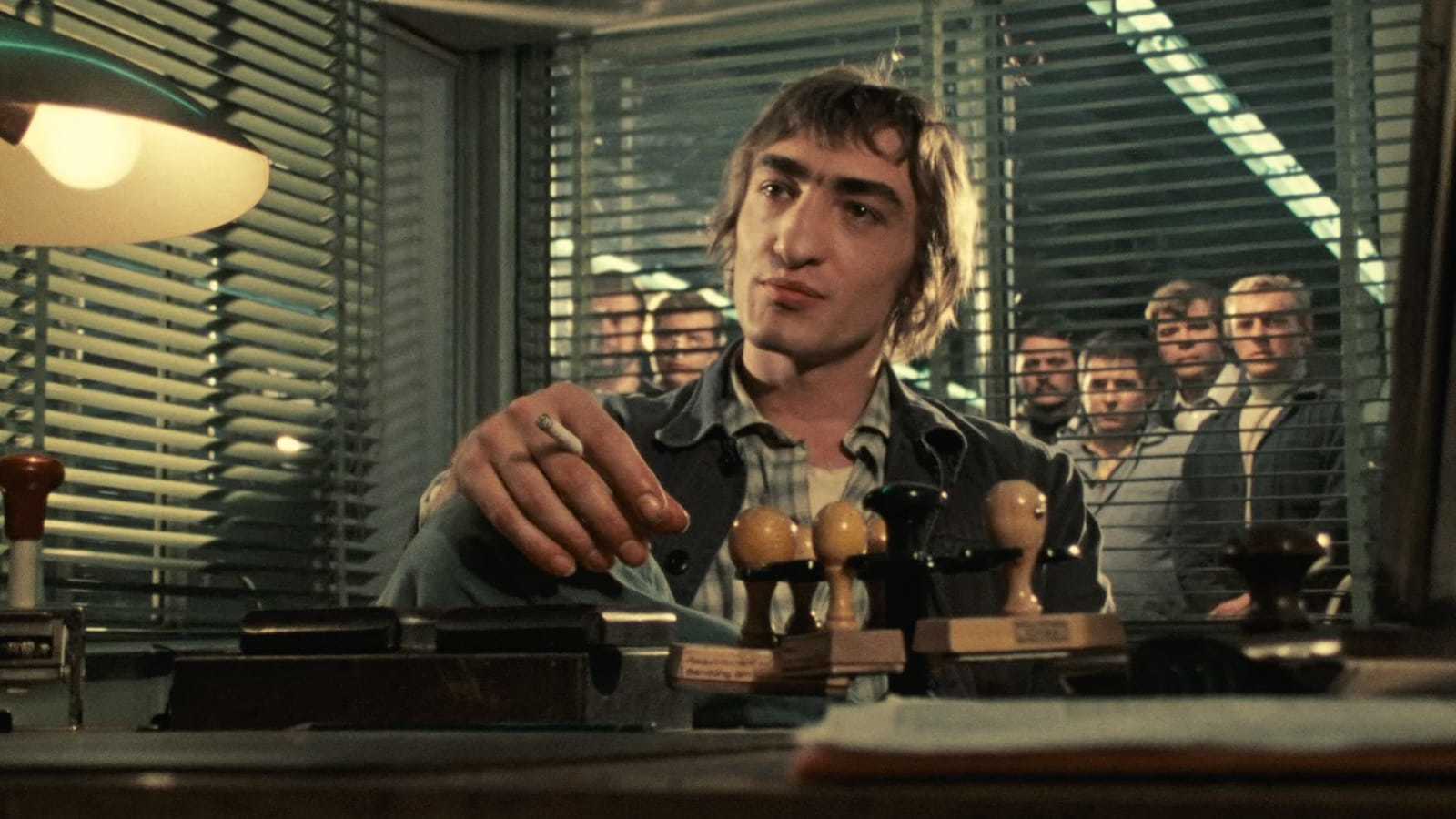
Eight Hours Don't Make a Day
 (1972-1973)
Until it was restored and issued on home video, this series was so hard to see I'd basically written it off as a "lost film" as far as I was concerned. So when it surfaced I approached it with a massive sense of occasion.
It's simultaneously a very Fassbinder project and a very un-Fassbinder one. The concerns - Marxist analysis; power dynamics in the workplace and home; women's societal entrapment; the formation, dissolution and reconstitution of relationships - are absolutely where Fassbinder was at the time, where he'd been, and where he was going, but they were presented, for the first and only time, in a framework that was positive rather than negative. It's his only film with a sunny view of human nature, which makes it slightly jarring but absolutely fascinating. It's a crucial film for students of Fassbinder, even if it's not really a crucial film in his development, since he never ventured into this territory again. Personally, I don't even see any particular lessons learned from this series in the long-form TV dramas that followed.
When I came back to the series, I decided to watch it one episode per week, to see if it struck me differently at its originally intended pace. The first time around, I'd gulped the whole thing down over a weekend and it made less of an impression on me than I'd hoped. A quick check established that even that pace was much faster than original audiences would have experienced, as it had trickled out at less than one episode per month (or, to be punctilious, at roughly monthly intervals, but with two months between the first and second episodes). And each episode is feature length, so this aired more as a series of TV movies, so it's kind of a weird format in any form.
The reason I did this was fundamentally to give the series a better chance of resonating with me, but alas it remains a fascinating curio rather than a great work, in my opinion. Let me try to get to the bottom of this:
1) Granny twinkles. The characters are all very static, in the fashion of a soap opera, in that they exhibit a handful of traits that never shift or evolve over the course of the narrative. We don't even gain greater understanding of the characters through shifts in perspective, as our own place in the narrative is static as well. It's a characteristic Fassbinder derives from long-form television, but at eight / five episodes, with a clearly planned beginning, middle and end, this isn't really long-form television in that sense. For the most part, this is a concealed flaw, in that it's a lack rather than a positive misstep, but it surfaces problematically whenever the narrative requires change in a character. Thus Harald is a comedy villain until he suddenly isn't, and Irmgard's arc calls for her to move from the outside to the inside, but her snooty behaviour (the sum total of her character) remains intact throughout, as does Jochen's "oh God, not Irmgard" Pavlovian response and Marion's "aw, she's not that bad" reflex rebuttal, even though the plot situation of the characters changes radically.
Because the series is generally optimistic, there are only a handful of one-dimensional baddies (the conniving boss, the racist co-worker) and a surfeit of bland, amiable good guys. One thing this series firmly establishes for me is that Fassbinder had a really hard time creating compelling positive characters,* so in the factory we get a stodgy mass of smiling, supportive, undifferentiated workmates (and one token racist). This spills over into the domestic arena, though there the actors at least get one trait to work into the ground (e.g. argumentative, lovelorn, curmudgeonly, puckish, evil incarnate). In total, this adds up to a dearth of vivid characters, which truly makes it an outlier for Fassbinder, who can conjure up vivid characters galore even when the film is an utter debacle (hello,
Satan's Brew).
2) It's the
mise-en-scene, honey. To me, this is one of Fassbinder's more anonymous-looking films. That can't be a function of it being made for television, because just look at all the other visually remarkable TV work he'd done and would do (
The Niklashausen Journey,
World on a Wire,
Nora Helmer,
Martha), so it must have been a conscious choice on his part to conform more readily to mainstream norms. This makes sense for a work intended as (and which succeeded as) stealth Marxist propaganda, but it doesn't ring my Fassbinder bell.
Probably the most impressively and elaborately staged and shot scene in the series is the long wedding reception in the penultimate episode, with the script juggling a bunch of micro-narratives and the camera gliding from room to room to grab snatches of them. The scene is nicely orchestrated, but the flatness of the characters means that the plot and character stuff that makes up the scene is rather thin, and its pleasure comes more from the old TV serial trick of seeing Character B interact with Character Y for the first time. It also suffers in comparison to the masterful party scenes that punctuate Reitz's
Die Zweite Heimat, which run several times longer and ten times deeper, but remain the more sophisticated descendants of scenes like this (or the opening of
Beware of a Holy Whore).
3) Don't you labour theory of value me, young man! in most Fassbinder films, the (largely Marxist) economic and political ideas are expressed by terrible things happening to his protagonists. In
Eight Hours Don't Make a Day, nothing terrible happens, but those ideas still have to be expressed, so they're expressed in dialogue, which leads to earnest scenes of, for instance, characters explaining surplus value to one another
without knowing that surplus value is what they're explaining. This is a thankless task for the scriptwriter, the actors, and the director. And it's not much fun for the audience either. And these scenes of contrived clunkiness run throughout the entire series. They're a core part of its conception and mission, but Fassbinder never finds an effective and convincing way for his characters to articulate the points he wants to make, whereas in other films he was an expert at articulating those same ideas through plot and action.
So, in total, this is a work I value highly for academic reasons, as it provides a unique insight into Fassbinder's preoccupations and way of working, but it just doesn't resonate that much with me, and I find it much clunkier and more simplistic than the other work he was doing at the time.
Needledrop footnotes: The soundtrack amounts to Fassbinder's Greatest Hits, with his axiomatic song choices - 'Smoke Gets In Your Eyes', 'Me & Bobby McGee', the first couple of Leonard Cohen albums - present and correct, alongside some deeper cuts, including (I think) the only appearance of Neil Young in a Fassbinder film. Most interesting to me is 'Candy Says' (apparently playing on a German pub jukebox!), which would later reappear in
Berlin Alexanderplatz. By 1972, the Velvet Underground was already appreciated among the cognoscenti, but most of that attention was focused on the debut album. The low-key third album had the lowest profile of their released work and had been their biggest flop, so I'm really curious as to how Fassbinder had been turned on to it.
* Since I wrote that, I've been scratching my head trying to come up with compelling positive characters in Fassbinder's films, and the best I could come up with was Armin Mueller-Stahl's lead in
Lola, but he's interesting mostly in the way in which he is allowed to be subtly corrupted.