541 The Night of the Hunter
-
Dylan

- Joined: Wed Nov 03, 2004 1:28 am
I do like it a lot. It's very peculiar, and the mood you're in when you watch it definitely reflects what you'll think of it. It's quite entertaining, and it has everything, even the little old woman who lived in a shoe (re: Gish).
Last edited by Dylan on Mon Oct 02, 2006 12:46 am, edited 1 time in total.
-
Godot

- Cri me a Tearion
- Joined: Sat Nov 06, 2004 4:13 am
- Location: Phoenix
Nice post, Andre. One of the my favorite scenes is the escape down the river, with giant animals in the foreground; it feels like a mix of diorama and children's nature storybook.Andre wrote:while The Night of the Hunter really "immerses" (it's so embarrassing to be using a Movie Critic buzzword) into the world of a child with all its absurd atmosphere and strange performances.
Your last comment made me think of other films that had this effect. I highly recommend William Cameron Menzies' Invaders from Mars (1953), told from the viewpoint of 10-year old David. Menzies frames many of the shots from David's viewpoint, but (more to your point) also uses the plot (aliens masquerading as humans) to cover an interesting assortment of childhood psychological fears (spooky girls, quick-to-anger parents, intimidating authority figures) and budding boy interests (whiz-bang-science-spouting square-jawed scientists (David's future?), military leaders jumping on David's every suggestion, sultry chesty doctor with torn blouse bonding with him). One of Savant's best articles goes into more detail on this.
Invaders also covers another type of "viewpoint": the dream/nightmare (hope that's not a spoiler). We could have a long thread covering fine examples of this style, wherein the performances, lighting, music and direction should tip us off that we're in a dream state. We could also easily discuss films that are whole or in part from the "mentally unbalanced" viewpoint. One of my favorite parts of the Point Blank thread was the debate about whether the film is Walker's dying revenge fantasy. So there are lots of interesting narrative approaches out there, just not so many that I can think of from a child's view (excepting minor examples like the opening graveyard scene in Lean's Great Expectations and Carol Reed's The Fallen Idol (1948), which more approximates your Mockingbird example).
Another film that fit this visual approach to a child-like viewpoint is Burton's Big Fish. I must admit, despite my generally stoic reaction to movies, I was floored emotionally by this film. It wasn't due to surprise: I figured out early on that Burton was using the father's storytelling wizardry to counterpoint the son's stodgy factual approach to life, that the son would eventually have to "grow" (by paradoxically "regressing" by accepting the child's delight in stories and myth and exaggeration) to understand his father's approach, and that Burton was playing up the father's joie de vivre by filming his memories/stories in bright colors and exaggerated settings. Fine, I got it. With each new scene I knew where it all was heading. And yet, the last 10 minutes overwhelmed me, not because it was a twist on my expectations or because I dreaded the emotional climax, but precisely because Burton so nicely shows what he could have lamely had the son explain: the characters of his father's life were just people, a little odd, but not the exaggerated legends of his stories. Those last scenes (from the hospital up to (but definitely not including) the barbeque coda) made the entire film for me.
-
Dylan
- Joined: Wed Nov 03, 2004 1:28 am
I know that "Night of the Hunter" is one of Tim Burton's favorites, but I think it's influence is perhaps felt mostly for the "Batman" films, "Nightmare Before Christmas" (strictly in design/sets), and "Edward Scissorhands."
"Invaders from Mars" was another favorite film of mine growing up. Now I find it cheesy and kind of boring, and it is a very silly movie (with terrible dialogue: "Gee Whiz!"), but like "Night of the Hunter" (which is a much much better film), it's full of cool, awkward, child-like versions of normal things.
Also worth of note is the excellent opening of Scorsese's "Alice Doesn't Live Here Anymore."
"Invaders from Mars" was another favorite film of mine growing up. Now I find it cheesy and kind of boring, and it is a very silly movie (with terrible dialogue: "Gee Whiz!"), but like "Night of the Hunter" (which is a much much better film), it's full of cool, awkward, child-like versions of normal things.
Also worth of note is the excellent opening of Scorsese's "Alice Doesn't Live Here Anymore."
Last edited by Dylan on Mon Oct 02, 2006 12:46 am, edited 1 time in total.
-
unclehulot
- Joined: Tue Nov 02, 2004 7:09 pm
- Location: here and there
Sigh... Sounds like something I'd expect to read on a Revenge of the Sith fan board from a 15 year old...... well, except that it would be appropriate for the level of that film, NOT this one. Sorry, just my opinion.....mmiesner wrote: this movie sucks and is boring. completely overrated and confused.
-
javelin
- Joined: Sun Dec 05, 2004 8:21 pm
- Location: Berkeley, CA
- Contact:
I agree Hulot, but the idea that there is a presupposed level for any given film, with one "level" inherently superior to another, seems - to me, at least - an absurd one. I do think mmiesner was being slightly ironic, but - agreed - comments like "this movie sucks" are hardly critical. I do, on the other hand, like the comment about the film being confused. That seems to me a viable criticism (although, once again, I disagree with it.)unclehulot wrote:Sigh... Sounds like something I'd expect to read on a Revenge of the Sith fan board from a 15 year old...... well, except that it would be appropriate for the level of that film, NOT this one. Sorry, just my opinion.
-
mmiesner
- Joined: Thu Mar 10, 2005 2:02 pm
i do have to admit i should not have written it exactly like that, and i did definitely think it made me sound 15 when i wrote it, but to be honest, i had a hard time thinking of a better way to write how i experienced this film. there's nothing worse than curling up on Halloween night trying to watch some classic scary films and ending up with something that is neither scary or lives up to it's hype as a great film. also, i did try to justify my comments in the paragraph below, i did not just say it sucked and run. and i also did not say that i am averse to watching it again. it just left me as disappointed as anything that has been superhyped is expected to be. just a letdown.
-
tryavna
- Joined: Wed Mar 30, 2005 8:38 pm
- Location: North Carolina
To digress for just a moment, I consider Reed's Fallen Idol a small masterpiece; in my opinion, it ranks just below The Third Man as Reed's finest accomplishment. (And this is another of Criterion's former LDs that deserves an upgrade to DVD.)Godot wrote:Carol Reed's The Fallen Idol (1948)
Why I think it's so great -- though it's so different in style to Hunter -- is that Reed follows to its conclusion the inner logic of his picture (which is to say that we only see the world through the child's eyes and therefore begin to adopt the child's own moral code). In this respect, I find it superior to To Kill a Mockingbird, which continually reminds us that the narrator is now an adult and can look back and reevaluate her former sense of morality. Fallen Idol never gives us the comfort of that narrator-looking-back commentary. What we see is the child's outlook, without commentary to distance us from it. The only thing that distances us would be our own adult sense of morality, which means that Reed leaves us alone to evaluate the child.
-
Steven H

- Joined: Tue Nov 02, 2004 7:30 pm
- Location: NC
Has anyone noted how thematically similar Fanny and Alexander is to this film? The child's eye view of the world, frightening religious figure (marries a widow no less), and a widowed mother becoming obsessively "spiritual" and dependant. Anyone else notice anything? Has Bergman ever brought up liking the film?
-
Galen Young

- Joined: Sat Nov 13, 2004 12:46 am
That's a good point! I wonder sometimes if David Lynch was influenced by it on Blue Velvet -- another tale about the redemption of innocence.Steven H wrote:Has anyone noted how thematically similar Fanny and Alexander is to this film?
Jean-Pierre Jeunet makes some interesting remarks about the film in a Take Five bit at Moviefone:
Personally, I think the film is a joy to watch. Laughter through the tears.Jean-Pierre Jeunet wrote:'Night of the Hunter' was another very important film for me. It a kind of fairy tale with monsters told in the same spirit as the Brothers Grimm, [in which two small children must escape a mysterious preacher character who has come to marry their mother and steal their fortune.] That style was a major influence on me and [co-director] Marc Caro for 'Delicatessen' and especially 'The City of Lost Children.' In fact, 'The City of Lost Children' was made as kind of a reference to 'Night of the Hunter' and everything we loved at this time. We invented a city with an ogre and children, which comes directly from 'Night of the Hunter': you have two children exactly like [our young heroine] Miette, and Robert Mitchum plays the monster. There is something beautiful and haunting about that film, very different from other American movies at the time. I cry each time I see the film at the moment when the children escape on the boat, and the little girl begins to sing, and Robert Mitchum yells because he realizes they're still alive.
-
dekadetia

- was Born Innocent
- Joined: Wed Nov 03, 2004 3:57 am
- Location: Pennsylvania, USA
I haven't seen this yet but I've been bumping into praise for it all over the place lately. Lars von Trier had this to say in Trier on von Trier, regarding Europa:
Oh, and Harmony Korine discusses the film briefly here. Again, this is sight unseen, but it seems almost absurd how many directors cite this film as an influence.
Spoiler
"...a fantastic film. A masterpiece. And completely unexpected, particularly in its brilliance of form. There were a lot of...scenes that were inspired by Laughton, not least the underwater scenes at the end of Europa. The image of Shelley Winters in Night of the Hunter, sitting drowned in a car at the bottom of a river, with her hair floating about her into the weeds, gave me the idea for Leo's death in Europa."
Last edited by dekadetia on Mon Dec 19, 2005 6:01 pm, edited 2 times in total.
-
Michael

- Joined: Wed Nov 03, 2004 4:09 pm
You folks have no idea how blessed I am to be a part of this forum. After reading all the comments and thoughts, I settled down with The Night of the Hunter last night. Keep in mind I've seen this film so many times and something about this film keeps pulling me back to it over the years but I was never able to embrace this film as much as I wanted to. Most of your comments really helped placing my mind in the right frame and something miraculous happened while watching this film last night. I sat totally transfixed thorough and my eyes bursted in tears numerous times. The journey on the river is powerfully moving with all the little creatures blessing the lost children. And the rest with Miss Cooper. Wow.
I never imagined that the 20th or 50th viewing could change everything (but in this case, with your tremendous, life-changing help ...thank you!)
I never imagined that the 20th or 50th viewing could change everything (but in this case, with your tremendous, life-changing help
...thank you!)-
Fletch F. Fletch

- Joined: Tue Nov 02, 2004 7:54 pm
- Location: Provo, Utah
To add another one in the mix, I've read that Green was heavily influenced by Night of the Hunter when he made Undertow -- children being chased through the American South by a crazed psycho.dekadetia wrote:Again, this is sight unseen, but it seems almost absurd how many directors site this film as an influence.
-
skuhn8

- Joined: Tue Dec 14, 2004 8:46 pm
- Location: Chico, CA
Well Hallelujahhhh! I've been saved!
Anyway...I saw this the first time about four years back and was quite disappointed. My closing comment was simply: "Hmmm. Interesting. Next?"
After reading all the above comments and then forgetting them and then remembering them I settled down and watched NOTH this afternoon for a second viewing. Wow. I'm a fan now. I'd double dip for a nice 2-discer. This film is like no other and maybe that has the been the problem it has faced over the years. It is a fairy tale with the horrible adult "real" world seeping in like an odorous sludge. And the Caligari imagery (killing the wife for instance)...WOW. Ahhh the gold days when people in the industry actually watched films.
I'd love to have a commentary for this and maybe a little followup to what has become of the child actors and what if any influence making this film had on their lives. I'm sure there's books out there on the matter as mentioned in above postings but I've no access here.
Anyway: to all the above posters. Thanks for bringing this film to my attention for a second shot. TImes like this when this forum REALLY pays off.
Anyway...I saw this the first time about four years back and was quite disappointed. My closing comment was simply: "Hmmm. Interesting. Next?"
After reading all the above comments and then forgetting them and then remembering them I settled down and watched NOTH this afternoon for a second viewing. Wow. I'm a fan now. I'd double dip for a nice 2-discer. This film is like no other and maybe that has the been the problem it has faced over the years. It is a fairy tale with the horrible adult "real" world seeping in like an odorous sludge. And the Caligari imagery (killing the wife for instance)...WOW. Ahhh the gold days when people in the industry actually watched films.
I'd love to have a commentary for this and maybe a little followup to what has become of the child actors and what if any influence making this film had on their lives. I'm sure there's books out there on the matter as mentioned in above postings but I've no access here.
Anyway: to all the above posters. Thanks for bringing this film to my attention for a second shot. TImes like this when this forum REALLY pays off.
-
Narshty
- Joined: Tue Nov 02, 2004 6:27 pm
- Location: London, UK
I love everything about the film up until the revoltingly saccharine ending that utterly capsizes the picture. It's all relentlessly and quite splendidly nightmarish and dark, then you have the dire last few minutes with something about a "shiny new watch". I always felt the logical ending point for the film was for the good townsfolk being left screaming for Mitchum's summary execution while Lillian Gish quietly ushers the children away. The current ending of the film is cringingly simplistic ("See how this here is evil? And over here, here's good") and the shift in tone is far too awkward. It's as ghastly as the studio-imposed ending for The Magnificent Ambersons.
-
jesus the mexican boi
- Joined: Fri Nov 05, 2004 9:09 am
- Location: South of the Capitol of Texas
I prefer to look at it as a companion piece to the ending of Bunuel's SUSANA. There's an unbelievably Up With People! saccharine ending that pushes the boundaries of what the audience can handle, a return to purity and, really, dull reality. What the ending of NOTH does is point back to everything that has gone before, just like SUSANA, and its simplicity, its Manichean duality, draws attention to itself by the very framework of the setup. Again, one of my favorites, and like skuhn8, I'd gladly double-dip for a double-disc.Narshty wrote:I love everything about the film up until the revoltingly saccharine ending that utterly capsizes the picture. It's all relentlessly and quite splendidly nightmarish and dark, then you have the dire last few minutes with something about a "shiny new watch". I always felt the logical ending point for the film was for the good townsfolk being left screaming for Mitchum's summary execution while Lillian Gish quietly ushers the children away. The current ending of the film is cringingly simplistic ("See how this here is evil? And over here, here's good") and the shift in tone is far too awkward. It's as ghastly as the studio-imposed ending for The Magnificent Ambersons.
-
clutch44

- Joined: Sat Nov 06, 2004 2:33 am
- Location: Camarillo, CA
Thanks for the article, very interesting indeed. I often wondered why Laughton never directed again, yet it never occurred to me that this great film was poorly received by critics and a commercial failure on release. Tragic that such a well regarded classic film would be the source of deep depression for a man that certainly deserved so much more.Fletch F. Fletch wrote:I've heard the film described as a fairy tale as well. It certainly isn't meant to be realistic... everything is heightened in the movie, from the German Expressionistic lighting (great use of shadows, btw.) and the exaggerated performances of the cast... esp. Mitchum who is so good. Definitely, a career-defining performance, IMO.
There are some truly striking images from the movie that are forever burned in my brain. Like that eerie underwater shot of the deceased Willa Harper. That one gets me every time. But the film does oscillate between moments of real terror and ones that are just so funny... like when Mitchum's preacher gets excited at the site of the dancer and flicks his switchblade... heh!
The kids' performances don't bother me and judging from what I've read they were instructed to act that way. There is an excellent article online that talks about the recently discovered rushes of the movie that shows Laughton in action, working with his cast that dispells a few myths that have surrounded the movie. Check it out here.
It is really a shame that this was Laughton's only directorial effort. I would have loved to see what else he might have made based on the brilliance of this movie.
-
scotty
- Joined: Tue Dec 14, 2004 12:04 am
I finally saw this classic last night in the restored print and it was an incredible experience. Laughton crams all kinds of techniques and styles into the film, and the tone does shift throughout. But the movie really becomes rapturous, and therefore essential, once the children reach the water. What follows has to be one of the most haunting and poetic (as well as stylized) passages in American cinema. I certainly felt a shiver when the children heard the silhouetted preacher singing "Leaning" as they hid in the top of the barn.
I think that we need to consider this not strictly in light of other films, however. The sensibilities of James Agee are all over this picture, even if Laughton did a lot of rewriting. Agee's almost smothering compassion for the downtrodden in his collaboration with Walker Evans, Let Us Now Praise Famous Men, informs the ending. Lillian Gish's talk of children enduring and abiding is exactly what Agee's literary mission was all about. Even the truest cynic will not be able to deny the force of Agee's passion from page one of Famous Men; he believes, or wants to, very, very badly. By the way, some of the exterior compositions early in the film reminded me of Evans.
Additionally, the gothic tradition in American literature is the true touchstone for the picture. The many tales of Hawthorne, especially "The Minister's Black Veil" and a host of others concerned with the condition of what he called the "heart" buried under social custom, religious tradition, and political authority, are an important reference point. So is Melville's The Confidence-Man, a work of the 1850s well ahead of its time (The Night of the Hunter is set in the 1930s, but could work just as easily in the 1850s- especially once the boat and the horse are employed during the middle section). Mark Twain's "The Man Who Corrupted Hadleyburg," Flannery O'Connor's Wise Blood (though much later) and many other works take the theme of the shifter of shapes who uses religion as a mask.
It also made me think of the way that tradition, and the film of which it is a part, continues to influence the culture. In music, for example, we woudn't have Springsteen's "Cautious Man" ("On his right hand Billy'd tattooed the word love and on his left hand the word fear"), Bob Dylan's "The Man in the Long Black Coat," just about the entire Music from Big Pink album by the Band, and so on.
My point is that I don't think we can deal with the film strictly in terms of its fidelity to or challenging of film tropes. The film is an incarnation of a cultural myth, and it is filmed that way. Agee's desire to evoke an American mythology, combined with a quest for spiritual absolution as a result of a highly (some would say over-) wrought compassion for the weak and impoverished, is imprinted on the film and, combined with Laughton's go-for-broke direction, gives it a singular beauty. It is an American opera.
I'm troubled that Sony let the fiftieth anniversary go by without issuing this
lovely print on DVD.
I think that we need to consider this not strictly in light of other films, however. The sensibilities of James Agee are all over this picture, even if Laughton did a lot of rewriting. Agee's almost smothering compassion for the downtrodden in his collaboration with Walker Evans, Let Us Now Praise Famous Men, informs the ending. Lillian Gish's talk of children enduring and abiding is exactly what Agee's literary mission was all about. Even the truest cynic will not be able to deny the force of Agee's passion from page one of Famous Men; he believes, or wants to, very, very badly. By the way, some of the exterior compositions early in the film reminded me of Evans.
Additionally, the gothic tradition in American literature is the true touchstone for the picture. The many tales of Hawthorne, especially "The Minister's Black Veil" and a host of others concerned with the condition of what he called the "heart" buried under social custom, religious tradition, and political authority, are an important reference point. So is Melville's The Confidence-Man, a work of the 1850s well ahead of its time (The Night of the Hunter is set in the 1930s, but could work just as easily in the 1850s- especially once the boat and the horse are employed during the middle section). Mark Twain's "The Man Who Corrupted Hadleyburg," Flannery O'Connor's Wise Blood (though much later) and many other works take the theme of the shifter of shapes who uses religion as a mask.
It also made me think of the way that tradition, and the film of which it is a part, continues to influence the culture. In music, for example, we woudn't have Springsteen's "Cautious Man" ("On his right hand Billy'd tattooed the word love and on his left hand the word fear"), Bob Dylan's "The Man in the Long Black Coat," just about the entire Music from Big Pink album by the Band, and so on.
My point is that I don't think we can deal with the film strictly in terms of its fidelity to or challenging of film tropes. The film is an incarnation of a cultural myth, and it is filmed that way. Agee's desire to evoke an American mythology, combined with a quest for spiritual absolution as a result of a highly (some would say over-) wrought compassion for the weak and impoverished, is imprinted on the film and, combined with Laughton's go-for-broke direction, gives it a singular beauty. It is an American opera.
I'm troubled that Sony let the fiftieth anniversary go by without issuing this
lovely print on DVD.
-
Michael
- Joined: Wed Nov 03, 2004 4:09 pm
-
scotty
- Joined: Tue Dec 14, 2004 12:04 am
By the way, the Library of America has just published an essential volume of James Agee. It contains Agee on Film plus previously uncollected film writings, magazine journalism from the 1930s, and the screenplay for The Night of the Hunter. Another volume contains Let Us Now Praise Famous Men and his fiction, including A Death in the Family.
-
hearthesilence

- Joined: Fri Mar 04, 2005 8:22 am
- Location: NYC
Would this be a candidate for HD-DVD or Blu-Ray? If it is, they better use that restored print because it is bee-yoo-tee-ful. Plus, watching the recently discovered outtakes and in-between-take footage would be interesting.
I heard Laughton was really scared when he made this. I don't think he had much confidence in himself as a director and supposedly it wasn't unusual for him to turn to other production members, maybe even the entire crew, and basically say, "I don't know what to do next, how should I do this shot? How should I do this scene?" Of course, none of this seems to be in those nearly discovered rushes. I'm guessing he only had problems setting up the shot, because it sounds like he had no problem directing the characters.
Having said that, I recall reading that Laughton ended up rewriting most of the script because Agee wasn't in good shape at the time and didn't write one to Laughton's satisfaction. I'm not sure if the changes themselves were that radical though but Laughton and I think a few others, possibly his wife, made changes on just about every scene.
This is all by memory. Anyone else read or hear any of this?
I heard Laughton was really scared when he made this. I don't think he had much confidence in himself as a director and supposedly it wasn't unusual for him to turn to other production members, maybe even the entire crew, and basically say, "I don't know what to do next, how should I do this shot? How should I do this scene?" Of course, none of this seems to be in those nearly discovered rushes. I'm guessing he only had problems setting up the shot, because it sounds like he had no problem directing the characters.
Having said that, I recall reading that Laughton ended up rewriting most of the script because Agee wasn't in good shape at the time and didn't write one to Laughton's satisfaction. I'm not sure if the changes themselves were that radical though but Laughton and I think a few others, possibly his wife, made changes on just about every scene.
This is all by memory. Anyone else read or hear any of this?
-
zedz

- Joined: Sun Nov 07, 2004 11:24 pm
Two great picks. The Window is a miracle of economy and is in serious need of rediscovery.davidhare wrote:On films from children's perspectives, two other great movies are surely Curse of the Cat People and Ted Tatzleff's The Window. And maybe The latter satisfies MMiesner's criterion for "scary" and not "overhyped". I'm still picking myself off the floor after that post.
-
scotty
- Joined: Tue Dec 14, 2004 12:04 am
Editor Michael Sragow, from the LOA Agee film volume, page 718 ("Note on the Texts"):Having said that, I recall reading that Laughton ended up rewriting most of the script because Agee wasn't in good shape at the time and didn't write one to Laughton's satisfaction. I'm not sure if the changes themselves were that radical though but Laughton and I think a few others, possibly his wife, made changes on just about every scene.
This is all by memory. Anyone else read or hear any of this?
"In 1954, Agee wrote the first draft of a sceenplay adapting Davis Grubb's 1953 novel The Night of the Hunter. After reading the draft, the film's director, Charles Laughton, cut and substantially rewrote Agee's original version. Although Agee retained sole writing credit, the screenplay was the product of this collaboration; as Agee wrote in January 1955: 'My feeling was, and is, that Charles had such an immense amount to do with the script, that it seems to me absurd to take credit, much as I'd like it . . . . I'm sure you know as well as I do or better, how embarrassed a writer should rightly feel in being given full credit, who has done a piece of work for and with Charles. It's on this basis that I feel very strongly that credit on the script should be double. At times, I've even felt that it should be given to him entirely: I can withdraw from that position only in realizing that I was useful, as a sort of combination sounding-board and counter-irritant.' The film was released in September 1955, a few months after Agee's death."
There is no question that the screenplay is a collaboration and that it is Laughton's film, but I also underscore the film's connection with Agee's literary preoccupations dating back two decades. An extraordinary work and I'm glad I got to see it in the restored print. Has anyone read Grubb's novel? I may not be giving him nearly enough credit.
-
David Ehrenstein
- Joined: Wed Oct 12, 2005 12:30 am
I wrote the liner notes for the Criterion laserdisc of The Night of the Hunter. I trust they'll be included on DVD editions.
The great thing about the outtakes -- an hours worth of which were screened at UCLA a few years back -- was how they show Laughton at work. If you recall the wedding night scene there's a master shot of Shelley Winters looking at herself in the mirror. Mitchum is already in bed and as the scene progresses the two have a dialogue exchange in which he predominates -- telling her they're not going to have sex. This is conveyed through close-ups of Mitchum. In the rushes we see the master shot being done with Winters, but when we get to Mitchum's close-ups she's not there. Laughton himself cues Mitchum, reading Winter's lines. Quite something as he says at one point "OK Mitch, we're still rolling. Say it again but make the scond part of the speech faster than the first." And BANG, Mitchum does it perfectly. They're completely in synch.
As for the kids the rushes show Laughton being very nice to them. There's one scene where they're in the cellar, standing on a heap of coal. They're suppsoed to respond to an off-scren sound cue and turn to react. Billy Chapin gets it, but little Sally Jane Bruce has trouble. She's only six and her motor skill coordination hasn't locked in yet. Laughton is extremetly patient with her and she obviously adores him. She apologizes for fluffing the cue and tries it again. When she finally gets it she sighs and says "This acting is HARD!"
The great thing about the outtakes -- an hours worth of which were screened at UCLA a few years back -- was how they show Laughton at work. If you recall the wedding night scene there's a master shot of Shelley Winters looking at herself in the mirror. Mitchum is already in bed and as the scene progresses the two have a dialogue exchange in which he predominates -- telling her they're not going to have sex. This is conveyed through close-ups of Mitchum. In the rushes we see the master shot being done with Winters, but when we get to Mitchum's close-ups she's not there. Laughton himself cues Mitchum, reading Winter's lines. Quite something as he says at one point "OK Mitch, we're still rolling. Say it again but make the scond part of the speech faster than the first." And BANG, Mitchum does it perfectly. They're completely in synch.
As for the kids the rushes show Laughton being very nice to them. There's one scene where they're in the cellar, standing on a heap of coal. They're suppsoed to respond to an off-scren sound cue and turn to react. Billy Chapin gets it, but little Sally Jane Bruce has trouble. She's only six and her motor skill coordination hasn't locked in yet. Laughton is extremetly patient with her and she obviously adores him. She apologizes for fluffing the cue and tries it again. When she finally gets it she sighs and says "This acting is HARD!"
-
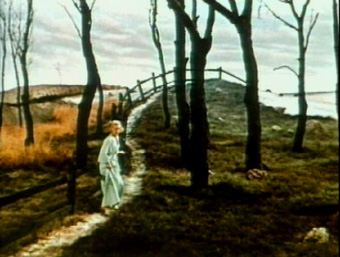
Godot
- Cri me a Tearion
- Joined: Sat Nov 06, 2004 4:13 am
- Location: Phoenix
It's the setting behind the house in Menzies' 1953 Invaders from Mars. The spaceship crash-landed just over the hilltop, and sunk into a sandpit. More to the point I was making, that scenery is dreamlike, suggestive and foreboding, the winding path disappearing over the hill, the barren trees, the gloomy sky.What is that still Dylan posted on the previous page from?