Mr Sausage, I have to say I disagree strongly that Harry Caul is simply paranoid in
The Conversation, or that things might be more benign than they seem to him:
For me (and zedz said part of this above), the point is that his paranoia is just mis-directed; he's right to suspect the big corporation, Harrison Ford and so on, but wrong to think that the young couple (and not Robert Duvall) are the victims. If anything, he isn't paranoid enough, and this point is made several times in the film when he opens up or trusts someone and is immediately betrayed.
Part of the point of that key repeated line is that it clearly indicates something bad is going on: it tells Harry, and us, that this young couple fear for their lives. What it doesn't tell us, without a bit of context, is that they're going to deal with this problem by means of a pre-emptive strike. They don't need protecting; and perhaps it's true that if they hadn't killed Duvall, he would have killed them instead. What's really awful about the ending is that Harry realises there are no good guys in this story, no innocent victims - except him, perhaps.
Most importantly, no one has yet mentioned the final scene: I don't know how others interpret this, but I think it proves that Harry doesn't know the half of what's been going on. His whole world really is swarming with bugs, traps and conspiracies, and he is powerless to stand up to any of this, or protect himself or anyone else; he can't even get a firm hold on who exactly needs protecting. But there's no doubt that the conspiracy is real and malign. That he responds to all this at the end by playing his (probably bugged) saxophone is a wonderful touch, and I love how the camera pans from side to side like a surveillance camera.
With regard to the twist, this never bothered me in the slightest - this too is, I think, a wholly successful aspect of the film, and one of the moments I treasure most. It sends shivers down my spine every time I see it. I don't agree with you, zedz, that the ending wouldn't work without the changed intonation. If the Frederic Forrest character still just said 'He'd kill us if he got the chance', without emphasising the 'us', a sharp viewer could still figure out what this actually meant. All Coppola does is change the intonation to spell the point out for the audience, and also to heighten the dramatic impact of the revelation - as a less than sharp viewer myself (I didn't figure out the ending of Blair Witch until hours after the film finished, when I was trying to sleep...), I appreciate this kind of thing, but I do also think it 'points' the horror of this moment.
What Sausage and matrix say about this being Harry's re-interpretation of the line also works, but I would place more emphasis on the way it fits in with the two other big nightmare moments leading up to the twist: the bloody hands thrust against the hotel window and the blood billowing up in the toilet bowl, both supremely creepy and shocking touches (the first anticipated when Harry is shocked by a loud noise as he listens in on the room next door). These moments, and the montage of details which precede 'He'd kill us if he got the chance', sufficiently establish an air of uncanny dread to make the change in intonation work - it's the icing on the cake.
As for
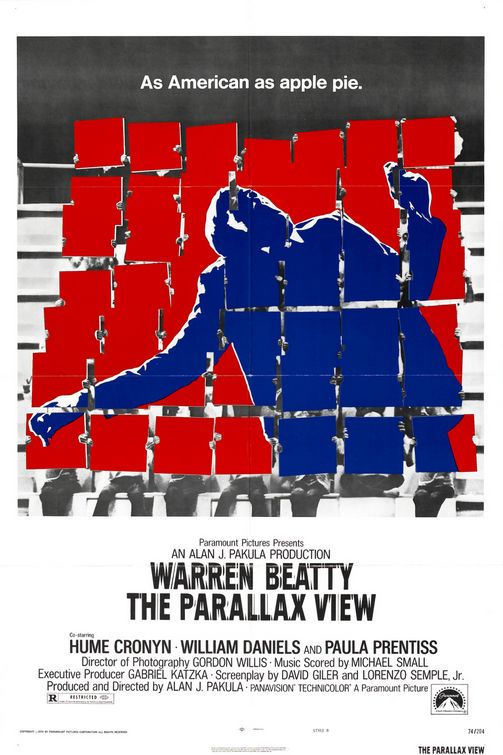
The Parallax View and
All the President's Men being Antonioni-esque, as zedz says the positioning of characters in relation to architecture and other surroundings (the Library of Congress, the whole of Washington - wonderful shots, these) feeds into this, although I would actually say this stuff is more overt and deliberately evocative of Antonioni in
The Conversation. Remember the big building that houses Caul's employers; and his own 'office' is at least as cavernous and alien as the car park in AtPM. The dream sequence where he sees Cindy Williams in the fog also reminds me of a great scene in
Red Desert (and the whole of
Il Grido;
Identification of a Woman hadn't quite been made yet...), and the use of parks (with mimes!), as well as more obvious factors, is of course reminiscent of
Blow Up.
I said the Pakula films deserve the label 'Antonioni-esque' more than Coppola's film for a very vague and subjective reason: I think Coppola is trying harder for these kind of effects, and going back to his film after getting into Antonioni, I couldn't help feeling that his treatment of alienation was an enthusiastic pose, lacking conviction at times. I hate to use the word 'pretentious', but there are times in
The Conversation where I just feel it's working too hard, and too obviously, to show how lonely and alienated Harry Caul is. I love David Shire's score, and it fits the movie very well, but I think that wry, lonely piano reinforces the sense that we're being told to see the hero in a certain light (note the 'And happy birthday!' moment at the beginning, and the way the score underlines this), whereas Antonioni or Pakula, at their best, achieve these effects more organically and, as I say, with more conviction.
(Interesting fact: David Shire also did the score for
All the President's Men and
Zodiac, and the music in the former is clearly imitative of Michael Small's score for
Parallax. Shire also composed the staggeringly awesome score for the original
Taking of Pelham 123, and I'm also fond of his work on the 1975
Farewell My Lovely. Sadly most of his career since the '70s seems to have been spent on TV movies. Fincher must have hired him partly as a homage to Pakula's film, I think.)
I tend to group Antonioni's films into two broad categories. In most of his films up to and including
Red Desert, we get a protagonist who is more or less emotionally 'normal' or 'well-adjusted', but finds him/herself in an increasingly alien, inhuman world; at the end, they find some partial and ambivalent way of coping with this world. From
Blow Up onwards, there is much more of a sense that the protagonist is fully immersed and integrated with that alien world - as if the pod people have already taken over. Although ostensibly they're still fighting against something (a murder conspiracy, the establishment, the mundanity of a settled existence, the dissolution of a love affair, or whatever), in fact we get an odd sense that they're not really fighting it at all, but that even the appearance of conflict and resistance is just part of the beautiful, soulless abyss that is the modern world.
I think
The Conversation fits into the former category, and its ending seems to me very similar to those of
La Notte and
Red Desert in particular. Pakula's films (at least the two under discussion) fit into the latter category; for instance, in
The Parallax View,
Beatty reacts to the Parallax test very much like Hemmings in Blow Up, impassive and un-moved; at the end he runs towards the light but is eclipsed and blown away, just as Hemmings looks for a body and ends up vanishing himself.
And I already mentioned the ending of AtPM. I couldn't really substantiate this point without watching all the films again, but I can't help feeling as though the heroes in Pakula's films are integral parts of those abstract forces of darkness that seem to hang over everything. They're perversely at home in this world, they operate smoothly and mechanically within it, and whether or not it literally destroys them, they (like everyone else we see) scarcely seem to exist as individuals with identities, emotions or thoughts. I might be alone on this, but I get a kick out of seeing the films this way. I look forward to re-watching
Klute soon; it seems to take several viewings for me to even begin to appreciate what Pakula is doing.