Re: Michel Deville
Posted: Wed May 01, 2019 1:22 am
Finishing off the 70s was easier than the 60s, with less to write about considering I’d already seen two of Deville’s masterpieces from the decade (L'Ours et la poupée and L’Apprenti salaud) and he wasn’t developing his style as rapidly by this point. I also realized that I had seen a Deville film before: Le mouton enragé (1974), a few years ago. I remember not liking it at all so there was no motivation to revisit it, but who knows; maybe it’ll be better in the context of his other work. From what I recall, it was pretty lifeless and uninteresting. Anyways,
Raphaël ou le Débauché (1972)
What starts off as a rather strong comedic costume drama in the vein of Tom Jones peters in its second half only to fizzle out by the end. I really admired some of the gags and funny lines in the first part, and even some of the well-acted dramatic moments in the second, but it dragged on for long enough to make me realize I didn’t care about any of the characters, which is something this Deville feature seemed to be pushing for, and rather forcefully at that. While he’s always interested in exploring the complexity of people, and absolutely cares about his own characters, Deville never really asks us to take them that seriously- instead finding less obvious ways to get us closer to understanding and appreciating them. This felt like a half-baked Deville film that became less distinguishable until I would’ve never guessed it was made by him at all. This wouldn’t be the first time that he takes such a sharp turn into serious terrain, but we miss the genre-toying Deville from Adorable menteuse precisely because of the lack of playful energy exerted once the drama kicks in. This is less flirting with genre, and more like two movies fused as one uneven experience (except the final shot completely undoes this seriousness and gave me a good laugh- though I’m not sure if it’s because it was actually funny to completely shift the mood back to the carefree nature of the beginning, or just only too welcome). Perhaps I’m being overly harsh by focusing on mostly negative aspects because I really didn’t hate this. Certain lines and scenes are good enough to still make me chuckle as I reflect back on them, so it’s not a bad movie so much as it just didn’t work as a whole.
La femme en bleu (1973)
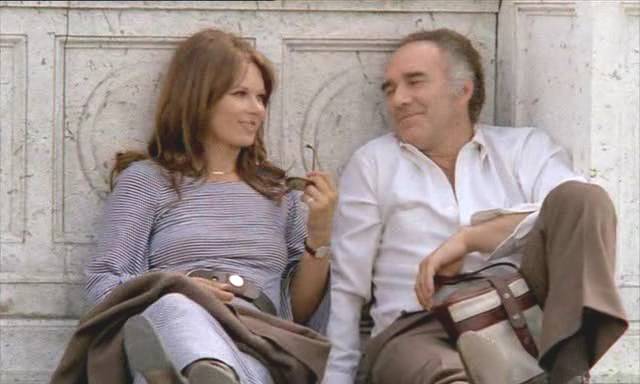
Thankfully Deville returns to his old self here, and then some! Domino already championed a lot of what makes this film work so well in his write-up, particularly in the analysis of Piccoli’s psychology and how it fits into Deville’s body of work thematically. What struck me about this was how emotionally zen it felt compared to his other films, with a mood far less erratic, zany, or untamed. That’s not to say that this is ordinary or even relaxed, but Deville seems to be meditating on something here- with less of a jump in range between the comedy and solemnity of being a human. Piccoli is always wanting, chasing, fearing, hiding, acting, or living for or after something. This may be Deville’s wisest film yet in many ways (content, formulation of mood), and not just because of how deep he delves into philosophical dialogue towards the end. The entire vibe is that of a mature filmmaker making a mature film, all while remaining exuberant and lighthearted. I’m itching to rewatch this already, and have a suspicion it’ll rank even higher in my esteem once I sit on it some more, as there’s a lot to unpack here and I’m still in a daze from my viewing 48 hours ago. I loved this so much that it rivals L'Ours and L’Apprenti for my favorite Deville, and that’s saying a lot considering the significant imbalance of humor between this and those!
Le dossier 51 (1978)
And now for something completely different: Deville goes back to experimenting with form to make a soup of surveillance thrillers and docu-drama noirs, both popular in the 70s but tracing back to the 40s. I appreciated this more than I liked it, and it’s a necessary step after the insanity of L’Apprenti salaud. There was no way Deville could top that and trying something new, especially a film mostly absent of comedy, is a welcome cool-down. The 60s may have been more experimental on the path of Deville’s professional development, but the 70s were just as diverse a decade for the director; and while less consistent in quality between films, probably wins out on the strength of three masterpieces alone.
Raphaël ou le Débauché (1972)
What starts off as a rather strong comedic costume drama in the vein of Tom Jones peters in its second half only to fizzle out by the end. I really admired some of the gags and funny lines in the first part, and even some of the well-acted dramatic moments in the second, but it dragged on for long enough to make me realize I didn’t care about any of the characters, which is something this Deville feature seemed to be pushing for, and rather forcefully at that. While he’s always interested in exploring the complexity of people, and absolutely cares about his own characters, Deville never really asks us to take them that seriously- instead finding less obvious ways to get us closer to understanding and appreciating them. This felt like a half-baked Deville film that became less distinguishable until I would’ve never guessed it was made by him at all. This wouldn’t be the first time that he takes such a sharp turn into serious terrain, but we miss the genre-toying Deville from Adorable menteuse precisely because of the lack of playful energy exerted once the drama kicks in. This is less flirting with genre, and more like two movies fused as one uneven experience (except the final shot completely undoes this seriousness and gave me a good laugh- though I’m not sure if it’s because it was actually funny to completely shift the mood back to the carefree nature of the beginning, or just only too welcome). Perhaps I’m being overly harsh by focusing on mostly negative aspects because I really didn’t hate this. Certain lines and scenes are good enough to still make me chuckle as I reflect back on them, so it’s not a bad movie so much as it just didn’t work as a whole.
La femme en bleu (1973)
Thankfully Deville returns to his old self here, and then some! Domino already championed a lot of what makes this film work so well in his write-up, particularly in the analysis of Piccoli’s psychology and how it fits into Deville’s body of work thematically. What struck me about this was how emotionally zen it felt compared to his other films, with a mood far less erratic, zany, or untamed. That’s not to say that this is ordinary or even relaxed, but Deville seems to be meditating on something here- with less of a jump in range between the comedy and solemnity of being a human. Piccoli is always wanting, chasing, fearing, hiding, acting, or living for or after something. This may be Deville’s wisest film yet in many ways (content, formulation of mood), and not just because of how deep he delves into philosophical dialogue towards the end. The entire vibe is that of a mature filmmaker making a mature film, all while remaining exuberant and lighthearted. I’m itching to rewatch this already, and have a suspicion it’ll rank even higher in my esteem once I sit on it some more, as there’s a lot to unpack here and I’m still in a daze from my viewing 48 hours ago. I loved this so much that it rivals L'Ours and L’Apprenti for my favorite Deville, and that’s saying a lot considering the significant imbalance of humor between this and those!
Le dossier 51 (1978)
And now for something completely different: Deville goes back to experimenting with form to make a soup of surveillance thrillers and docu-drama noirs, both popular in the 70s but tracing back to the 40s. I appreciated this more than I liked it, and it’s a necessary step after the insanity of L’Apprenti salaud. There was no way Deville could top that and trying something new, especially a film mostly absent of comedy, is a welcome cool-down. The 60s may have been more experimental on the path of Deville’s professional development, but the 70s were just as diverse a decade for the director; and while less consistent in quality between films, probably wins out on the strength of three masterpieces alone.