Page 2 of 2
Posted: Sun Feb 11, 2007 2:04 pm
by Cinesimilitude
I find that with all the photos I take that resemble whats being discussed here, the greater the scope the better. That is to say I'd rather see as much landscape as possible without it containing any distractions from the primary subject. I'm not sure if it's a certain solitude or loneliness that I'm going for, but I just like seeing man vs nature in a one on one setting. So with that in mind the only reason your last shot seems out of place to me is the lack of space around the subject.
And while we're posting them anyways, has anyone else got a flickr account that posts here? do add me as a contact.
Posted: Sun Feb 11, 2007 2:18 pm
by ChrisW
Yeah, there's lots of good examples on Flickr. For me, this is the best
rückenfigur shot I've seen on there - absolutely nails it...

(Photo by George Draskóy)
Posted: Sun Feb 11, 2007 8:17 pm
by zedz
Scharphedin2 wrote:I am not familiar with Spider Forrest, or, the aesthetic definitions of what a rückenfigur is or is not supposed to be or express. However, strictly based on the stills in ChrisW's post, would this not qualify more as subjective use of the camera? And/or, as Chris suggests himself, a use of the camera to create suspense?
I also haven't seen the film, but I think there's a difference between this and subjective camerawork, as the camera's point of view is not that of a character, but is nevertheless connected (at a slight remove) to the point of view of the character in the frame. We're seeing what they're seeing, but we're seeing more, because we're also seeing them seeing it - there's a layer of reflexivity.
A film that uses a very similar technique, but which I wouldn't associate with Friedrich, is the Dardennes'
The Son, in which we're forever trailing the protagonist around, at very close quarters. It's much closer to subjective camerawork than the Friedrich-like examples cited above, but there's still that crucial distance, and much of the film's power comes from
not being in the head of the protagonist. And, as Scharphedin says, there's something about this position of seeing / not seeing, identifying / not identifying that lends itself to suspense.
This could probably all be much more clearly illustrated by Venn diagrams.
Posted: Mon Feb 19, 2007 4:34 am
by Kinsayder
In the first half of Vertigo, Madeleine, the "lonely wanderer", is filmed repeatedly from behind in contemplative poses that seem to evoke the compositions of Friedrich:


These are all point-of-view (POV) shots, but not Madeleine's POV: this is Scottie watching Madeleine, who remains remote to us because we are not "in her head" (to use zedz' terminology). This is different, therefore, from the familiar POV shot which has us peering over the shoulder of the character whose POV we're seeing; but closer, I think, to Friedrich, whose figures also have a sense of mystery and distance:

Posted: Mon Feb 19, 2007 2:59 pm
by jesus the mexican boi
God... those Vertigo shots are so gorgeous. I love this concept, this image. Leave it to the Germans to give it a name, but as these examples show, it transcends borders and tongues.
I was going to post Herzog screenshots but I'm all thumbs at such things. Still, the image of Klaus Kinski as Fitzcarraldo watching the ship being hauled up the mountain in the fog seems like a ruckenfiger deadringer.
Posted: Sat Feb 24, 2007 12:46 am
by backstreetsbackalright
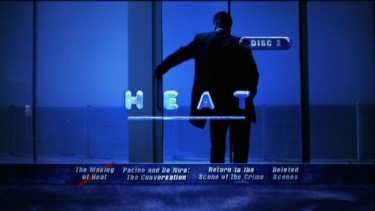
I'm surprised our Michael Mann fans haven't chimed in. His films are thick with these kinds of shots. Take this one from
Heat's DVD menus, even:
Posted: Sun Feb 25, 2007 11:42 am
by ChrisW
Posted: Sun Feb 25, 2007 12:01 pm
by HerrSchreck
tryavna wrote:I don't mean to rain on anyone's parade here, but aren't some you guys defining rückenfigur a little broadly? I mean, surely not all filmmakers have the rückenfigur image in mind every single time they film somebody with their back to the camera..
Amen. The caps up to the point of this post by travna were getting absurd. You could post caps from just about every movie ever made when someone turns their backs to the camera or is seeing what the camera sees.
Necessary-- A solitary melding into or identification with environs, an emotional distance.. a melancholic or mercenary state?
Certainly not a shot of going to the store to buy milk where the camera happens to catch you from the rear for a second.
Posted: Sun Feb 25, 2007 5:16 pm
by Michael Kerpan
I think the Proposition grabs are highly pertinent. No going out to the store to buy milk in these. ;~}
Posted: Mon Feb 26, 2007 2:31 am
by Cinesimilitude
Oddly enough, the opening shot of the first script I wrote has the main character entering frame left, with his back to the screen. He's going to 7-11 to buy milk. Hell, the title is "1% or 2?". I just find that funny.


