I was curious enough in spite of domino's warnings to watch
Chronicle of the Years of Fire, and now in turn feel obliged to caution anyone reading: if you buy the upcoming set, the disc with this film on it might as well be blank.
Chronicle... is one of the worst, most incompetent professionally-made movies I have
ever seen. There aren't mistakes on the level of, like, overexposed film or ineptly-lit actors (see: any number of z-grade slashers or exploitation movies from this decade or the next one), and the filmmakers have access to things like dolly tracks and a crane, but on every other level this so completely resembles a product that one would expect from a complete novice that it astonished me to learn that not only were the heads of department
not amateurs, but some of them had impressive résumés. The cinematographer for this film even shot
The Battle of Algiers, a great film about the same milieu that has its own excellent and distinct look. Co-writer/co-star/director Mohammed Lakhdar-Hamina is evidently incapable of managing a project of this size and makes constant Form 101 errors that congeal into a very confusing viewing experience. To a half-interested or charitable viewer some of these mistakes may just seem like clunky staging or bad editing (both errors with which the film is separately plagued), but a careful look at many of the more dialogue-intensive scenes (which is to say any of them that consist of more than just flat long takes with hilarious, Robert Altman-esque endless panning) reveal a bit more going on under the hood. Lakhdar-Hamina is very bad at placing his camera and establishing location and geography in these more static scenes; too often are there extremely disjointed cuts between too-close closeups of characters sitting in the same room talking to each other that give the false impression that distance or time is being traversed in a cut. These mistakes may
manifest as confusingly-cut sequences with bizarre jumps between angles, but a savvy viewer can surely hear the editor swearing under his breath at the coverage given to him. Not only is there an enormous amount of footage in this exhausting and overlong movie, most of it repetitious and neither aesthetically nor narratively interesting, but most of it is the
wrong footage in some way. Imagine a film made out of the stuff trimmed from a rough cut and it would look something like this.
Nor does the material of the script help salvage the project. While it would be difficult for most modern cinephiles to watch the film and disagree with its politics, there isn't anything noteworthy about the people we follow or most of the events we see within the film's milieu. The movie reduces some fascinating details about indigenous attitudes towards themselves and towards colonizers (knives has already pointed out the Algerian attitude towards Hitler and the early battle over water as points of interest, to which I'd add the initial reaction of the Algerians to a man they presume an informant) down to tropes and cultural scripts while minimizing the traits and emotive responses of most characters, presumably to take a load off of the already-overmatched cast. (Certainly there is a ton of SHOUT SHOUT SHOUTING in this movie; some actors only bellow their dialogue, even when they are in social settings that might demand otherwise). If this is the point, if the intent was to create a broad or Brechtian film that keeps you at a distance to create a certain emotional response to the real-life drama, it certainly doesn't work, especially with the material involving Lakhdar-Hamina's in-universe "mad" narrator. His endless scenes add nothing to the movie and demonstrate a pathetic sense of vanity on the part of the filmmaker who made sure they stayed in.
As a sidenote, the 1975 Cannes jury that awarded this film the Palme was completely bizarre: among others, Jeanne Moreau, Fernando Rey, George Roy Hill, Anthony Burgess, a Soviet filmmaker who
also directed a
separate Cannes-award-winning movie called
Chronicle of the Years of Fire, and Pierre Salinger, a speechwriter-turned-U.S. Senator-turned-campaign-manager-turned-journalist with an insane Wikipedia page. The table of contents alone is promising:
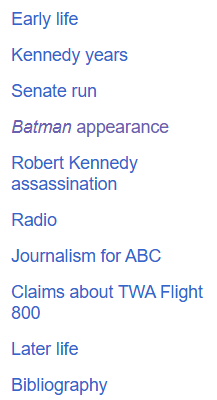
Among his co-authors in his bibliography: Frank Mankiewicz, son of Herman and father of Ben;
Muammar Gadaffi