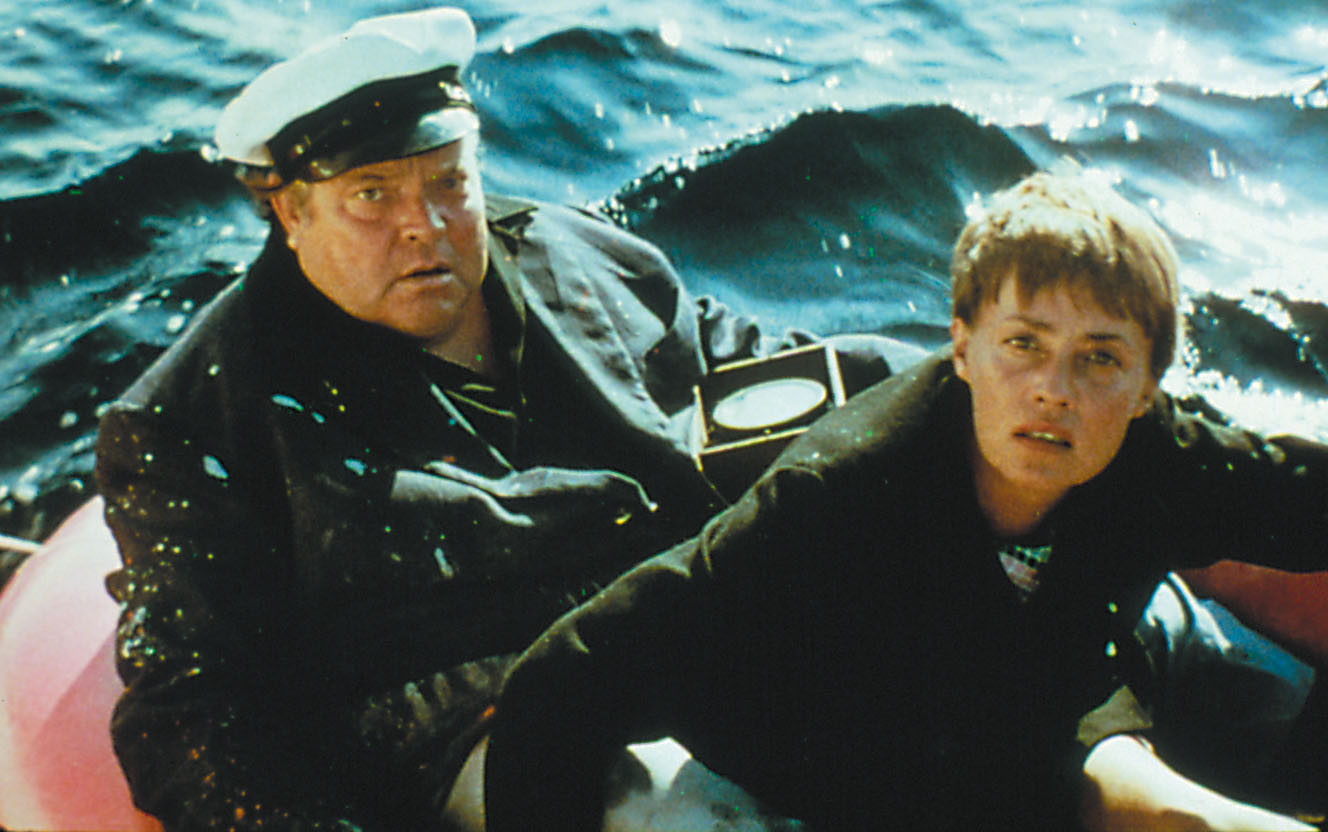
Well, I hate to tell you, but it was actually quite excellent. Droessler made clear in the introduction that Welles' intended this to be a popular film, to show he could deliver a hit, and it's easy to see how this could have been a very successful, fun film in the mold of
Lady From Shanghai and
Touch of Evil.
I'm sure you're mostly familiar with the plot, and I need to re-read the chapters in
WEHTOW, but the entirety of the plot is in place. We open in a dream sequence of Oja's, where she is pushed off the deck, she comes awake, and we are on ship with her and her husband. The opening sequence is
long, as are many of the sequences. Droessler stressed that as a work print, shots are intentionally repeated, and different takes of the same scene are inserted intentionally several times because the film would have been edited down.
-There are many blank frames where close-ups were to have been inserted
-Welles' lines are mostly absent, as he would have dubbed his own lines in last after everyone else did
-Harvey's lines are all (clearly) read by Welles. He has the most finished dialogue of anyone in the film (because of this?). He died before having the chance to dub.
-Moreau has a lot of dialogue recorded, and clearly most of it is NOT overdubbed, which was a nice treat.
-All of Welles' lines you hear are live in shot
-Most of Kodar and her husband's lines are clearly overubbed
-The assembled/displayed work print consists of pieces of 2 separate workprints and even some rushes. Welles printed rushes on whatever shitty film stock he had lying around. The film frequently goes from black and white to color.
-I can confirm for you that
this does not represent at all the color timing. Sorry, would be nice if it looked like that, but the color stock was mostly faded, or I assume, never color-timed to begin with (I would have no idea technically what to make of it. Very, very faded)
I lost track of time, but if I were imagining what the edit would have consisted of, the first reel would have been: 1) dream sequence 2) wake up 3) see Harvey approaching in boat 4) figure out what's going on with him 5) husband gets suspicious and investigates other boat 6) discovers Welles and Moreau 7) discover Harvey was faking illness and gets away. This could easily make up 15 minutes, and with a 15 minute reel establishing plot, of what would probably be a 1.5 hour movie, it would establish everything pretty well.
As the film goes on, Harvey comes off very well as paranoid that his boat mates are out to get him. Even without his voice, the performance is clearly strong and desperate. Perhaps unsurprisingly, Kodar is sort of the weak link of the film. At the beginning of the film, she is sympathetic to Harvey's plight, even while her husband is suspect. Then, of course, she is kidnapped by Harvey. She actually seems perfectly well-cast, but it's kind of underdeveloped from what we see. She has a chance at one point to kill Harvey, but spares him. This is something I jus didn't get. She moves between feeling bad for the guy's clear mental wreckage, and at the same time is plotting to kill him or escape, eventually drugging him long enough to find Welles's and co's boat. She's not bad, really, but her character's motivation is lacking. And there's plenty of this-era Kodar-esque close-ups stuck in for good measure that don't necessarily fit the rest of the film (of course, maybe finished they would have, but who knows).
I cannot stress how great Welles is though. Playing a bit part instead of a lead, he's doing his best Falstaff, except it really seems like he's channeling
Thomas Mitchell in
Stagecoach. He's constantly drinking and smoking, and tossing off snooty one-liners as the exposition is explained, and we learned about what really happened from Moreau, as she explains to Kodar's husband what really happened. The plot, is basically (from what I gather):
-Harvey washes up on Kodar and husband's boat, claiming everyone on his boat is dead from food poisoning and his wife is dead.
-Turns out, in reality, he's gone mad, thinks others are out to get him. His wife is Moreau, and she's alive. But Harvey killed Welles's wife.
-Kodar's husband spends night figuring out how they can reach Kodar's boat, which isn't sinking (their boat is, though slowly).
The clear highlight of the film is the scene right before they set the boat on fire so Kodar would see them in the distance. I think they are supposed to be throwing gasoline around the boat, but this humorous scene lasted 5 minutes, and they were clearly throwing around various paint cans all over the boat. There's even a minute or so with yellow and red-tinted film. I'm not sure if this was the first film Welles planned to make with color, but you can imagine an anarchistic scene where people are tossing full-paint cans all over the boat. With finished color processing, it clearly would have been a joy to watch. It's a comedic scene and a real blast.
Unfortunately, the climactic close-ups of Harvey and Welles in their final, underwater fight, eventually killed by a shark are all lost.
So, overall, a great workprint. Sure, it needed a lot of trimming, but the film clearly had potential. The only reel with music featured a french jazz LP (Droessler narrated about 4 or 5 times during silent stretches), and that modern soundtrack would have been wonderful. It's very effective the brief moments it's used.
I think that's all I can conjure up. It has a happy ending which mirrors Kodar's dream sequence at the open, so surely Welles was going for something he could market. But it works, and is a mostly entertaining film. Long stretches of silence in a crowded theater are somewhat difficult to endure, but it's really not too bad at all.
As far as the original negative goes, Droessler's speculation is that the negative is destroyed. It was apparently housed somewhere, where, basically it would have needed to have been signed out, and there's no accounting for when it left where it was held. More than likely, he thinks, Welles quietly had it removed from the archive without signing it out so he wouldn't have to pay a tax on it. Eventually, however, customs would have held it, having figured it had been removed 2 or 3 times without payment, and demanded payment to ship it back to where it belongs. Customs would have only held something for a year or two before "chopping it." So if Welles couldn't come up with the tax bill to rescue the film, it would be destroyed, which it probably was, it sounded like.
At least, that's how I understood his speculation. Anyone who knows a thing or two about customs can probably clear up the details of what I've just tried to describe.