
Thanks for this. The older master has tons of dust and scratches all the way through which was a tell-tale sign the French label re-used it.
EDIT : Imagica indeed restored it in 4K.
Kenji Mizoguchi
-
FilmSnob
- Joined: Sat Mar 31, 2018 5:36 pm
Re: Kenji Mizoguchi
Well I finished Mizoguchi's filmography and these were the Mizo's I liked:
The Water Magician
The Story of the Last Chrysanthemum
The Life of Oharu
Ugetsu
Sansho the Bailiff
Princess Yang Kwei Fei
Street of Shame
Interesting to watch Mizoguchi's development right after finishing Ozu and Shimizu's filmographies. Shimizu came from a very wealthy background, Ozu was middle class, and Mizoguchi proletarian. You can really see that in their work too. Mizoguchi's roots dating back to his shimpa and socialist tendency films from the 1920s.
I liked his silent The Water Magician (1933) and his first masterpiece The Story of the Last Chrysanthemum (1939) from his developmental period. Mizoguchi's voice, of course, is known for his depiction of women's suffering against the patriarchy of society, but these two films feature noble male leads which exalts the sacrifice of the women who love them. As you will see in the rest of this post, I found Mizoguchi's worst films tended to depict weak, passive, or flat, shallow male caricatures that were simply foils for his class and gender warfare polemics.
The war films were the war films, but-- I particularly disliked his version of The 47 Ronin. Not because he excluded any semblance of fighting or the climactic raid, which was well within his artistic license especially given the context of the political times, but because he transformed the last hour of this most hallowed tale of masculine redemption of honor into a minor subplot involving the romantic longings of a 19 year old girl. That gets the Mizoguchi eyeroll from me.
I was surprisingly disappointed with his immediate post war output. With the exception of the venereal Women of the Night (1948), which I didn't exactly like but concede it was effective (Mizoguchi far surpassed this anyway with his similar but far superior Street of Shame. I just hated watching his 1939-1951 films. At first I thought it was because the characters are so badly drawn, especially the men. Kinuyo Tanaka displays quite a bit of range portraying disparate two-dimensional heroines, but there's no depth to any of the writing. Just polemic, incredibly didactic films where the protagonists are helpless victims against the evils of society. Now I still think that, but since Mizoguchi's final late period started right after the end of the Allied Occupation, I can't help but notice that 1939-1951 period corresponds exactly with the censorship enforced on him, first by the Japanese themselves during the war, and then the Americans after the war.
Regardless, The Life of Oharu (1952) was terrific because right in the middle of the film Mizoguchi starts to shed all those trappings that I disliked so much. Mizoguchi's trademark style had been around since the conclusion of his developmental period at the end of the 1930s, but finally him and his screenwriter Yoshikata Yoda returned to personal, individual stories of well-drawn characters. Oharu earns her sympathy as a fully believable woman, yes a victim of the evils of men and society, but she also suffers from several self-inflicted wounds and personal indiscretions; and even when she sorts all that out, she just gets hit with plain bad luck. A truly memorable and tragic arc.
From that point forward was of course Mizoguchi's best work. Ugetsu (1953) the male characters have strong but misguided will. Sansho the Bailiff again all of the things that make Mizoguchi films wonderful, but the male lead has that same determined quality of character as Kikonosuke in The Story of the Last Chrysanthemum, making the tragic sacrifices of his mother and sister so much more powerful.
Chikamatsu Story (1954) I actually loathed this one as full of coincidences, plotholes, contrived melodrama, Mizoguchi giving into his worst impulses.
On the other hand, I rate Princess Yang Kwei Fei (1955) higher than consensus. Solid, nothing groundbreaking here, you might even call it conservative within the bounds of what Mizoguchi was capable of, but that allowed for the performances to stand out. Machiko Kyo was wonderful. I didn't like Masayuki Mori's emperor that much, but for some reason I always find amusing joy with So Yamamura's supporting roles.
Mizoguchi's final film Street of Shame (1956) might actually be his best film. I can only compare with Tamizo Ishida's all-geisha house chamber drama Flowers Have Fallen (1938). Incredibly well-drawn characters and individual performances by Ayako Wakao, Machiko Kyo, Michiyo Kogure, and others, that made me sympathize with these successful and struggling prostitutes alike. The only thing that held me back from giving this a full 5-star rating was the conservative ending. Funny how I've always thought it was silly when Shakespeare plays ended with a dozen different people killing each other or committing suicide in the final moments, but one of the characters (if you've seen the movie, you know who) really should have died at the end ... there was a certain explosive element of tragedy missing in the conclusion, just my opinion.
The Water Magician
The Story of the Last Chrysanthemum
The Life of Oharu
Ugetsu
Sansho the Bailiff
Princess Yang Kwei Fei
Street of Shame
Interesting to watch Mizoguchi's development right after finishing Ozu and Shimizu's filmographies. Shimizu came from a very wealthy background, Ozu was middle class, and Mizoguchi proletarian. You can really see that in their work too. Mizoguchi's roots dating back to his shimpa and socialist tendency films from the 1920s.
I liked his silent The Water Magician (1933) and his first masterpiece The Story of the Last Chrysanthemum (1939) from his developmental period. Mizoguchi's voice, of course, is known for his depiction of women's suffering against the patriarchy of society, but these two films feature noble male leads which exalts the sacrifice of the women who love them. As you will see in the rest of this post, I found Mizoguchi's worst films tended to depict weak, passive, or flat, shallow male caricatures that were simply foils for his class and gender warfare polemics.
The war films were the war films, but-- I particularly disliked his version of The 47 Ronin. Not because he excluded any semblance of fighting or the climactic raid, which was well within his artistic license especially given the context of the political times, but because he transformed the last hour of this most hallowed tale of masculine redemption of honor into a minor subplot involving the romantic longings of a 19 year old girl. That gets the Mizoguchi eyeroll from me.
I was surprisingly disappointed with his immediate post war output. With the exception of the venereal Women of the Night (1948), which I didn't exactly like but concede it was effective (Mizoguchi far surpassed this anyway with his similar but far superior Street of Shame. I just hated watching his 1939-1951 films. At first I thought it was because the characters are so badly drawn, especially the men. Kinuyo Tanaka displays quite a bit of range portraying disparate two-dimensional heroines, but there's no depth to any of the writing. Just polemic, incredibly didactic films where the protagonists are helpless victims against the evils of society. Now I still think that, but since Mizoguchi's final late period started right after the end of the Allied Occupation, I can't help but notice that 1939-1951 period corresponds exactly with the censorship enforced on him, first by the Japanese themselves during the war, and then the Americans after the war.
Regardless, The Life of Oharu (1952) was terrific because right in the middle of the film Mizoguchi starts to shed all those trappings that I disliked so much. Mizoguchi's trademark style had been around since the conclusion of his developmental period at the end of the 1930s, but finally him and his screenwriter Yoshikata Yoda returned to personal, individual stories of well-drawn characters. Oharu earns her sympathy as a fully believable woman, yes a victim of the evils of men and society, but she also suffers from several self-inflicted wounds and personal indiscretions; and even when she sorts all that out, she just gets hit with plain bad luck. A truly memorable and tragic arc.
From that point forward was of course Mizoguchi's best work. Ugetsu (1953) the male characters have strong but misguided will. Sansho the Bailiff again all of the things that make Mizoguchi films wonderful, but the male lead has that same determined quality of character as Kikonosuke in The Story of the Last Chrysanthemum, making the tragic sacrifices of his mother and sister so much more powerful.
Chikamatsu Story (1954) I actually loathed this one as full of coincidences, plotholes, contrived melodrama, Mizoguchi giving into his worst impulses.
On the other hand, I rate Princess Yang Kwei Fei (1955) higher than consensus. Solid, nothing groundbreaking here, you might even call it conservative within the bounds of what Mizoguchi was capable of, but that allowed for the performances to stand out. Machiko Kyo was wonderful. I didn't like Masayuki Mori's emperor that much, but for some reason I always find amusing joy with So Yamamura's supporting roles.
Mizoguchi's final film Street of Shame (1956) might actually be his best film. I can only compare with Tamizo Ishida's all-geisha house chamber drama Flowers Have Fallen (1938). Incredibly well-drawn characters and individual performances by Ayako Wakao, Machiko Kyo, Michiyo Kogure, and others, that made me sympathize with these successful and struggling prostitutes alike. The only thing that held me back from giving this a full 5-star rating was the conservative ending. Funny how I've always thought it was silly when Shakespeare plays ended with a dozen different people killing each other or committing suicide in the final moments, but one of the characters (if you've seen the movie, you know who) really should have died at the end ... there was a certain explosive element of tragedy missing in the conclusion, just my opinion.
-
Michael Kerpan

- Spelling Bee Champeen
- Joined: Wed Nov 03, 2004 5:20 pm
- Location: New England
- Contact:
Re: Kenji Mizoguchi
Oh well, you slated my favorite (Chikamatsu Monogatari).  (For me, it's not even a close call between this and whatever might come next -- lots of candidates).
I have mixed feelings about his films between 1946 and 1951. I would say Victory of Women was easily his worst post-war film, because not only was the story dreadful, it was uncharacteristically visually dull throughout. Most of the other films during that period offered lots of visual beauty (and Portrait of Madame Yuki is an exquisitely beautiful film, regardless of whatever plot reservations I may have). Overall, I would not dismiss any of these out of hand -- other than VoW.
Street of Shame is wonderful for me mostly -- but my perceived major flaw seems different from your (it is the sub-plot about the older woman and her dreadful son -- conceptually fine, but seems worse-written and performed than the rest).
Yang Kwei Fei is mostly cherishable to me because of Machiko Kyo and the color photography. It doesn't seem like the colors are as good (or survived as well) for Taira Clan -- which I did like more on revisitation this year after starting the new (saublime) anime adaptation of Heike Monogatari.
(For me, it's not even a close call between this and whatever might come next -- lots of candidates).I have mixed feelings about his films between 1946 and 1951. I would say Victory of Women was easily his worst post-war film, because not only was the story dreadful, it was uncharacteristically visually dull throughout. Most of the other films during that period offered lots of visual beauty (and Portrait of Madame Yuki is an exquisitely beautiful film, regardless of whatever plot reservations I may have). Overall, I would not dismiss any of these out of hand -- other than VoW.
Street of Shame is wonderful for me mostly -- but my perceived major flaw seems different from your (it is the sub-plot about the older woman and her dreadful son -- conceptually fine, but seems worse-written and performed than the rest).
Yang Kwei Fei is mostly cherishable to me because of Machiko Kyo and the color photography. It doesn't seem like the colors are as good (or survived as well) for Taira Clan -- which I did like more on revisitation this year after starting the new (saublime) anime adaptation of Heike Monogatari.
-
FilmSnob
- Joined: Sat Mar 31, 2018 5:36 pm
Re: Kenji Mizoguchi
What do you like about Chikamatsu Monogatari? I may give it a second watch, but the first try was easily my least favorite of his post-1951 films.Michael Kerpan wrote: Tue Dec 28, 2021 11:06 pm Oh well, you slated my favorite (Chikamatsu Monogatari).
I'm adding on Kinuyo Tanaka's films (as a director) since I'm at the end of Mizoguchi now. Seems appropriate. I doubt there is a thread here, but The Eternal Breasts is highly acclaimed.
-
Michael Kerpan
- Spelling Bee Champeen
- Joined: Wed Nov 03, 2004 5:20 pm
- Location: New England
- Contact:
Re: Kenji Mizoguchi
I like just about everything about Chikamatsu Monogatari -- it catches (to a considerable degree) the tone of Saikaku's story (really more his story than Chikamatsu's play based on it) -- a mix of tragedy and rather black humor. It is the most authentically traditionally Japanese of Mizoguchi's major films. And it was Kurosawa's favorite, for what that's worth.
-
ando

- Bringing Out El Duende
- Joined: Mon Dec 06, 2004 10:53 pm
- Location: New York City
Re: Kenji Mizoguchi
Ah, I’m in the middle of my Mizoguchi March and while I’ve enjoyed revisiting favorites like Ugetsu and Life of Oharu, my recent first 47 Ronin watch (over two nights on the channel) was a stunning experience. Passing by it over the decades I tossed it off as likely fluff that Mizoguchi had to produce for wartime Japan. Boy, was I wrong. It kept me rapt the whole way through. Of course, it was produced as propaganda but as Mizoguchi was charged with delivering it, he did so in his own initimitable way, severely playing down nationalistic themes and highlighting the virtues of the samurai code of honor. By today’s standards these codes seem inextricably linked to the limitations of feudalism, class barriers and even barbarism, but Mizoguchi illustrates a kind of beauty in the fidelity to those codes in way that (imo) less gifted directors fail to convey; particularly, the conflict within the characters between duty to societal structures and their own happiness. The screenplay is intelligent (Seika Mayama’s play makes a marvelous springboard) and Kôhei Sugiyama’s fluid camerawork (under M’s direction) captures this entire world like the best staged Verdi operas. To me this is another level of chambara that warrants repeated viewings.
-
ando
- Bringing Out El Duende
- Joined: Mon Dec 06, 2004 10:53 pm
- Location: New York City
Re: Kenji Mizoguchi
That's interesting - I didn't catch the black humor on my initial viewing. The story itself is relentlessly grim, particularly the portrait of the dog-eat-dog world of Edo period politics in which Mizoguchi has the three main characters attempt to navigate and survive. And in terms of the fate of its characters, I felt the die was cast for them long before the picture started. The film's beautiful visual unfolding is what kept me rapt. I only wish I was fluent in Japanese as I’m sure details and nuance were missed due to subtitle subservience. On the other hand, the audience eye-winking from characters like Tatsuya Ishiguro's Isan broke the spell on a couple of occasions. But for me it’s one to revisit just for the pleasure of watching Mizoguchi's compositions shift and change, alone.Michael Kerpan wrote: Fri Dec 31, 2021 4:03 am I like just about everything about Chikamatsu Monogatari -- it catches (to a considerable degree) the tone of Saikaku's story (really more his story than Chikamatsu's play based on it) -- a mix of tragedy and rather black humor. It is the most authentically traditionally Japanese of Mizoguchi's major films. And it was Kurosawa's favorite, for what that's worth.
-
ando
- Bringing Out El Duende
- Joined: Mon Dec 06, 2004 10:53 pm
- Location: New York City
Re: Kenji Mizoguchi
There are three films by KM streaming on Tubi that aren't on CC; one of which, The Woman of Rumor (1954), I felt worth mentioning. Its basic story structure reminded me of GB Shaw's Mrs. Warren's Profession, as both narratives deal with young women fresh out of college, having to face the societal and psychological/emotional repercussions of having a brothel owning mother. Both women have inherited their mother's determination and pluck, however Shaw's heroine, Vivy, is horrified by her mother's continued involvement in the trade where Mizoguchi's daughter, Yukiko, is mortified by the trade itself. Another difference, of course, is that Yukiko attended school knowing how her tuition was being paid and only began to suffer when her fiancé breaks off their engagement after his discovery, while Vivy has been ignorant of it until the reunion with her mother in the first act. However, her personal happiness is of no significant concern and she's ultimately able to walk away from her mother altogether, devoting herself to social reform law. Yukiko, on the other hand, who was personally affected by her mother's profession continues to take a firsthand role, not only in caring for the geishas who fall ill or are subject to extreme hardship, but in a far larger role in her mother's life than she anticipated. In keeping Vivy far away from her mother's several houses of entertainment Shaw keeps her empathetic side, aside from initially feeling sympathy for her mother's early struggles, theoretical. Her argument defending powerless young women is one among many in the play as Vivy is never directly involved with her mother's work. Alternatively, Yukiko (as she states late in the film) has circumstances forced upon her. It seems she would have loved to have the leisure of Vivy in order to make up her mind about her position in the world. Vivy would have loved not having a choice; hence, abandoning her mother to manifest this reality.
With regard to the film’s visual composition, it was interesting to see elements of Noh Theater incorporated in the framing; many of the scenes, including actual Noh footage are deliberately “stagey”, as opposed to the kinetic movement of traditional kabuki theater, which I’ve seen more often represented in Mizoguchi films. Given the more subtle lens of this contemporary melodrama and its portrait of a brothel owner’s bourgeois pretensions, in particular, the Noh elements compliment the melodrama quite well.
Turns out the version streaming on Tubi is notably inferior to streaming Blu-ray transfers I've seen elsewhere on the web. It's looking like version 2 of Eureka's Late Mizoguchi 8 film Blu-ray set will be my next purchase: DVD Beaver review.
With regard to the film’s visual composition, it was interesting to see elements of Noh Theater incorporated in the framing; many of the scenes, including actual Noh footage are deliberately “stagey”, as opposed to the kinetic movement of traditional kabuki theater, which I’ve seen more often represented in Mizoguchi films. Given the more subtle lens of this contemporary melodrama and its portrait of a brothel owner’s bourgeois pretensions, in particular, the Noh elements compliment the melodrama quite well.
Turns out the version streaming on Tubi is notably inferior to streaming Blu-ray transfers I've seen elsewhere on the web. It's looking like version 2 of Eureka's Late Mizoguchi 8 film Blu-ray set will be my next purchase: DVD Beaver review.
-
ando
- Bringing Out El Duende
- Joined: Mon Dec 06, 2004 10:53 pm
- Location: New York City
Re: Kenji Mizoguchi
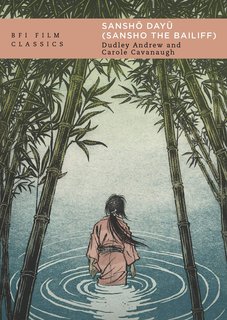
Before ending my month long Mizoguchi dive with a viewing of Sancho The Balliff (deliberatley put off til the end
 ), I downloaded a copy of the Andrew/Cavanaugh penned edition of Sancho in the BFI Film Classics Series. In general, I found the background information instructive, but I was particularly struck by this:
"In both American and Japanese cinema there is an over-reliance on genre, because, following [Stanley] Cavell's claim*, the membership relations that films in a genre produce mask their individual strivings toward self-contemplation. There is another telling point of resemblance: the philosophical import of both national film groups has gone unrecognized by native audiences (who, in this case, Cavell claims, 'lack the means to grasp this thought as such for the very reason that [they] naturally or historically lack the edifice of philosophy within which to grasp it') and both have relied on European critics for that initial recognition (Mizoguchi 'discovered' by the French is an example). The similar philosophical conditions of American and Japanese film account for the uncanny familiarity some critics in the United States sensed when they saw Japanese films for the first time in the 50s and 60s, despite profound cultural differences." - Carole Cavanaugh, pp. 34
Now, is the former actually true (that genre masks individual striving toward self-contemplation (and reference, by extension - though referencing doesn't necessarily imply any deep consideration)?
I'd definitely say the second part of the contention is true - in the main - as, unlike other world audiences, Americans (anyway), by sheer inundation of superficial entertainment presented as film culture, are not conditioned to regard film in this way. It's not that Americans don't have the tools. They're just not, for the most part, used to this end. The evidence about national genre reliance is irrefutable but the reasons for its proliferation (and more interestingly, influence) are (I think) debatable.
*the absence of the European edifice of philosophy, hence, the ambition of self-thought and self-invention and the craving to examine it publicly.
-
domino harvey

- Dot Com Dom
- Joined: Wed Jan 11, 2006 6:42 pm
Re: Kenji Mizoguchi
Watched this tonight and enjoyed it a lot (it’s also the first film I’ve watched that zero Letterboxd friends have seen in a while), especially the wonderful efficiency. The stripped down narrative is even reflected back by the terrific fight scenes which are refreshingly quick and terse--Michael Kerpan wrote: Thu Feb 05, 2009 9:37 pmFilm stock was in short supply when this was made. I don't see much sign of anything missing. It really provides an interesting variant of one piece of the MM story.sidehacker wrote:Is this only 53 minutes because the rest of the film was lost, or was it originally this long?Michael Kerpan wrote:his little Musashi Miyamoto film.
Spoiler
the climactic fight in particular has to last like twenty seconds and it’s just perfect. I’m not that familiar with the samurai genre beyond the titles everyone has seen but this struck me as quite a twist on audience expectations of grand finales, though perhaps it is de rigeur?
-
Michael Kerpan
- Spelling Bee Champeen
- Joined: Wed Nov 03, 2004 5:20 pm
- Location: New England
- Contact:
Re: Kenji Mizoguchi
I think that climactic fight was viewed as rather shocking.
Some early (especially pre-talkie) samurai films had amazing fight choreography. Very different from the later films that are much better known.
Some early (especially pre-talkie) samurai films had amazing fight choreography. Very different from the later films that are much better known.
-
Peacock

- Joined: Mon Dec 22, 2008 11:47 pm
- Location: Scotland
Re: Kenji Mizoguchi
Flicker Alley will be releasing The Water Magician as part of their upcoming Art of Benshi Blu-ray boxset.
-
Michael Kerpan
- Spelling Bee Champeen
- Joined: Wed Nov 03, 2004 5:20 pm
- Location: New England
- Contact:
Re: Kenji Mizoguchi
Interesting -- what other films will be included?
I wonder if one will have the option to watch without the narration?
I wonder if one will have the option to watch without the narration?
-
Matt

- Joined: Tue Nov 02, 2004 4:58 pm
Re: Kenji Mizoguchi
Peacock posted this in the Flicker Alley thread:
Peacock wrote: Sat Feb 21, 2026 1:30 am Flicker Alley’s ‘Art of Benshi’ Boxset will include, at least, Kinugasa’s A Page of Madness (1926), Mizoguchi’s The Water Magician (1933), Futagawa’s Orochi/Serpent (1925).
-
Michael Kerpan
- Spelling Bee Champeen
- Joined: Wed Nov 03, 2004 5:20 pm
- Location: New England
- Contact:
Re: Kenji Mizoguchi
Thanks -- a very varied set of films.
-
Peacock
- Joined: Mon Dec 22, 2008 11:47 pm
- Location: Scotland
Re: Kenji Mizoguchi
It’s interesting to compare these films to the ones Digital Meme put out almost 20 years ago. Here’s our forum’s thread. Fingers crossed The Downfall of Osen gets included! Or if the set sells well (hmm…) that we get a follow up set with more of these titles.
I don’t have any personal insider intel about this release everything I’ve said here and the other thread came from the Flicker Alley Blu-ray.com thread.
I don’t have any personal insider intel about this release everything I’ve said here and the other thread came from the Flicker Alley Blu-ray.com thread.
-
HardNight'sDay
- Joined: Thu May 07, 2026 12:48 pm
- Location: Pittsburgh, PA
Re: Kenji Mizoguchi
The 39th Tokyo International Film Festival will have a Mizoguchi retrospective
featuring 13 films and seven newly restored titles.
featuring 13 films and seven newly restored titles.
-
Michael Kerpan
- Spelling Bee Champeen
- Joined: Wed Nov 03, 2004 5:20 pm
- Location: New England
- Contact:
Re: Kenji Mizoguchi
Sound like a nice intermediate-sized retrospective. Since Tales of the Taira Clan has a new restoration I hope this increases the odds of a first (post-VHS) English-subbed home video release.
-
Peacock
- Joined: Mon Dec 22, 2008 11:47 pm
- Location: Scotland
Re: Kenji Mizoguchi
Not sure how newly restored most of them are, but always good for a couple more Mizo’s to get taken care of.
What’s the HD hold up with a resto of 47 Ronin? Surely this is a crossover title and would be an easy one to sell. Is it due to the length?
What’s the HD hold up with a resto of 47 Ronin? Surely this is a crossover title and would be an easy one to sell. Is it due to the length?
-
LastMinit

- Joined: Sun Sep 07, 2025 8:01 am
Re: Kenji Mizoguchi
Gotta be the poor condition of the elements. All the pre 1945 Japanese films I've seen on the channel look like they're assembled from rough working prints.Peacock wrote: Sat Sep 26, 2026 6:14 pm What’s the HD hold up with a resto of 47 Ronin? Surely this is a crossover title and would be an easy one to sell. Is it due to the length?
-
Stefan Andersson
- Joined: Thu Nov 15, 2007 5:02 am
Re: Kenji Mizoguchi
The Water Magician, Mizoguchi, 122 mins.:
"4K digital restored version based on a 35mm internegative created in 1999 based on multiple 16mm prints. /.../ 20fps for a more natural projection speed"'
https://2026.tiff-jp.net/ja/lineup/film/39007CLA10
Shin Heike Monogatari, Mizoguchi:
"In 2004, the film was digitally restored through a joint project between the National Film Center (now the National Film Archive of Japan) and what was then Kadokawa Pictures."
https://www.nfaj.go.jp/program/tiff-nfaj202610-11/
"4K digital restored version based on a 35mm internegative created in 1999 based on multiple 16mm prints. /.../ 20fps for a more natural projection speed"'
https://2026.tiff-jp.net/ja/lineup/film/39007CLA10
Shin Heike Monogatari, Mizoguchi:
"In 2004, the film was digitally restored through a joint project between the National Film Center (now the National Film Archive of Japan) and what was then Kadokawa Pictures."
https://www.nfaj.go.jp/program/tiff-nfaj202610-11/
-
Stefan Andersson
- Joined: Thu Nov 15, 2007 5:02 am
Re: Kenji Mizoguchi
Update - spoiler alert:Stefan Andersson wrote: Thu Oct 01, 2026 2:02 pm The Water Magician, Mizoguchi, 122 mins.:
"4K digital restored version based on a 35mm internegative created in 1999 based on multiple 16mm prints. /.../ 20fps for a more natural projection speed"'
https://2026.tiff-jp.net/ja/lineup/film/39007CLA10
"the surviving print is incomplete: a substantial section toward the end of the film – covering Taki’s arrest , escape, recapture, and the courtroom sequence
– is missing, and the narrative moves directly from the Tokyo lodging-house scenes to the final moments of the trial.
The Water Magician [Digitally Restored Version] was digitally restored in fiscal year 2026 by the National Film Archive of Japan, through a commission from the Yanai Initiative at UCLA and Waseda University, using as its source material the longest version of the 35mm black & white internegative, which the NFAJ
produced in 1999 from multiple 16mm prints. Based on research into materials from the time of the f ilm’s original release and comparative screenings at various frame rates, 20 fps was determined to be the most natural projection speed. The restoration was managed by Imagica Entertainment Media Services, Inc"
Source: 2026 Pordenone catalogue - PDF downloadable here, under menu Giornate:
https://www.giornatedelcinemamuto.it/en ... V-TB6_lGJk