Page 14 of 60
Posted: Mon Jan 07, 2008 10:05 pm
by RagingNoodles
Is Hames' book The Czechoslovak New Wave the essential book for that particular era in film? I am just starting to see some Czech New Wave films and really want to read up on that era.
Posted: Mon Jan 07, 2008 10:48 pm
by MichaelB
RagingNoodles wrote:Is Hames' book The Czechoslovak New Wave the essential book for that particular era in film? I am just starting to see some Czech New Wave films and really want to read up on that era.
Few film books are definitive, but this one is. I'm pretty well read when it comes to English-language literature on Czech cinema, and I can't think of any other book that comes anywhere close to the scope of Hames's work.
He's been researching this subject for over 30 years - and it shows.
Posted: Mon Feb 04, 2008 6:40 pm
by Fletch F. Fletch
Dylan wrote:Thank you for the recommendation! I just picked up the revised 1999 edition (which covers his career up to The Rainmaker) at the library and I've treaded a little bit into it and it's utterly magnificent, exactly the kind of book I was hoping to find on the man. Should be an excellent read. Thanks again.
Another good one I'd highly recommend tracking down is On the Edge: The Life and Times of Francis Coppola by Michael Goodwin and Naomi Wise. It's not up-to-date (it came out in 1989) but it is well-written and exhaustively researched. Definitely worth checking out.
Geoffrey O'Brien
Posted: Mon Feb 04, 2008 7:25 pm
by gubbelsj
I recently finished reading Geoffrey O’Brien’s The Phantom Empire: Movies in the Mind of the 20th Century, and can’t recall if anybody had already mentioned it in this thread. I found it to be a fascinating read, both erudite and earthy. It’s less a book about the movies or film theory than it is an examination of the act of watching film and how this act has impacted 20th century psychology. And yet, this is almost more of a prose poem than anything else. O’Brien spends more time investigating high schlock and horror and costume epics than what others might consider the canon of great directors, but that’s how he comes to his conclusions that film history has “charted the evolution of tiny mutations, as if everybody set out to make exactly the same movie – like monks copying out the writings of Origen and Athanasius – and failed in revealing waysâ€. There are lots of interesting ideas to ponder over on nearly every page of this book. It could well infuriate some readers, as it is free-flowing and at times rather dense. But it’s unique, and manages to make fleeting or in-depth reference to literally hundreds of movies.
Posted: Sat Feb 16, 2008 12:33 pm
by filmyfan
Anyone read Making Waves: New Wave, Neorealism, and the New Cinemas of the 1960s by Geoffrey Nowell-Smith? I wonder if the book is an improvement over Peter Cowie's similarly themed book Revolution!: The Explosion of World Cinema in the Sixties?
I went to the BFI yesterday to see GN-S make a presentation about this book-he seemed to me to make an interesting topic seem rather boring-and he didnt seem to know what to say next on a couple of occasions-and his "talk" made use of more frequent clips as he went on without him saying very much at all ! I am sure he knows his stuff but I came away not wanting to read the book ! I think I will just stick with Cowie's book which I quite enjoyed and which covered a fair amount of stuff in quite a light way.
Posted: Sat Feb 16, 2008 1:39 pm
by foggy eyes
American Movie Critics (edited by Phillip Lopate) has been out in
paperback for a month or so, and it's an excellent compilation with great essays from Ellison, Baldwin, Sontag, Mekas, Arnheim, Farber, Hoberman and many others. The paperback has been updated to include Nathan Lee's excellent review of
Zodiac and Bordwell's blog entry on
New Media & Old Storytelling.
Posted: Mon Mar 31, 2008 4:12 pm
by Antoine Doinel
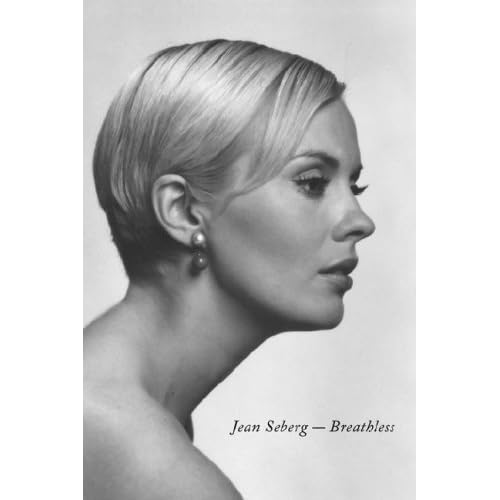
There is a new biography of Jean Seberg by Garry McGee,
Jean Seberg – Breathless. Haven't seen any reviews of it, but there is an interview with him
here.
Posted: Mon Mar 31, 2008 5:27 pm
by Kinsayder
I like the cover.
Posted: Thu Apr 03, 2008 2:48 pm
by colinr0380
I remember not being that interested in reading Pictures At A Revolution, the latest book by Mark Harris that looks at the five best picture nominees from 1967 and uses them to examine the era, simply because I wasn't really a fan of the films (even, gasp!, Bonnie and Clyde and The Graduate), but after listening to
this interview I've gotten very interested in reading a copy!
Posted: Thu Apr 17, 2008 1:08 am
by Chull
Can anyone recommend some books on digital camera use and cinematography? A friend of mine just bought a fairly high end camera and he's trying to coerce me into helping him make some short films. Neither of us know a thing about using a camera and I was wondering if there might be a book explaining the use and theory of the various functions. I'm also interested in aesthetic theory as well (framing etc.) I checked out Amazon but found the options a bit overwhelming to wade through. Anyone have any suggestions? Thanks.
Posted: Thu Apr 17, 2008 1:13 am
by domino harvey
Chull wrote:Can anyone recommend some books on digital camera use and cinematography? A friend of mine just bought a fairly high end camera and he's trying to coerce me into helping him make some short films. Neither of us know a thing about using a camera and I was wondering if there might be a book explaining the use and theory of the various functions. I'm also interested in aesthetic theory as well (framing etc.) I checked out Amazon but found the options a bit overwhelming to wade through. Anyone have any suggestions? Thanks.
Do a search
at this forum, there's a wealth of information available there
Posted: Thu Apr 17, 2008 7:29 am
by ellipsis7
Now I haven't read it (although I have heard Figgis speak) but this is supposed to be good...

Posted: Thu Apr 17, 2008 1:01 pm
by Chull
Do a search
at this forum, there's a wealth of information available there[/quote]
Thanks Domino, this looks great.
Posted: Thu Apr 17, 2008 1:08 pm
by foggy eyes
I can't recommend the exhaustively comprehensive and lavishly illustrated new book on
James Benning (ed. by Barbara Pichler and Claudia Slanar) highly enough. It's available from Austrian Filmmuseum
here and Wallflower in the UK
here.
Posted: Thu May 08, 2008 7:29 pm
by Kenji
Yeah i got little black movie book as it seemed better than the usual similar books, before realising it was edited by Chris and with some distinguished contributors. I looked for Story of Late Chrysanthemums, Paris Texas, Celine and Julie go Boating, even Seven Samurai (!) in vain, but general thumbs up (key events selections v.useful). Though does a Godard punch really carry so much intellectual weight? And the American avant-garde from the 50's on is surely overrated- compared with the groundbreaking European (esp French) stuff of the 20's, say, which is all too often overlooked. And 4 Jerry Lewis films, as many as Mizoguchi? Come off it.
Posted: Fri May 09, 2008 3:44 am
by mattkc
Kenji wrote:American avant-garde from the 50's on is surely overrated- compared with the groundbreaking European (esp French) stuff of the 20's, say, which is all too often overlooked.
How do you know? Have you seen the films written about in the book? And they're not necessarily the "masterpieces" of American experimental cinema, not by any means. I agree they could have included more early avant-garde film, but at the expense of what was written about American stuff? Because films like The Man Who Invented Gold, The Flower Thief, 21-87, Poor Little Rich Girl, All My Life, etc., get written about
so much.
Posted: Fri May 09, 2008 7:35 am
by Awesome Welles
As far as I am aware American Avant Garde from the 50s on has been quite extensively written about, in particular the late 60s and 70s with Hollis Frampton being one of the most cited figures. In general my (incidental) reading about the subject shows the American figures in the Avant Garde as being very well respected and having made some of the best films at that time. Saying another period is overrated because another was groundbreaking is a little unfair given the earlier time period in which cinema was still growing and it was more likely to be groundbreaking in terms of cinematic language, this wasn't really possible later on and the experimentation took new forms which really can't be compared. What you can say about the later Avant Garde I think is that it was more overtly politicised, certainly some of the films in the 80s about the gay black community have a lot to say; in a way that wasn't possible in the 1920s.
Posted: Fri May 09, 2008 8:53 am
by Awesome Welles
I wasn't commenting on the book, I am not familiar with it, merely Kenji's post, I wouldn't want him to think that the 50s onwards was not as good as it is. But I appreciate your point entirely, I have the same problem with books of this sort, which is why I tend to stay away from them.
Two Taschen Antonioni editions
Posted: Sun May 18, 2008 6:10 am
by Ovader
Does anyone have both editions of the Antonioni books by Taschen? The
2004 edition has 192 pages and 9.38"x8.22"x0.72" at 1.90 lbs. That book is OOP and selling at a high price on the used market. The
2008 edition has 96 pages and 8.96"x7.36"x0.32" at 0.78 lbs. There must be a lot of missing text and photos in the 2008 edition unless it is considered Part 2 with completely different text and photos.
Posted: Sun May 18, 2008 6:12 am
by domino harvey
Has to be a different book, the '08 has the subtitle, "The Investigation 1912-2007"
EDIT Holy shit, the '04 is selling for almost $200 used on Half.com

I don't even like this book, I will sell my copy to anyone on this board for $100.
Posted: Sun May 18, 2008 7:11 am
by Ovader
Domino, does your 2004 edition include the same photos as
these from the 2008 edition?
Posted: Sun May 18, 2008 7:26 am
by domino harvey
Ovader wrote:Domino, does your 2004 edition include the same photos as
these from the 2008 edition?
I just checked and it does. The only difference I noticed (though wasn't really looking closely, there might be more) was the layout is different on the Nicholson pages (in the '04 edition, the position of his picture and the text are flipped)
Posted: Sun May 18, 2008 11:03 am
by ellipsis7
I have both MA books - like many in the Taschen series it's the profusion of rarely published archival photographs, sourced with the help of the Antonionis - which make them valuable resources... The 2008 edition is an edit down of the larger 2004 book (text by Seymour Chatman in both), and omits about a third to a half of the photographs in the latter... And of course Antonioni died in 2007, so the 2008 slim edition takes the opportunity to be absolutely completist...
BTW the 2004 192 page book is still available at a reasonable price (€14.99) in the German edition - same pics, just German text - available from Amazon.de
here
What really is a steal and a must have in the Taschen series is the lovely large hardback book on Jean Renoir, with a text by Christopher Faulkner... Again rarely published visual material assembled with the help of Alain Renoir, the UCLA Renoir archives... And it's available at a ridiculously reasonable price....
Posted: Wed May 28, 2008 3:11 am
by wattsup32
i find this thread useful and so wanted to bump it up to a place where it was more easy to find.
Posted: Wed May 28, 2008 5:11 am
by Cash Flagg
With Amazon's current Buy 3/Get 1 Free under $10.00 book discount, you can purchase four of the $9.99 Taschen books for $29.97 shipped. Not a bad deal.