I feel like I’m just starting to get my head around this film after a couple of viewings. I’ve also just read Chapter 4 of James Steffen’s
The Cinema of Sergei Parajanov, which was fascinating and helpful. Here are four passages from his account that really struck me, and that might provide some prompts for discussion:
James Steffen wrote:Parajanov represents, in purely cinematic terms, how the young Arutin already displays a basic trait of poets – the ability to transform concrete sensory impressions into something new via metaphorical thinking. (p. 140)
[An] important theme running through the film is the struggle between asceticism and sensuality. Indeed, the film embodies this opposition through its very style: one the one hand it is constructed largely from a series of tableaux using a restricted color range and a limited degree of movement within the frame; on the other hand it displays a great deal of surface tactility and employs a densely layered soundtrack. In the childhood scenes this dynamic is established already in the episode portraying the young Arutin’s monastic education, which is followed immediately by the scenes depicting his sensual discovery of the world. (p. 144)
If The Color of Pomegranates represents in part a long vanished, alien past gazing back at us on the screen, these objects also gaze back at us as the sole remaining witnesses of that past. (p. 151)
[Sabir] Rizaev [a contemporary critic]…hinted at the film’s problematic treatment of gender: “But the main thing is that the spiritual anguish of man in medieval Armenia, as the literature, the astonishing miniatures, and the national architecture all attest, is full of poetic passion, which was always remarkably transparent, enviously strict, and emphatically manly [muzhestvennyi, which as Steffen points out can also be translated as ‘courageous’].” In contrast, he characterized the passions of the film’s hero as “luxurious,” a quality which he argued was alien to the era. (pp. 154-5)
And here are a few thoughts in response…
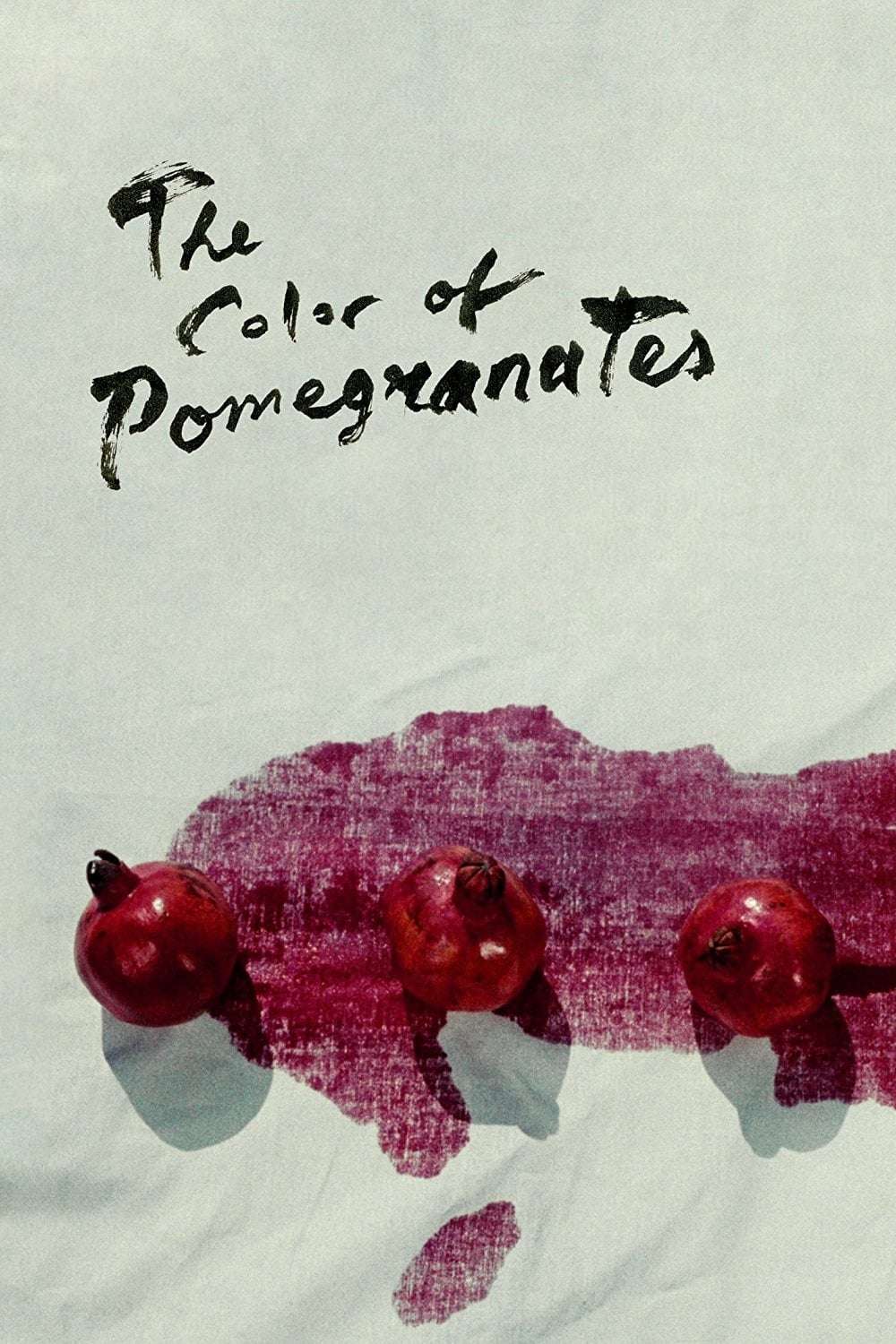
At the beginning of the film, we see pomegranates bleeding (not spilling) juice into the white cloth beneath them, without having been visibly cut or bitten; then we see a knife also bleeding into the white cloth, but because the object is now a knife, we associate the colour with blood; so maybe it is blood instead of (or as well as) pomegranate juice. These images are juxtaposed with recurring shots of an open manuscript and, on the soundtrack, a recurring line of poetry: ‘I am he whose life and soul are torment.’ So this is a person talking about himself, but we don’t see him, we see fruit, and a knife, and then fish and bread; and the fruit oozes juice without being touched, and the knife draws blood without being used.
Later on, when Sayat Nova enters the monastery, we see the other monks noisily eating pomegranates; later still we see a knife stabbing a wall, prompting blood to flow from it. These images (and sounds), though still metaphorical, denote literal gluttonous consumption, and literal violence, from which Sayat Nova distances himself. As a great-souled poet, he is always at one remove from reality, learning and communicating through figurative texts and images, evoking the colour and taste of a pomegranate without actually eating one, bleeding from mortal wounds that are emotional and invisible, and even making love from a distance (to the point of ‘ejaculating’ milk onto a glass screen that separates him from his beloved, in one infamous outtake).
Those opening images introduce us to the poet’s mindset – his modes of feeling and thought – and much of the film is about his sense of detachment and alienation from the world. He is ‘luxurious’ and revels in colours, tastes, and textures, but his luxuriousness is also that of the rarefied aesthete, burying himself in books, seeing and experiencing the world through beautiful but highly artificial caricatures of reality. Indeed, as portrayed in this film he even has an unstable relationship with his own physical identity, and his gender: he is played by three different actors, the first two keep re-appearing in other forms, and the second (who portrays his coming of age, his entry into manhood) is a woman (Sofiko Chiaureli).
My favourite sequence is the one where the young Arutin is instructed in the value of texts, and the importance of those who communicate texts to the masses; and then he carries a book up to the rooftop, pores over those extraordinary miniatures, and lies amongst an infinite number of drying manuscripts, in a shot that seems to defy the laws of physics by covering every vertical and horizontal surface with flapping books; is the boy lying down or standing up? He gradually assumes a cruciform posture, and I guess this is partly a secular appropriation of religious iconography – but it feels more like Arutin taking his place amongst these texts, opening himself up like them, facing the heavens but expressing an earthly perspective, receptive to the world but reflecting it back through figures and symbols, forever staring through a window which is also the wall of his cage. He is part of humanity but elevated from it, on a rooftop, a product and disseminator of higher learning.
As in a lot of medieval love poetry, there is a strong link between this detached, textual, figurative attitude to life, and the pain of loneliness or unfulfilled desire which lies at the core of the poet’s work. He is cursed to look at an everyday object like a curved hunk of bread, and see in its place a fish out of its element, curled up in agony; he is that fish, perpetually out of his element and trapped in a crass, brutal world. So he retreats into gorgeously illuminated dreams full of otherworldly colours, objects, and spatial relations, but he also stays in the world and travels through it, and that world infuses those beautiful dreams.
This ties into the archaism of the film as well. It reminded me of other films that try to adopt (as well as evoke) a ‘medieval’ aesthetic and point of view, especially Rohmer’s
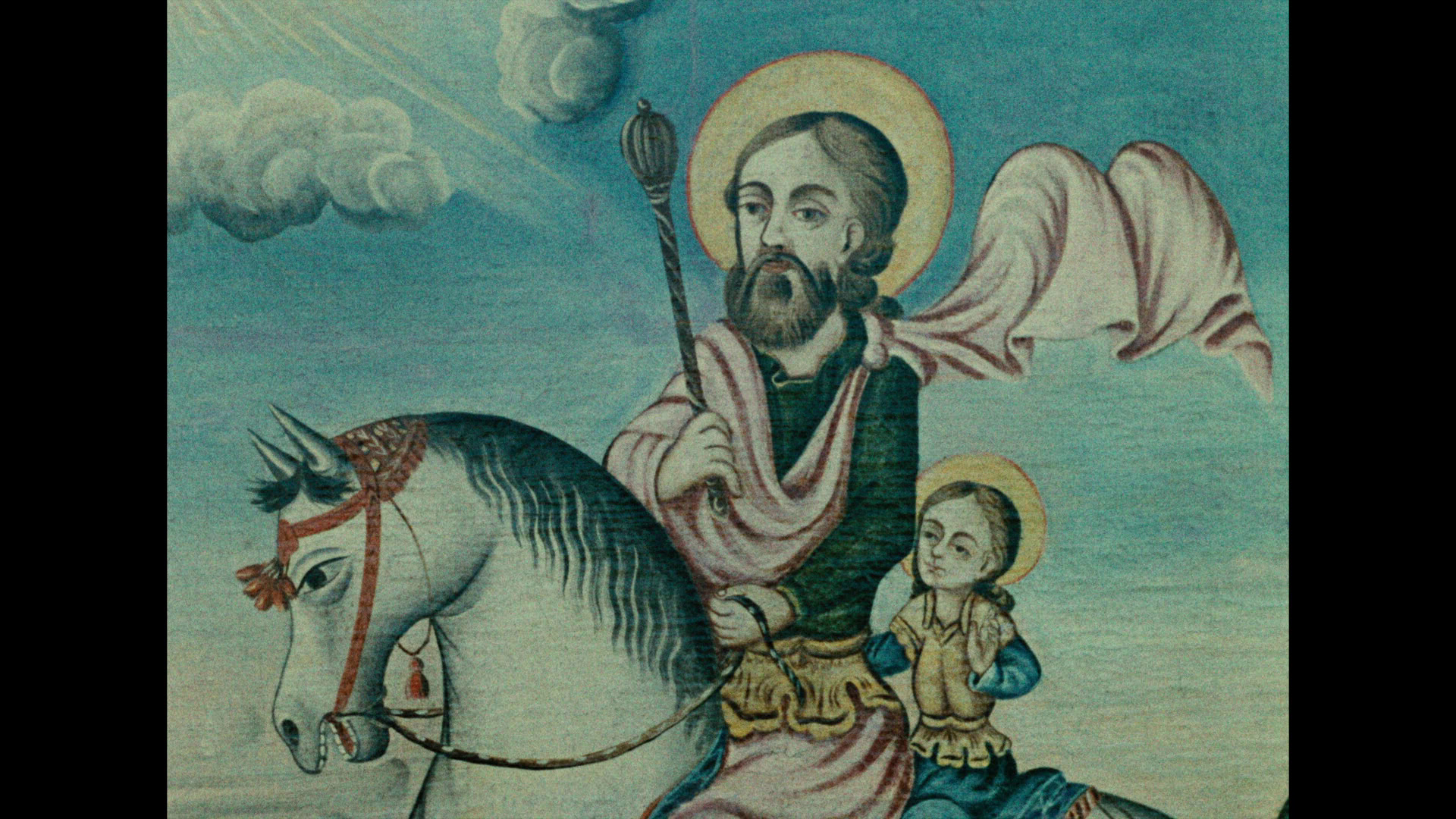
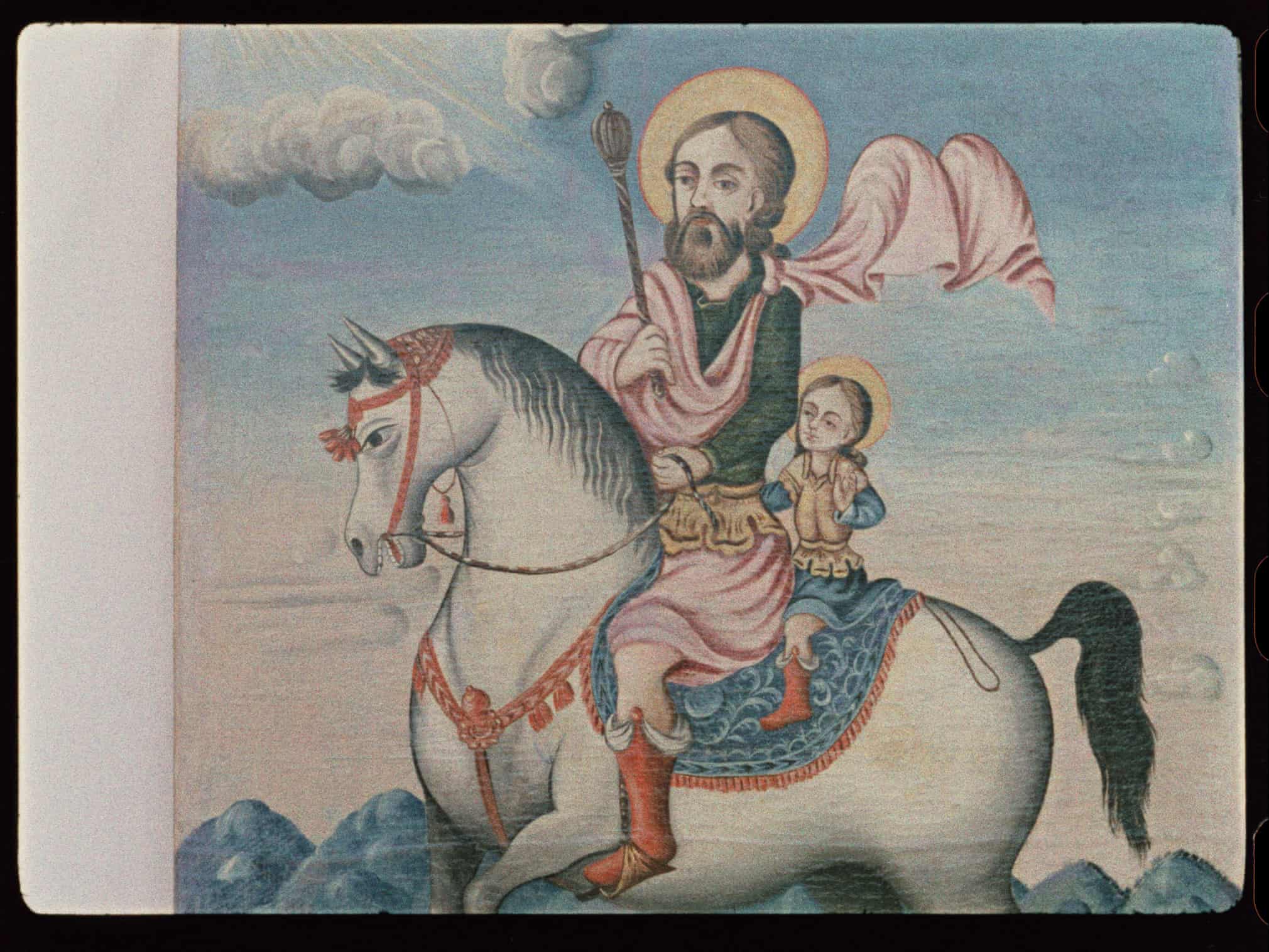
Perceval. There’s something so beautifully unforgiving about the fixed-camera aesthetic, the stylised pantomime action (even the horse isn’t allowed to trot like a normal horse), and the impenetrable coded tableaux. It really is like opening an old manuscript and finding some weird medieval allegory, with illustrations around the margins that might aid understanding or might just be jokes (which of course you also won’t understand), but still feeling totally absorbed by these voices from the past. There’s an echo here of Parajanov’s previous (completed) film’s title,
Shadows of Our Forgotten Ancestors, only these feel more direct than shadows.
And that’s a nice paradox: we’re brought into what feels like very direct contact with a medieval voice that is characterised by indirectness; we’re engaging in a very ‘real’ way with something very artificial. That’s also the paradox of poetry, or art, in general, that it uses lies to give a special insight into truth. Medieval art is, to modern eyes, alarmingly artificial, static, and two-dimensional, but somehow also incredibly dynamic, full of texture and depth and emotion; it’s amazing that Parajanov captures these same qualities in this film. And it really does make you feel something profound about love, loneliness, and existential pain – I’d echo Kat’s point about the importance of the music (and the soundtrack in general). Tigran Mansuryan (in the ‘World is a Window’ documentary) talks about the effect of repeating the phrase ‘shatatsel e’, which he says means ‘increases’, and which I think in context refers to the ‘overflowing’ of the river banks; it is an unforgettably haunting sound.