Page 4 of 6
Re: Setsuko Hara
Posted: Fri May 06, 2011 9:21 pm
by lubitsch
Michael Kerpan wrote:A lot of Hara's acting contemporaries (and older and younger colleagues) were far less right-wing than she was -- alas.
Usually with German film people of the Third Reich I take a defensive stand in most cases like this because there's a genuine hysteria regarding everything made between 1933-45, even doing pure entertainment is somehow seen as supporting and stabilizing the totalitarian state. As if Soviet Russia or North Korea wouldn't prove the opposite, the lack of entertainment isn't enough to make people so unhappy that they start a revolution.
However I think it's important to recognize that some people in Italy, Germany and Japan eagerly and willingly supported the militarist, racist and totalitarian ideology and threw themselves into the work. Others did their best to evade as far as possible. I have the impression that Italian and Japanese filmmakers got away with murder in most international film histories and popular perception while Germans were thoroughly attacked. This corresponds with the lack of availability of propaganda films for these two countries while German films of the era float around en masse and you can buy them on pages like IHF. Naturally it's also a difference in being ready to investigate the own past with Japan and Italy being less willing to do so.
Taking this into account I allow myself to point out what Michael has already mentioned earlier in this thread. Hara being Japan's beloved virgin and an international star for the film history lovers is problematic in two ways. First in forgetting to split the achievements of the actress from these of the person Hara. If people think her a genuinely good actress. fine. But as an idol she's badly cast. She was an active propagandist of absurd and murderous values not like a Karl Ritter. She didn't stumble into a film or was forced to do this, she regularily appeared propaganda films from the very beginng of her career and pretty much in the nastiest ones. I am not aware that she ever regretted her actions as e.g. Ri Koran/Shirley Yamaguchi did.
The second point might be more controversial because I seriously doubt Hara's achievements as an actress which I believe also stem from her right wing attitude. She played a Japanese icon of purity (no kissing scenes for her) limiting therefore her range. She may embody a certain cliche of Japaneseness to foreigners (but Japanese as well) which rings quite hollow on the screen to me. However this is obviously a matter of debate.
Re: Setsuko Hara
Posted: Fri May 06, 2011 9:39 pm
by ambrose
lubitisch wrote: She played a Japanese icon of purity (no kissing scenes for her)
 Edit: Tatsuya Nakadai and Setsuko Hara in Mikio Naruse’s Musume tsuma haha (1960).
Re: Setsuko Hara
Posted: Fri May 06, 2011 9:44 pm
by Michael Kerpan
Hara played a number of post-war roles that do not fit with the image you describe -- most importantly in Typhoon Woman, Idiot and Tokyo Twilight. there may be more -- but I have not seen but a fraction of her films (most of which were potboilers).
I've seen several of Hara's war-time films -- and I don't see too much that was terribly offensive in these (beyond her terrible Chinese diction when playing a Chinese girl) -- but I have not seen her most extreme role (in a film made as Japan's days were clearly numbered). I think you seriously over-state her "culpability".
(What on earth is that shot from, ambrose?)
Re: Setsuko Hara
Posted: Fri May 06, 2011 10:01 pm
by ambrose
Michael Kerpan wrote:(What on earth is that shot from, ambrose?)
According to the consistently unreliable Google translate, it is from a film called
"That woman" by Kawashima Yuuzou:1958.
Re: Setsuko Hara
Posted: Fri May 06, 2011 10:31 pm
by lubitsch
ambrose wrote:lubitisch wrote: She played a Japanese icon of purity (no kissing scenes for her)
Michael Kerpan wrote:Hara played a number of post-war roles that do not fit with the image you describe -- most importantly in Typhoon Woman, Idiot and Tokyo Twilight. there may be more -- but I have not seen but a fraction of her films (most of which were potboilers).
I've seen several of Hara's war-time films -- and I don't see too much that was terribly offensive in these (beyond her terrible Chinese diction when playing a Chinese girl) -- but I have not seen her most extreme role (in a film made as Japan's days were clearly numbered). I think you seriously over-state her "culpability".

. If it's that easy to contradict me via googling, I guess we have some even more daring discoveries for Miss Hara ahead of us. But seriously and taking into account Michael's reply, yes, I'm sketching the case very broadly and this screenshot proves this very well. I neither wish to completely negate her artistic achievements nor am I wishing her a horrible death. My aim is just to point out that there are certain shifts and uneven balances in the perception of filmmakers from the axis, check e.g. the wikipedia article on her which completely ignores her role. Imagine this happening with Veit Harlan who had a far lesser involvement based on percentage and willingness to produce propaganda. I'm always amazed how people like Hara, Kurosawa or Rossellini got away in the public perception of today's film fans while Riefenstahl or Harlan didn't though all had a disturbing eagerness to churn out propaganda. If there are three ways to act in a dictatorship (opposition, passivity with different degrees of involvement, active participation) then all of them are doubtlessly in the third category.
As for the films itself I obviously have to rely on High's detailed descriptions due to lack of copies and/or subtitles. Japanese cinema doesn't seem to have had a strong current of hate propaganda aimed at the enemy itself, but the tendency to evoke a Japanese spirit and more or less to define themselves as a master race thanks to this heritage is no less disturbing than the dreams of Aryan superiority. Obviously as a woman Hara's opportunities in embodying this spirit were more limited excluding the military option and she was too young to play the mother who gladly offers her son for the army, but she still plays in a wide selection of roles. I think however that she embraces the limitations put on her by the restrictive roles women had to play from 1937 on and after the war roots of these roles still can be seen in her acting. I found the quote by Catherine Russell
Catherine Russell wrote:Her star image was thus closely bound to the national imaginary,in which the ideology of the virgin harbored an ideal of cultural purity. Hara Setsuko's screen persona is one of tight control,under which a current of strong emotion can often be detected. [...] However,she also excelled in expressing highly contradictory and conflicted emotions. She can be at once hopeful and doubtful at marriage proposals;she laughs when she is most sad and cries when she is most happy.
very interesting because I didn't quite have the same impression. This description of a tension fits to me excellently for actresses like Deborah Kerr or Ruth Leuwerik where you can detect in the acting or the voice (especially with Leuwerik) the fragility of their posture as controlled bourgeois women. With Hara I also recognize tensions but not the destructive, subversive power that sees Kerr kissing on the beach in
From here to eternity or leuwerik's decisoon to throw away her old life in
Die Rote by Käutner.
But obviously the limitations of available films might open other perspectives. I'd love to see a few popular blockbusters of this era and not just the high art of NaruseKurosawaOzuMizoguchi, there are still too huge gaps something like Typhoon Woman I don't know about
Re: Setsuko Hara
Posted: Mon May 16, 2011 9:46 am
by ambrose
Re: Setsuko Hara
Posted: Sun May 22, 2011 11:20 pm
by Leo Wong
Re: Setsuko Hara
Posted: Mon May 23, 2011 5:27 am
by ambrose
I can see that the spirit of reciprocity is not quite dead Mr.Wong!
Re: Setsuko Hara
Posted: Mon May 23, 2011 11:16 am
by Leo Wong
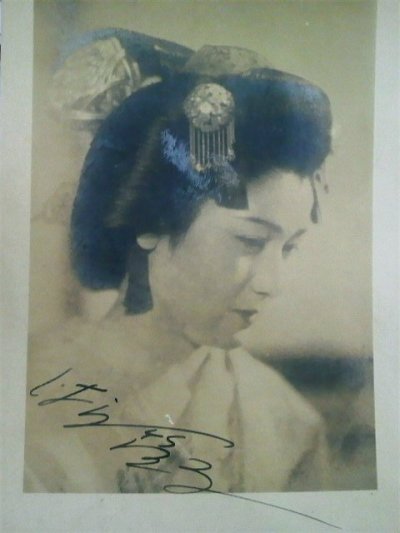
Thank you very much, Mr. Allen, for posting this and other happy discoveries. One still wants to find out: when and for what occasion was the photo taken? when was the photo signed? who took the photo? who took the photo of the photo? who owns the photo? where can one find the original website where the photo was found? And probably other things as well.
Re: Setsuko Hara
Posted: Sat May 28, 2011 10:29 pm
by ambrose
Kessen no Ozora e (Toward the Decisive Battle in the Sky). Peter B. High wrote:Hara Setsuko plays the elder sister of a young and sickly boy.Through her gentle chiding, and the example of a group of Yokkaren cadets who regularly visit the house, the boy is inspired to overcome his physical weaknesses and to become a cadet himself. As Iijima pointed out in a contemporary review: "The film avoids depictions of the youngsters as supermen, persuasively making the point that anyone can become a fine military man."
Re: Setsuko Hara
Posted: Sat May 28, 2011 11:04 pm
by Leo Wong
While there you might as well take in the march
Gunkan Machi (Warship March), from
Hawai Mare oki kaisen (The War at Sea from Hawaii to Malay), 1942, and later used by Ozu in
An Autumn Afternoon
Re: Setsuko Hara
Posted: Tue Jun 07, 2011 3:29 am
by ambrose
Re: Setsuko Hara
Posted: Wed Jun 08, 2011 1:33 pm
by ambrose
Re: Setsuko Hara
Posted: Sun Jun 12, 2011 4:46 pm
by Michael Kerpan
Can you identify the films these shots are from?
Re: Setsuko Hara
Posted: Sun Jun 12, 2011 5:06 pm
by ambrose
The first and the third sequences are from Repast;the second sequence of images is from The ball at the anjo house.
Re: Setsuko Hara
Posted: Sun Jun 12, 2011 6:34 pm
by Michael Kerpan
I thought these looked familiar. ;~}
Re: Setsuko Hara
Posted: Tue Jun 14, 2011 12:13 am
by ambrose
The Male Gaze In feminist theory, the male gaze expresses an asymmetric (unequal) power relationship, between viewer and viewed, gazer and gazed, i.e. man imposes his unwanted (objectifying) gaze upon woman. Second Wave feminists argue that whether or not women welcome the gaze, they might merely be conforming to the hegemonic norms established to benefit the interests of men — thus underscoring the power of the male gaze to reduce a person (man or woman) to an object (see also exhibitionism).
The existence of an analogous female gaze arises when the male gaze is considered. Mulvey argues that "the male figure cannot bear the burden of sexual objectification. Man is reluctant to gaze…" Describing Wide Sargasso Sea (1966), by Jean Rhys, Nalini Paul indicates that the Antoinette character gazes at Rochester, placing a garland upon him, making him appear heroic: "Rochester does not feel comfortable with having this role enforced upon him; thus, he rejects it by removing the garland, and crushing the flowers".
From the male perspective, man possesses a gaze because he is a man, whereas, a woman has a gaze only when she assumes the male gazer role, when she objectifies others by gazing at them like a man. Eva-Maria Jacobsson supports Paul's description of the "female gaze" as "a mere cross-identification with masculinity", yet evidence of women's objectification of men — the discrete existence of a Female Gaze — is in the "boy toy" adverts published in teen magazines, despite Mulvey's contention that The Gaze is property of one gender. Moreover, in power relationships, the gazer can direct his or her gaze to members of his or her gender, for asexual reasons, such as comparing the gazer's body image and clothing to those of the gazed at man or woman.
Re: Setsuko Hara
Posted: Fri Jun 17, 2011 7:01 am
by ambrose
Eiga Stars: Portraits of Japanese Divas in Fan Magazines of the 1950s.

Just a normal day in the life of Setsuko Hara: knitting, sweeping, pondering, pointing. From Eiga Fan, February 1951.

More than simple profiles and photos, of course, fan magazines were an integral part of creating and defining a star’s personality. Studios worked hand-in-hand with the magazines to make sure that the pictured “offscreen life of stars” (or the version found in magazines) was tailored to specific onscreen personas. Setsuko Hara, Japan’s “Eternal Virgin” known for her portrayal of becalmed, stoic daughters and mothers and her roles in many Yasujiro Ozu films (including Late Spring and Early Summer), was often depicted accomplishing household chores with a smile (see the spread above).
Re: Setsuko Hara
Posted: Mon Jun 20, 2011 2:40 pm
by ambrose
Re: Setsuko Hara
Posted: Thu Jun 23, 2011 10:51 pm
by ambrose
Re: Setsuko Hara
Posted: Sat Jun 25, 2011 12:26 am
by ambrose
Re: Setsuko Hara
Posted: Sun Jun 26, 2011 8:37 pm
by ambrose
Re: Setsuko Hara
Posted: Thu Jun 30, 2011 12:54 pm
by ambrose
Re: Setsuko Hara
Posted: Fri Jul 01, 2011 11:33 am
by ambrose
Uruwashiki shuppatsu (1939). Could someone both confirm the source of this image and provide plot details?
Re: Setsuko Hara
Posted: Fri Jul 01, 2011 1:29 pm
by Michael Kerpan
Not I -- but I would _love_ to see this film.