942 The Tree of Life
- Murdoch
- Joined: Mon Apr 21, 2008 3:59 am
- Location: Upstate NY
Re: The Tree of Life (Terrence Malick, 2011)
Just watched it tonight and I wonder
Overall I liked it, I wouldn't rank it as highly as The New World or even Thin Red Line, but like every Malick film there are images which completely captivate me, and the score was magnificent.
if Jessica Chastain floating was a nod to Zerkalo. Whether the similarity is intentional or not it was my favorite moment of the film, next to Chastain lying in the glass coffin. Really whenever she was on camera were the highlights for me.
- Kirkinson
- Joined: Wed Dec 15, 2004 9:34 am
- Location: Portland, OR
Re: The Tree of Life (Terrence Malick, 2011)
Actually, one of the most interesting things about the choice of that particular piece of music for that particular scene is that Berlioz was most likely an atheist ("I believe nothing," if I remember the quote correctly). Yet he wrote what is for me one of the most moving and seemingly deeply reverent requiems of all time. Obviously I'm not suggesting that Berlioz's religious beliefs influenced Malick's choice, but I think it's instructive in understanding how The Tree of Life, much of which probably does spring from religious feelings, works so well for me and for many others like me who don't share Malick's beliefs.jwd5275 wrote:It is hardly a coincidence that the whole scene plays out to an Agnus Dei by Berlioz...

There's a great deal of "religious" music that I find deeply moving. I'm talking here not just about historical figures like Bach, but contemporary composers like John Tavener, Arvo Part and Giya Kancheli whose religious views are well-known and publicly self-avowed, as is the influence those views have on their work. I have absolutely no trouble as an atheist in being moved, touched, wrenched, or otherwise impacted by the music these composers write, and I don't think it's because I simply "tune out" the religion. Rather, I would say that the needs and desires and impulses that drive these composers' religious feelings and their need to express them are universal. They may be using religious language, but the ideas and emotions they are expressing with that language are rooted in something essentially human.
I feel much the same way about The Tree of Life. It is a great work of religious art, but it is a great work of human art first and foremost, and I appreciate it in much the same way I appreciate Arvo Part's Te Deum or Mozart's Requiem. The way in which it moves me even reminds me very much of the way I engage with music, an art form in which the particular structure of abstract* elements usually has far more to do with the work's emotional, intellectual, or spiritual impact than the "text" itself (in the case of operatic, choral, and vocal work, and to some degree in the case of ballets and tone poems).
*NOTE: By "abstract" I mean that a single melody, harmony or rhythm (or note, to get even more basic) has no intelligible "meaning" of its own, and it is the unique combination of these elements with each other and sometimes with a text that creates impact.
I'm writing very little here about the film itself, but the effect it had on me was both overwhelming and pretty unique, and therefore difficult to pin down and describe. It's lush with beauty and rich in evocative ideas, but it's also a very personal work and I'm not at all surprised that it divides people and that there are some viewers who just don't relate to it at all. Malick doesn't really expend any effort to lead unsympathetic viewers to make the same connections he does; unlike, for example, Patricio Guzman in Nostalgia for the Light, which does this very well while wandering into some of the same cosmic territory from a different perspective. This obviously isn't a problem for me and all the viewers who have thought along similar lines, but I wonder if the way would have been clearer for everyone if the film were longer, which is partially why the talk of a longer talk interests me. Honestly, I really wanted the film (and particularly the prehistoric sequence) to go on much longer.
A few scattered thoughts on the dinosaurs:
It pains me to say that they were the most disappointing aspect of the film for me. I thought the elasmosaurus on the beach was totally convincing, and the young parasaurolophus in the forest was fine, too. But the scene at the river just looks terrible. The previous poster who said the dinosaurs in Jurassic Park looked like shit is crazy. When I watched that film recently I was amazed again at how much its CG animals remain the gold standard almost 20 years later. The theropod on the river (a troodon, maybe?) just didn't have the weight and presence of a real animal and at no point is it successfully integrated into its environment. But worse than that is the way the dinosaurs' eyes are animated in that scene, particularly the eyes of the defenseless one.
Spoiler
It is indeed too easy to read emotion into them; not so much that I would call them anthropomorphic, but enough that I would say they look more like a puppy's eyes than those of a wild bird or reptile. With wilder, less easily legible eyes I could have been free to interpret the scene as a simple illustration of survival instincts ("Hey, this thing is dying but not wounded; maybe it's sick and I shouldn't eat it") but with the look in the little one's eyes I felt I was being pulled too far in one particular direction.
And my geekiest complaint about that scene: scientific consensus would now favor giving a small theropod predator like the one in The Tree of Life some feathers, especially if it is a troodon. I would have expected Malick to get this right, given his well-known ornithological enthusiasm, not to mention the fact that the shot of the elasmosaur was based on a Larry Felder painting from a ten-year-old book that contains copious illustrations of feathered dinosaurs.
- matrixschmatrix
- Joined: Wed May 26, 2010 3:26 am
Re: The Tree of Life (Terrence Malick, 2011)
In defense of the CGI dinosaurs in this, the ones in Jurassic Park were a mixture of CGI and animatronic, and animatronics are obviously much better at getting a sense of weight and presence across.
I'm glad to hear the movie can work profoundly even if the religious sentiment behind it isn't itself something you can agree with- I had been wondering if the movie resonated so deeply with me primarily because it's something I share, at least in some degree, with Malick.
- dad1153
- Joined: Thu Apr 16, 2009 2:32 pm
- Location: New York, NY
Re: The Tree of Life (Terrence Malick, 2011)
Saw "The Tree Of Life" a week ago (July 4th weekend) and, unlike 99% of people in this thread, I knew absolutely nothing about it going in other than (a) Malick wrote/directed, (b) it was delayed since forever, (c) Penn & Pitt were in it and (d) it won Palme D'Or at Cannes. No idea there would be dinosaurs, evolution, any of that. So imagine my surprise when the movie ended (after we lost 10 or so people that simply got up and left at various parts of the movie... at the NYC Sunshine Cinema!) and my biggest shock was the fast-pace and length of the shots in "The Tree of Life." Seriously, compared to previous Malick movies (the only one I haven't seen is "The New World") this thing moves and feels like a 145 min. music video. Handheld camera angles right in the actors' faces (and chasing after them)? Nature shots that last seconds instead of minutes? OK, an exaggeration, but I walked in expecting the typical languid film language I was used to from previous Malick movies I had seen and it turns out "The Tree of Life's" most experimental aspect is the fact Malick isn't shooting like Malick used to anymore (or for this particular film he threw out his usual playbook). I wouldn't be surprised if the rumored longer cut of "The Tree of Life" is the theatrical version with every shot lasting a few frames/seconds longer, which is the movie I expected to see.
"Tree of Life" itself was OK at bringing simple-yet-complex ideas to cinematic life that I'm still thinking about (my niece just turned a year old, so the shots of the baby growing up with little touches and steps becoming key moments in his early formative years really made an impression) but seriously, the creation vision stuff (courtesy of Douglas Trumbull) and the 50's Waco stuff are two different beasts that belong together as much as DeNiro in a Superman flick. I get that's the whole point Malick is making (the universe each of us, insignificant creatures in the vast circle of intergalactic life, experiences in our own way means the world to us while it shapes/makes us into what we let it become) but it's playing in a genre that is either feast (Kubrick's "2001") or famine ("The Fountain"). Kudos that, as an atheist, I can't pin whether Malick is a deeply religious, philosophical or non-believing person as "The Tree of Life" is wide open at any number of interpretations (including the whole film being an indictment of the man-made Gods/religions robbing people from the simplest pleasures of their short-in-this-world lifespan... a 'do you really believe this bullshit'? distorted mirror reflection of the audience's most-deeply held beliefs). Pitt is awesome (he totally disappears into a 50's patriarchal role that Kevin Bacon would have not been able to make you forget you were looking at Kev) and the kid actors are OK, but Sean Penn's scenes were frankly bad (he might as well be thinking how badly the local baseball team is doing... that's how empty and lost his stare-at-emptiness looks) and the already OTT-by-Malick-standards camera work went full-tilt into Obession TV commercial territory at the end. Obviously I have to see this again a few more times to 'get it,' but that'll be when the Blu-ray comes out. Overall I like "The Tree of Life" for what it forced Malick to do (switch his shooting style, forcing him to embrace SFX and CGI... no, the CG dinos didn't bother me at all) and because, frankly, there was little room for his particular mise-en-scene to go but forward-in-time after already exploring the past ("New World Order," "Days of Heaven," "Thin Red Line") and the laconic then-present ("Badlands").
It's an odd juxtaposition, but 50's Waco and the beginning/end of the world come together best when you're sitting in a theater watching "The Tree of Life" and close your eyes (without falling asleep). I swear, hearing the music alone made more of an impression than the dozens of millions of $$$ Malick spent filming Dykstra's practical/CG effects shots. And yes, I already downloaded the soundtrack to my MP3 player. :-)
"Tree of Life" itself was OK at bringing simple-yet-complex ideas to cinematic life that I'm still thinking about (my niece just turned a year old, so the shots of the baby growing up with little touches and steps becoming key moments in his early formative years really made an impression) but seriously, the creation vision stuff (courtesy of Douglas Trumbull) and the 50's Waco stuff are two different beasts that belong together as much as DeNiro in a Superman flick. I get that's the whole point Malick is making (the universe each of us, insignificant creatures in the vast circle of intergalactic life, experiences in our own way means the world to us while it shapes/makes us into what we let it become) but it's playing in a genre that is either feast (Kubrick's "2001") or famine ("The Fountain"). Kudos that, as an atheist, I can't pin whether Malick is a deeply religious, philosophical or non-believing person as "The Tree of Life" is wide open at any number of interpretations (including the whole film being an indictment of the man-made Gods/religions robbing people from the simplest pleasures of their short-in-this-world lifespan... a 'do you really believe this bullshit'? distorted mirror reflection of the audience's most-deeply held beliefs). Pitt is awesome (he totally disappears into a 50's patriarchal role that Kevin Bacon would have not been able to make you forget you were looking at Kev) and the kid actors are OK, but Sean Penn's scenes were frankly bad (he might as well be thinking how badly the local baseball team is doing... that's how empty and lost his stare-at-emptiness looks) and the already OTT-by-Malick-standards camera work went full-tilt into Obession TV commercial territory at the end. Obviously I have to see this again a few more times to 'get it,' but that'll be when the Blu-ray comes out. Overall I like "The Tree of Life" for what it forced Malick to do (switch his shooting style, forcing him to embrace SFX and CGI... no, the CG dinos didn't bother me at all) and because, frankly, there was little room for his particular mise-en-scene to go but forward-in-time after already exploring the past ("New World Order," "Days of Heaven," "Thin Red Line") and the laconic then-present ("Badlands").
It's an odd juxtaposition, but 50's Waco and the beginning/end of the world come together best when you're sitting in a theater watching "The Tree of Life" and close your eyes (without falling asleep). I swear, hearing the music alone made more of an impression than the dozens of millions of $$$ Malick spent filming Dykstra's practical/CG effects shots. And yes, I already downloaded the soundtrack to my MP3 player. :-)
Last edited by dad1153 on Sun Jul 10, 2011 5:32 pm, edited 1 time in total.
-
Grand Illusion
- Joined: Wed Sep 26, 2007 11:56 am
Re: The Tree of Life (Terrence Malick, 2011)
I would like to say that it's possible to be an atheist, enjoy some religious art (who doesn't love some Mozart or Caravaggio?), but also see Malick's "heaven on the beach" as a cliche and completely unrevelatory way of portraying whatever human emotion he's trying to convey.
The sequence worked for me, as I have more of a casual interest in dinosaurs and paleontology, but thumbs up for your critique.Kirkinson wrote:A few scattered thoughts on the dinosaurs:
It pains me to say that they were the most disappointing aspect of the film for me. I thought the elasmosaurus on the beach was totally convincing, and the young parasaurolophus in the forest was fine, too. But the scene at the river just looks terrible. The previous poster who said the dinosaurs in Jurassic Park looked like shit is crazy. When I watched that film recently I was amazed again at how much its CG animals remain the gold standard almost 20 years later. The theropod on the river (a troodon, maybe?) just didn't have the weight and presence of a real animal and at no point is it successfully integrated into its environment. But worse than that is the way the dinosaurs' eyes are animated in that scene, particularly the eyes of the defenseless one.After seeing it twice it strikes me even more as the one really wrong note in the film.Spoiler
It is indeed too easy to read emotion into them; not so much that I would call them anthropomorphic, but enough that I would say they look more like a puppy's eyes than those of a wild bird or reptile. With wilder, less easily legible eyes I could have been free to interpret the scene as a simple illustration of survival instincts ("Hey, this thing is dying but not wounded; maybe it's sick and I shouldn't eat it") but with the look in the little one's eyes I felt I was being pulled too far in one particular direction.
And my geekiest complaint about that scene: scientific consensus would now favor giving a small theropod predator like the one in The Tree of Life some feathers, especially if it is a troodon. I would have expected Malick to get this right, given his well-known ornithological enthusiasm, not to mention the fact that the shot of the elasmosaur was based on a Larry Felder painting from a ten-year-old book that contains copious illustrations of feathered dinosaurs.
- matrixschmatrix
- Joined: Wed May 26, 2010 3:26 am
Re: The Tree of Life (Terrence Malick, 2011)
Doesn't something have to be overused to be a cliché? Where else have you seen whatever device is being employed there used? It reminds me of the end of 8 1/2, but it certainly didn't feel like something I'd seen over and over again.
- knives
- Joined: Sat Sep 06, 2008 10:49 pm
Re: The Tree of Life (Terrence Malick, 2011)
I can't remember any specific examples right now, but I've encountered it in a few books though the way it works as closure, the sentimentality that Finch identified, could be considered overused. If nothing else I think it was pulled off in a more interesting manner in Neo Genesis.
-
Grand Illusion
- Joined: Wed Sep 26, 2007 11:56 am
Re: The Tree of Life (Terrence Malick, 2011)
Well, Heaven or an afterlife as a sparse, beautiful natural space has been used as recently as Inarritu's Biutiful one year earlier. In that, it was a white, snow-covered forest, but the lead character (Bardem) also saw his father, conveniently at the same age that we last saw his image represented on film. Sharing a similar reconciliation moment as Penn shares with Pitt.matrixschmatrix wrote:Doesn't something have to be overused to be a cliché? Where else have you seen whatever device is being employed there used? It reminds me of the end of 8 1/2, but it certainly didn't feel like something I'd seen over and over again.
Malick's version of this "natural" Heaven has a variety of lost souls wandering around aimlessly, but I'd hardly call that an original conceit. So that's one movie a year earlier. We could make the argument about how overused the empty beach imagery is (Leonardo DiCaprio washing up on the beach in Inception's "limbo").
Images such as Chastain's hands in the white light instantly recalls hundreds of other films that use overexposed light and fading to white as signifiers for spirituality or "going into the light," even coming from the atheist Charlie Kaufman's Synecdoche, New York. I'm just pulling relatively recent films off the top of my head. With further research, I'm sure this board could compile countless others. And as others have critiqued as well, this uplifting imagery of people walking into the sunlight has been used in countless advertisements as well.
- matrixschmatrix
- Joined: Wed May 26, 2010 3:26 am
Re: The Tree of Life (Terrence Malick, 2011)
Hmm, I can't debate Biutiful, as I haven't seen it, but I think representing what we're seeing there as 'Heaven or an afterlife' is making it unnecessarily concrete- it seems to me more the culmination of the skipping through time that had happened throughout the movie, and we have no particular reason to believe that Penn's character has died. I suppose it's difficult for me to see that scene as a cliché because I don't think I saw it as trying to achieve the same goals- if it is meant strictly to be a way of visualizing life after death, it will perforce be something we've seen before, because there are a limited number of ways to picture "a place where you are reunited with your loved ones". I have not, however, seen anything else where emotional turmoil is resolved by an ecstatic vision of otherworldly togetherness in a way that seemed at all similarly visualized- with, perhaps, the exception of 8 1/2.
In any case, there's a difference between "I've seen this before" and a cliché, and I certainly don't think you can argue that it's a cliché in the sense that Malick is just using familiar imagery as a shortcut and not arriving there naturally- he's not just giving us a series of symbols that everyone recognizes as representing 'Heaven' (harps, angels, and clouds, maybe?) and expecting us to think "well, that resolves everything"- he's presenting something that, for me at least, actually gives the emotional resolution that making contact with those you had lost might create, one that grows out of the specific characters and symbols that had been worked out throughout the movie. In particular, the visual motif with the light you cite is something that had occurred in association with Chastain over and over again- even in the opening scene with her as a child, the screen is overwhelmed by bright light. It's a common trope to associate such light with spirituality, but that doesn't actually make it a cliché, and certainly it doesn't make every scene in which it occurs clichéd.
-
Grand Illusion
- Joined: Wed Sep 26, 2007 11:56 am
Re: The Tree of Life (Terrence Malick, 2011)
Narratively, considering Penn has zero motivation and goes through no arc whatsoever, I think the beach sequence absolutely comes as a dramatic shortcut.matrixschmatrix wrote:I certainly don't think you can argue that it's a cliché in the sense that Malick is just using familiar imagery as a shortcut and not arriving there naturally
The only thing he does is go through some doorway (gate of heaven, perhaps?), and all his ennui is solved. Deus ex beach.
I think it's to miss the point to exclusively label this as an afterlife. Whether you want to call it Heaven, or a New Age soul gathering, or a place where time collapses, this is some sort of unnatural spirit realm. We know this because it's obviously not a natural space.- he's not just giving us a series of symbols that everyone recognizes as representing 'Heaven' (harps, angels, and clouds, maybe?) and expecting us to think "well, that resolves everything"- he's presenting something that, for me at least, actually gives the emotional resolution that making contact with those you had lost might create, one that grows out of the specific characters and symbols that had been worked out throughout the movie. In particular, the visual motif with the light you cite is something that had occurred in association with Chastain over and over again- even in the opening scene with her as a child, the screen is overwhelmed by bright light. It's a common trope to associate such light with spirituality, but that doesn't actually make it a cliché, and certainly it doesn't make every scene in which it occurs clichéd.
We can talk about making contact with those we have lost, but I see this as extremely played out in cinema. In fact, we're trained as an audience to even expect these "lost souls" to appear at the exact same age that they were last shown on film. The fact that Malick plays to the same common motifs means that not only is this scene intellectually problematic, but also cinematically unoriginal.

A scene where the living commune with the dead "as we remember them".
So Malick shows the following:
- a gate/doorway to a spiritual realm
- white light as signifier for spirits and "heavenly" being
- dead people as we last saw them on film
- walking towards the light, raising hands to the sky
- a vast natural space as a spiritual realm
Whether you see these as "common tropes" rather than cliches, I'd say that will depend on your enjoyment of the film.
- MichaelB
- Joined: Fri Aug 11, 2006 10:20 pm
- Location: Worthing
- Contact:
Re: The Tree of Life (Terrence Malick, 2011)
This is surprisingly common amongst composers of great requiems. Verdi doesn't seem to have had conventional religious views, and György Ligeti was an avowed atheist.Kirkinson wrote:Actually, one of the most interesting things about the choice of that particular piece of music for that particular scene is that Berlioz was most likely an atheist ("I believe nothing," if I remember the quote correctly). Yet he wrote what is for me one of the most moving and seemingly deeply reverent requiems of all time.jwd5275 wrote:It is hardly a coincidence that the whole scene plays out to an Agnus Dei by Berlioz...
- Lars Von Truffaut
- Joined: Sun Mar 20, 2011 10:50 pm
Re: The Tree of Life (Terrence Malick, 2011)
I can't see how this is accurate at all. The ENTIRE MOVIE is Penn's emotional arc.Narratively, considering Penn has zero motivation and goes through no arc whatsoever, I think the beach sequence absolutely comes as a dramatic shortcut.
I don't believe this to be heaven, but rather a representation of Penn coming to grips with his memories. And that has not been shown in any way I'd find cliche'.I think it's to miss the point to exclusively label this as an afterlife. Whether you want to call it Heaven, or a New Age soul gathering, or a place where time collapses, this is some sort of unnatural spirit realm. We know this because it's obviously not a natural space.
- Michael
- Joined: Wed Nov 03, 2004 4:09 pm
Re: The Tree of Life (Terrence Malick, 2011)
If it is Penn's emotional arc, then it is not successfully handled. Not once I connected to Penn's emotions or his arc or whatever. In fact, when he reappeared very late in the film (the end), he seemed already out of place that I found his revisitation jarring and distancing. There seem to be some links, scenes, pages missing and despite the luminous Texas family life core, the ending ruined the film. The ending is a total cop out.Lars Von Truffaut wrote:I can't see how this is accurate at all. The ENTIRE MOVIE is Penn's emotional arc.Narratively, considering Penn has zero motivation and goes through no arc whatsoever, I think the beach sequence absolutely comes as a dramatic shortcut.
- swo17
- Bloodthirsty Butcher
- Joined: Tue Apr 15, 2008 2:25 pm
- Location: SLC, UT
Re: The Tree of Life (Terrence Malick, 2011)
That's not how I remember them!Grand Illusion wrote:
A scene where the living commune with the dead "as we remember them".
- tavernier
- Joined: Sat Apr 02, 2005 11:18 pm
Re: The Tree of Life (Terrence Malick, 2011)
And the composer of the greatest Requiem of them all (Gabriel Fauré), though he was cagey about saying whether he was an atheist, was certainly non-religious.MichaelB wrote:This is surprisingly common amongst composers of great requiems. Verdi doesn't seem to have had conventional religious views, and György Ligeti was an avowed atheist.Kirkinson wrote:Actually, one of the most interesting things about the choice of that particular piece of music for that particular scene is that Berlioz was most likely an atheist ("I believe nothing," if I remember the quote correctly). Yet he wrote what is for me one of the most moving and seemingly deeply reverent requiems of all time.jwd5275 wrote:It is hardly a coincidence that the whole scene plays out to an Agnus Dei by Berlioz...
- Tom Hagen
- Joined: Mon Apr 14, 2008 4:35 pm
- Location: Salt Lake City, Utah
Re: The Tree of Life (Terrence Malick, 2011)
Yeah, it was so cliche to use all of those archetypes and symbols to do a scene about how a guy who grew up as a white, American, Protestant in the latter half of the 20th century would reconcile himself to death.
-
hollyharry
- Joined: Sun Jun 19, 2011 7:55 pm
Re: The Tree of Life (Terrence Malick, 2011)
You're speaking in Syd Fieldian screenplay terms: "Motivation", "Arc". Malick is not making a normal movie, or even what our notion of what a movie is, and I think it's unfair to demand that from him. Lars is right, the entire film is about Penn. The whole movie is essentially his interior life, it doesn't matter how much Penn "appears".Michael wrote:If it is Penn's emotional arc, then it is not successfully handled. Not once I connected to Penn's emotions or his arc or whatever. In fact, when he reappeared very late in the film (the end), he seemed already out of place that I found his revisitation jarring and distancing. There seem to be some links, scenes, pages missing and despite the luminous Texas family life core, the ending ruined the film. The ending is a total cop out.Lars Von Truffaut wrote:I can't see how this is accurate at all. The ENTIRE MOVIE is Penn's emotional arc.Narratively, considering Penn has zero motivation and goes through no arc whatsoever, I think the beach sequence absolutely comes as a dramatic shortcut.
- Michael
- Joined: Wed Nov 03, 2004 4:09 pm
Re: The Tree of Life (Terrence Malick, 2011)
Whether the film is normal or not (whatever that means), Penn's arc still didn't work for me because I didnt connect to him to start with. He moped around, looking miserable, staring out windows - only for a very few minutes in the beginning of the film and then he reappeared two hours later, for a couple more minutes. I instantly connected to the 1950s family which I knew belonged to Penn. Someone else here said the film is 75% masterpiece which I concur with. The 75% is the Texas family core of the film and a bit of the Creation sequence. I think the film would be best left out of the Penn scenes, esp that awful ending. Empty beach with souls wandering and reconnecting/reconciling (Fellini, Wenders), doors opening to Mom as "Virgin Mary" with her prayer / opening hands in heavenly light, and then a city bridge in the distance - all led me to one thought: Malick was going after some kind of spiritual carthasis - emotional / physical release / healing.hollyharry wrote:You're speaking in Syd Fieldian screenplay terms: "Motivation", "Arc". Malick is not making a normal movie, or even what our notion of what a movie is, and I think it's unfair to demand that from him. Lars is right, the entire film is about Penn. The whole movie is essentially his interior life, it doesn't matter how much Penn "appears".
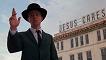
Different filmmaking but over Tree of Life's last moments, I would take David Lynch's reconciled now-happy Betty and Rita ascending above the City of Dreams towards the blue-haired Goddess "amen"ing Silencio and Claudia's smile in Magnolia.
- matrixschmatrix
- Joined: Wed May 26, 2010 3:26 am
Re: The Tree of Life (Terrence Malick, 2011)
Obviously whether the Penn scenes worked or not is up to you, but I agree hollyharry that demanding more concrete links between Penn and the Texas parts is asking the movie to be something it's not- it's enormously elliptical, and all the connections we do see are imagistic and emotional, it would be out of place for it actually to explain "this is who this character is, this is what he's feeling, this is why."
- jwd5275
- Joined: Tue Jun 08, 2010 4:26 pm
- Location: SF, CA
Re: The Tree of Life (Terrence Malick, 2011)
This is exactly where everyone is missing the point...Grand Illusion wrote:Malick's "heaven on the beach" as a cliche and completely unrevelatory way of portraying whatever human emotion he's trying to convey.
Who says that the beach scene is about heaven..?
It is far more likely making no statement about the afterlife and is instead is a visual reconciliation of Sean Penn's character with his past, both spiritually and in his own memory. Hence he meets himself as a child, he puts his hand on his father in forgiviness, etc. The word of the Agnes Dei playing during this sequence strongly lend support to this, especially that the final words are 'grant us peace' and after which we see Sean Penn's character smile for the first time in the movie. (Notice even before this Sean Penn calls his living father and apologizes for some harsh words). It is all a sequence about the internal choice of a life of grace as Malick himself defined it in the beginning of the movie.
Everyone is assuming that the beach is heaven on their own accord (mostly likely contrary to what Malick was actually doing).
(...and yes, I agree. It is very reminescent of the end of 8 1/2 too)
-
whocansay
- Joined: Fri Jun 17, 2011 4:19 am
Re: The Tree of Life (Terrence Malick, 2011)
I can't agree with this more, and I think that the final 5 or so shots after the beach sequence disprove or at the very least problematize the notion that Penn is in heaven. Though it's not unreasonable to assume that, I can't go down that road without also assuming that he's died, which is a terribly problematic assumption when the beach sequence is placed immediately after a shot from inside an elevator going up a tall building. It reeks of death-fetishism, which is not only really incongruous with the rest of the film's sense of wonder at the world and at creation, but makes the film quite troubling to me, since it would make the film very simplistic. It would reduce it to "childhood/the past is utopia and the present is horrible, and death is the only deliverance." I can't accept something like that in this film, so I'm left with the option that it's a catharsis, and the 5-shot epilogue a sign of his rediscovered appreciation for life/existence.jwd5275 wrote: Everyone is assuming that the beach is heaven on their own accord (mostly likely contrary to what Malick was actually doing).
- Michael
- Joined: Wed Nov 03, 2004 4:09 pm
Re: The Tree of Life (Terrence Malick, 2011)
I was not asking to be spoonfed. It's not that the film being elliptical is the problem for me. There are plenty of elliptical films I love: Denis, Kubrick, Roeg, Wong for examples.matrixschmatrix wrote:Obviously whether the Penn scenes worked or not is up to you, but I agree hollyharry that demanding more concrete links between Penn and the Texas parts is asking the movie to be something it's not- it's enormously elliptical, and all the connections we do see are imagistic and emotional, it would be out of place for it actually to explain "this is who this character is, this is what he's feeling, this is why."
The film is unquestionably beautiful but the ending tainted the whole experience for me. The New Worlds ending is also ellipitical but incredibly moving and spiritual by far. I weep every time. I guess it helps to have Q'orianka Kilcher anchor the film soul but Sean Penn didn't for me, his arc or not.
- Alan Smithee
- Joined: Mon Dec 06, 2010 3:49 pm
- Location: brooklyn
Re: The Tree of Life (Terrence Malick, 2011)
I don't think Penn is supposed to be the anchor of the film, Hunter McCracken is. One benefit of not getting too deep into Penns future/present story is that you are supposed to look at his face and see McCracken as an adult. However with Penn being such a known star this can be problematic.Michael wrote:The film is unquestionably beautiful but the ending tainted the whole experience for me. The New Worlds ending is also ellipitical but incredibly moving and spiritual by far. I weep every time. I guess it helps to have Q'orianka Kilcher anchor the film soul but Sean Penn didn't for me, his arc or not.
- colinr0380
- Joined: Mon Nov 08, 2004 8:30 pm
- Location: Chapel-en-le-Frith, Derbyshire, UK
Re: The Tree of Life (Terrence Malick, 2011)
That makes me wonder if Penn is performing the same kind of function here as he did in Thomas Vinterberg's It's All About Love. In that film he was detached from the main events of the narrative circling in an airplane unable to land while in Tree of Life he is isolated from the other important characters in a temporal rather than geographical sense, but in both cases is only able to reminisce in a poetic manner.
(Way off topic: I think It's All About Love is a severely underrated film. It is bizarre in some ways (the ice-skating clones seemingly embodying different moods are a beautifully weird touch though. And the steady assassinations of them in mid-performance while skating to a darkened arena is an amazing scene) but incredibly beautiful in others. Though the beauty of the imagery also caused some controversy at the time, as it was suggested that Vinterberg was 'abandoning' his Dogme roots after the success of Festen for something slicker. However I am looking forward to the chance of comparing this particular 'overly commercial film by a Dogme director which deals with reactions to an inevitable extinction event' with Lars von Trier's Melancholia to see if they may share any similarities of tone and theme!)
-
Grand Illusion
- Joined: Wed Sep 26, 2007 11:56 am
Re: The Tree of Life (Terrence Malick, 2011)
Did you even read beyond the sentence you quoted? The one where I said it doesn't even matter if it's actually Heaven as afterlife or just some variant of some sort of spiritual realm? I think it's fallacious to imply this is Penn's memory, since there are other "lost souls" meandering that Penn doesn't seem to recognize. Still, it really doesn't matter what this exact space is.jwd5275 wrote:This is exactly where everyone is missing the point... Who says that the beach scene is about heaven? It is far more likely making no statement about the afterlife and is instead is a visual reconciliation of Sean Penn's character with his past, both spiritually and in his own memory. Hence he meets himself as a child, he puts his hand on his father in forgiviness, etc. The word of the Agnes Dei playing during this sequence strongly lend support to this, especially that the final words are 'grant us peace' and after which we see Sean Penn's character smile for the first time in the movie. (Notice even before this Sean Penn calls his living father and apologizes for some harsh words). It is all a sequence about the internal choice of a life of grace as Malick himself defined it in the beginning of the movie.Grand Illusion wrote:Malick's "heaven on the beach" as a cliche and completely unrevelatory way of portraying whatever human emotion he's trying to convey.
Everyone is assuming that the beach is heaven on their own accord (mostly likely contrary to what Malick was actually doing). (...and yes, I agree. It is very reminescent of the end of 8 1/2 too)
What matters, to me, is that it's played out in an entirely banal manner, contrary to the sense of wonder that I got from the rest of the film. The second Penn walks through that doorway on the beach, I could've given you a play-by-play of the next twenty minutes.
So we see Penn smile once, but we never get the feeling of why Penn is overcome with such ennui in his Antonioni-esque modernity. If you're going to have characters, human beings, in your art film and you expect us to be empathetic with them, then they need to have understandable motivations. There's no motivation or reason for Penn to be moping around as he is.
And make no mistake. Malick is expecting us to be empathetic with Penn. It's an extremely sentimental moment. It's obviously not going to work with me on an intellectual level, so the dearth of emotion or wonderful imagery leaves it completely hollow.
His past is not enough. Yes, he loses his brother, but ostensibly he couldn't have become a successful business person in the modern world if he spent all his days moping around like Eeyore from Winnie The Pooh. I severely doubt the loss of his brother or, going further back, having a strict father sent him into a forty-year stasis of being mopey.