Page 1 of 2
739 Safe
Posted: Tue Sep 16, 2014 4:02 pm
by swo17
Safe

Julianne Moore gives a breakthrough performance as Carol White, a Los Angeles housewife in the late 1980s who comes down with a debilitating illness. After the doctors she sees can give her no clear diagnosis, she comes to believe that she has frighteningly extreme environmental allergies. A profoundly unsettling work from the great American director Todd Haynes,
Safe functions on multiple levels: as a prescient commentary on self-help culture, as a metaphor for the AIDS crisis, as a drama about class and social estrangement, and as a horror film about what you cannot see. This revelatory drama was named the best film of the 1990s in a Village Voice poll of more than fifty critics.
DIRECTOR-APPROVED SPECIAL EDITION:
• New 4K digital restoration, supervised by director Todd Haynes, with uncompressed monaural soundtrack on the Blu-ray
• Audio commentary featuring Haynes, actor Julianne Moore, and producer Christine Vachon
• New conversation between Haynes and Moore
•
The Suicide, a 1978 short film by Haynes
• New interview with Vachon
• Trailer
• PLUS: An essay by critic Dennis Lim
Re: 739 Safe
Posted: Tue Sep 16, 2014 5:14 pm
by John Cope
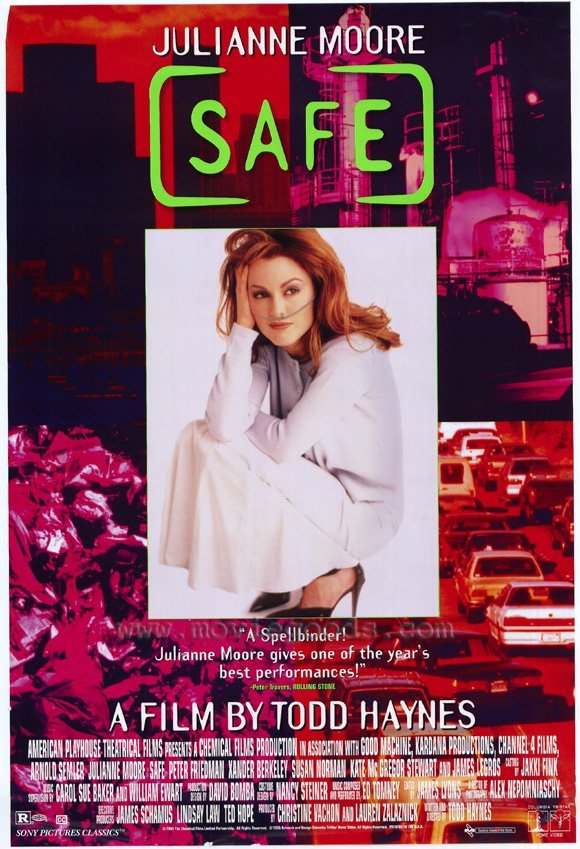
Should have gone with the great video release artwork (also thread should probably be re-titled [Safe]).
Re: 739 Safe
Posted: Tue Sep 16, 2014 5:21 pm
by colinr0380
Julianne Moore looks far too glamorous in that picture though! Although that is perhaps the point, with its upper middle class housewife getting poisoned by her surroundings. Nevertheless it feels a bit too much like Fault In Our Stars-style 'terminally ill-chic'!
Re: 739 Safe
Posted: Tue Sep 16, 2014 5:22 pm
by John Cope
Yeah, but that's sort of the point (I always found it remarkably perceptive work for video release art especially).
Re: 739 Safe
Posted: Tue Sep 16, 2014 5:23 pm
by colinr0380
I've edited my post as I figured out the meaning just in time!

Re: 739 Safe
Posted: Tue Sep 16, 2014 5:35 pm
by domino harvey
So glad I was able to unload my Sony disc a few months back for big bux (RIP our ability to do that on Amazon)
Re: 739 Safe
Posted: Tue Sep 16, 2014 8:15 pm
by colinr0380
In case anyone is on the fence about this film,
it has Kelly Reichardt's seal of approval!
Re: 739 Safe
Posted: Tue Sep 16, 2014 11:03 pm
by whaleallright
The Criterion description reminded me of the impressive fact that this topped the
Village Voice's "best of the 1990s" poll. To be honest, I think that has as much to do with the film's pushing a lot of New-York-intellectual buttons (post-structuralism, critique of suburbs and materialism—and California, AIDS metaphors, slow-cinema aesthetics
avant la lettre) as its inherent quality. (btw RIP
Village Voice as an outlet for serious culture writing.) It's a brilliant film, purposeful and controlled in a way that few independent films are. But like many of Haynes's features, despite being a determinedly "open" text it feels limited by a kind of critical-poetic feedback loop, where the film is designed to be interpreted in the same terms that informed its construction.
Here's a great interview with Haynes about the film, conducted by Larry Gross (
spoilers 'n' stuff)
Re: 739 Safe
Posted: Wed Sep 17, 2014 1:26 am
by hearthesilence
In case anyone was curious, the top ten voted in that poll were:
1. Safe
2. Breaking the Waves
3. Flowers of Shanghai
4. Taste of Cherry
5. GoodFellas
6. Fireworks
7. Naked
8. Underground
9. Satantango
10. Fallen Angels
(It continues down to 245 with a lot of ties.)
Re: 739 Safe
Posted: Wed Sep 17, 2014 4:17 am
by _shadow_
It's disappointing to see "AIDS metaphor" continue to appear in discussions of the film, e.g. in Criterion's summary notes. The "Horror" segment of "Poison" has an AIDS metaphor. "Safe" takes place in a world with AIDS. There's no metaphor involved, and framing the film as such encourages a limited reading of the film that sidesteps its broader concerns.
Or, I could just quote Haynes on the subject from the great Projections 5 interview with him, Christine Vachon and Julianne Moore:
"A lot of people have asked me if Safe was a giant metaphor for AIDS, and if so, why didn't I deal with AIDS. Of course, the film is not a metaphor for AIDS. It co-exists in the universe of the film, but it's unlike Poison, where the bizarre disease the scientist comes down with really is a metaphor for AIDS, with huge quotation marks around it. I was particularly interested in Environmental Illness for what makes it very distinct from AIDS. EI is a disease that is at a much earlier stage in its public visibility and perception, so that it brings with it all the mistrust and uncertainty about its very existence. That was never part of the early days of AIDS - people were dying from the beginning, you knew something was wrong immediately. The questions were about how the disease was transmitted and who it was targeting, and then the stigmas generated around these issues. EI is much more innocuous and less easily placed in somebody else's backyard, and so the stigmas aren't as well defined - that's what I liked about it. And the fact that you can imagine it being psychosomatic in ways that you really can't with AIDS was also what drew me to it, because it puts the illness on the individual in a much more profound way, and it makes you rethink your own psychology and mental stability in different ways to AIDS."
Re: 739 Safe
Posted: Wed Sep 17, 2014 6:58 am
by evilfred
Thank you _shadow_. I absolutely love Safe and the AIDS comparison has always sat uncomfortably for me. The "co-exists" thing makes sense in terms of a sort of awkwardness and un-addressability of the disease but it would be overly reductive and dismissive to describe Safe as a simple "AIDS metaphor".
I can see how the mercurial nature of the movie can be frustrating to some when trying to pin it down, but I appreciate it. The DVD commentary drove home the point that Julianne's character is not intended to be wholly sympathetic. But as a queer director with a firm sense of 'camp', if slightly submerged in comparison to "Superstar", Haynes demonstrates the ability to simultaneously make fun of his protagonist and authentically empathize with her.
Re: 739 Safe
Posted: Wed Sep 17, 2014 10:28 am
by colinr0380
I certainly see it more as an "anxiety metaphor" than AIDS in particular. The sense that you know that something is wrong with your environment and can feel yourself bodily reacting against it, so that every asthma attack or nose bleed confirms that you are in the first stages of some dreadful killer disease (I love the way that film plays with your standard expectations going into a medical drama movie here too. There has to be the 'inciting event'). In a sense the whole film is someone searching for validation that they actually are 'ill', and once they find an environment that gives them that validation and support (and reason for being - in that sense this is another Douglas Sirk-ian social picture about a housewife discovering herself) the film shifts into its sublime-yet-darkly disturbing cult-commune retreat section.
I see [Safe] very much as a forerunner to themes (finding anxiety or comfort within a family or commune being about finding a secure mental place as much as a physical one; the toxification of the environment) that are only just being explored again now in films such as Martha Marcy May Marlene and Upstream Color.
Re: 739 Safe
Posted: Wed Sep 17, 2014 11:20 am
by FrauBlucher
My initial viewing of this film was just a few years ago. The HIV/Aids was not a medaphor I saw at all. Of course, timing is everything and makes it relevant or not. I assume people watching this in the mid-nineties couldn't help but think about a connection to Aids, especially on the heals of Philidelphia.
As time goes by though, you can see this is truly still an issue of the poisoning of the environment (fracking anyone), whether overtly or covertly, and it stands on it's own and should not be underscored by another disease or issue. I was satisfied to read Haynes explanation that _shadow_ posted.
I, for one, am looking forward to seeing this again, and with all the bonus material that should definitely shed more light on this topic. Plus, Haynes' style and mis-en-scene adds all the more to the suspense and drama of his masterpiece.
Re: 739 Safe
Posted: Wed Sep 17, 2014 4:52 pm
by John Cope
jonah.77 wrote:It's a brilliant film, purposeful and controlled in a way that few independent films are. But like many of Haynes's features, despite being a determinedly "open" text it feels limited by a kind of critical-poetic feedback loop, where the film is designed to be interpreted in the same terms that informed its construction.
Yes, a 100 times yes. I used to love
[Safe] in a kind of all encompassing, almost entirely unqualified sort of way but my response has developed over the years and become less positive and more complicated, as evidenced by
this conversation I participated in. The issues I have with the film now are also a very difficult thing to get at or pin down as evidenced by the swirling rabbit hole this whole argument becomes. I know that this "conversation" took far longer than any other which we've done.
Re: 739 Safe
Posted: Wed Sep 17, 2014 9:48 pm
by jsteffe
jonah.77 wrote:It's a brilliant film, purposeful and controlled in a way that few independent films are. But like many of Haynes's features, despite being a determinedly "open" text it feels limited by a kind of critical-poetic feedback loop, where the film is designed to be interpreted in the same terms that informed its construction.
Yes! I think you just nailed my underlying reservation about Todd Haynes' work as a whole, even though I do admire it very much. Perhaps to oversimplify what you are saying, it is as if Haynes is making his films in anticipation of what hip critics and scholars will say about them.
For me, FAR FROM HEAVEN is the prime example of this, as a postmodern spin on the Sirkian melodrama. There is something just a little too knowing about how it all plays out, even though Haynes obviously loves Sirk and melodrama in general.
He is not the only filmmaker or writer to suffer from this tendency. A prime example for me is the French novelist Claude Simon, who won the Nobel Prize in 1985. During the Seventies, I think his work suffered from his association with the
Tel Quel critical school. Novels such as
Les Corps conducteurs (1971) and
Triptyque (1973) became heavily caught up in a self-reflexive examination of language and representation, to their detriment. They're still interesting to read, but they don't hold up as well as
La Route des Flandres (1960) or
Les Géorgiques (1981). I think the same thing may have happened with Rushdie in
Midnight's Children, but that is a different story.
Still, Hayne's SAFE works for me because of Julianne Moore's remarkable performance, and the guru figure is also fascinatingly ambivalent. I'm looking forward to revisiting the film and seeing how I respond to it this time around.
Re: 739 Safe
Posted: Thu Sep 18, 2014 12:28 am
by zedz
FrauBlucher wrote:My initial viewing of this film was just a few years ago. The HIV/Aids was not a medaphor I saw at all. Of course, timing is everything and makes it relevant or not. I assume people watching this in the mid-nineties couldn't help but think about a connection to Aids, especially on the heals of Philidelphia.
Believe it or not, in the mid-nineties, AIDS was generally
not thought of as "that disease from the Oscar-winning movie
Philadelphia." It was a natural reference point for audiences to bring to this film because it was a social fact with enormous impact and because Haynes was an openly gay filmmaker whose previous film had included a metaphorical treatment of the disease. But, as noted above, Haynes is really defining Carol White's condition
in contrast to AIDS, in order to deal with much more general themes about ideas of wellness and security.
Re: 739 Safe
Posted: Thu Sep 18, 2014 10:38 am
by FrauBlucher
zedz wrote:FrauBlucher wrote:My initial viewing of this film was just a few years ago. The HIV/Aids was not a medaphor I saw at all. Of course, timing is everything and makes it relevant or not. I assume people watching this in the mid-nineties couldn't help but think about a connection to Aids, especially on the heals of Philidelphia.
Believe it or not, in the mid-nineties, AIDS was generally
not thought of as "that disease from the Oscar-winning movie
Philadelphia." It was a natural reference point for audiences to bring to this film because it was a social fact with enormous impact and because Haynes was an openly gay filmmaker whose previous film had included a metaphorical treatment of the disease. But, as noted above, Haynes is really defining Carol White's condition
in contrast to AIDS, in order to deal with much more general themes about ideas of wellness and security.
I'm not suggesting Aids was a Nineties disease. But middle america/main stream america still didn't pay attention to the Aids epidemic to the extent they should have, until the early to mid-nineties. Of course, Rock Hudson's death was the first time it accured to many people that this is serious, then the next big shot was Magic Johnson's reveleation that he was HIV positive and then as the Reagen/Bush period ends and Clinton takes over the presidency, Aids awareness and compassion are allowed to get a foothold in the White House. So, by the time Philidephia is released the disease is more open to the general masses. And it's Hollywood's first major film and push to move HIV/Aids forward to the consciousness of the mainstream.
How this affected Safe I'm not sure but not surprised that some thought it was a metaphor for Aids because the country was at the beginning stages of getting over the stigma of the disease. But watching Safe now, the HIV/Aids connection just doesn't feel as significant in the context of the film as it did watching 20 years back.
And, even now in some quarters environmentally produced illness is still not thought of as a real problem.
Re: 739 Safe
Posted: Thu Sep 18, 2014 4:43 pm
by RobertB
FrauBlucher wrote:
I'm not suggesting Aids was a Nineties disease. But middle america/main stream america still didn't pay attention to the Aids epidemic to the extent they should have, until the early to mid-nineties.
I love the film
Safe and I'm enjoying reading this discussion. But my recollection is that AIDS (and before that "Gay-plague") was huge news in the 80's. In 1983
New York Times reported that the scare of AIDS had led to the collapse of tourism in Haiti. And I remember how nurses and dentists objected to treating gay men (and even refused).

Re: 739 Safe
Posted: Thu Sep 18, 2014 6:02 pm
by Numero Trois
RobertB wrote:I love the film Safe and I'm enjoying reading this discussion. But my recollection is that AIDS (and before that "Gay-plague") was huge news in the 80's.
No one said it wasn't. It was absolutely front page news back then everywhere. Like others have said, mainstream America's view of the disease gradually changed sometime after 1992-93. Before then it was viewed as something that only "them" in the big city contracted.
Re: 739 Safe
Posted: Thu Sep 18, 2014 6:24 pm
by vidussoni
Numero Trois wrote:RobertB wrote:I love the film Safe and I'm enjoying reading this discussion. But my recollection is that AIDS (and before that "Gay-plague") was huge news in the 80's.
No one said it wasn't. It was absolutely front page news back then everywhere. Like others have said, mainstream America's view of the disease gradually changed sometime after 1992-93. Before then it was viewed as something that only "them" in the big city contracted.
I have to disagree. Their views changed in the late 1980s because of Ryan White.
Re: 739 Safe
Posted: Thu Sep 18, 2014 6:48 pm
by Numero Trois
Ryan White helped but was hardly the only factor even by mainstream America's terms. It was a hard fought battle that took many years. Such a gradual process can't be broiled down to a single person.
Re: 739 Safe
Posted: Thu Sep 18, 2014 7:42 pm
by zedz
FrauBlucher wrote:zedz wrote:FrauBlucher wrote:My initial viewing of this film was just a few years ago. The HIV/Aids was not a medaphor I saw at all. Of course, timing is everything and makes it relevant or not. I assume people watching this in the mid-nineties couldn't help but think about a connection to Aids, especially on the heals of Philidelphia.
Believe it or not, in the mid-nineties, AIDS was generally
not thought of as "that disease from the Oscar-winning movie
Philadelphia." It was a natural reference point for audiences to bring to this film because it was a social fact with enormous impact and because Haynes was an openly gay filmmaker whose previous film had included a metaphorical treatment of the disease. But, as noted above, Haynes is really defining Carol White's condition
in contrast to AIDS, in order to deal with much more general themes about ideas of wellness and security.
I'm not suggesting Aids was a Nineties disease. But middle america/main stream america still didn't pay attention to the Aids epidemic to the extent they should have, until the early to mid-nineties.
I think you've missed my point entirely, which wasn't that AIDS wasn't a nineties disease, but that it wasn't a
movie disease. People who saw references to AIDS in
Safe weren't doing so because of the existence of
Philadelphia, as you suggested.
Re: 739 Safe
Posted: Fri Sep 19, 2014 10:30 am
by FrauBlucher
RobertB wrote:FrauBlucher wrote:
I'm not suggesting Aids was a Nineties disease. But middle america/main stream america still didn't pay attention to the Aids epidemic to the extent they should have, until the early to mid-nineties.
I love the film
Safe and I'm enjoying reading this discussion. But my recollection is that AIDS (and before that "Gay-plague") was huge news in the 80's. In 1983
New York Times reported that the scare of AIDS had led to the collapse of tourism in Haiti. And I remember how nurses and dentists objected to treating gay men (and even refused).
A New York Times article written in 1983 about Haiti and Aids had absolutely no bearing on what the rest of the country, not named New York, Los Angeles and San Fransisco, thought about aids or even that they cared.
zedz wrote:I think you've missed my point entirely, which wasn't that AIDS wasn't a nineties disease, but that it wasn't a movie disease. People who saw references to AIDS in Safe weren't doing so because of the existence of Philadelphia, as you suggested.
I think you missed my point as well. I'm not saying Safe and Philidelphia had a link of convenience. What I'm suggesting is that HIV/Aids became front in center in the consciousness of the American public by that time and, the film, Philidelphia played a small part in the that along with my other examples. That in turn allowed people to, maybe, think there was a little message or metaphor on Aids in Safe.
Re: 739 Safe
Posted: Fri Sep 19, 2014 3:49 pm
by RobertB
FrauBlucher wrote:
A New York Times article written in 1983 about Haiti and Aids had absolutely no bearing on what the rest of the country, not named New York, Los Angeles and San Fransisco, thought about aids or even that they cared.
Did you read it? "charter flights and cruise ships have stopped docking in Port-au- Prince, the tropical verandas of the AIDS is now a worldwide problem" and "Hoteliers, local officials and foreign diplomats complain that the whole country has been stigmatized by AIDS".
This is saying the scare was gripping ALL of USA. Nobody would visit Haiti or even meet Haitians, because of the AIDS scare.
Philadelphia was hardly part of making AIDS the centre of consciousness. Hollywood was very late in addressing the issue. Roger Ebert was not part of the New York or San Fransisco gay scene and in
his review he said:
"Philadelphia" marks the first time Hollywood has risked a big-budget film on the subject. No points for timeliness here; made-for-TV docudramas and the independent film "Longtime Companion" have already explored the subject, and "Philadelphia" breaks no new dramatic ground... Sooner or later, Hollywood had to address one of the most important subjects of our time, and with "Philadelphia" the ice has been broken.
Re: 739 Safe
Posted: Fri Sep 19, 2014 4:09 pm
by FrauBlucher
RobertB wrote:FrauBlucher wrote:
A New York Times article written in 1983 about Haiti and Aids had absolutely no bearing on what the rest of the country, not named New York, Los Angeles and San Fransisco, thought about aids or even that they cared.
Did you read it? "charter flights and cruise ships have stopped docking in Port-au- Prince, the tropical verandas of the AIDS is now a worldwide problem" and "Hoteliers, local officials and foreign diplomats complain that the whole country has been stigmatized by AIDS".
This is saying the scare was gripping ALL of USA. Nobody would visit Haiti or even meet Haitians, because of the AIDS scare.
You're dramatically overstating the article. Ask any Aids activist and organization, they will tell you that the Aids crisis in the early 80s was neglected by the government and got little to no sympathy from the vast majority of American public. Besides Haiti has never been a big destination spot for many Americans because of it's constant political turmoil over the years. Is it safe to say you're not American or have lived in the US?