Page 1 of 1
Ulrike Ottinger
Posted: Sun Apr 09, 2017 9:37 pm
by zedz
ULRIKE OTTINGER (1942- )
 FILMOGRAPHY
1972
Laokoon & Sons: The Transformation of Esmeralda del Rio
1972
Berlinfever - Wolf Vostell: Documentation of a Happening
1975
The Enchantment of the Blue Sailors
1977
Madame X - An Absolute Ruler
1979
Ticket of No Return
1981
Freak Orlando
1984
Dorian Gray in the Mirror of the Yellow Press
1985
China: The Arts - The People
1986
Superbia - The Pride (segment of
Seven Women, Seven Sins)
1987
Usinimage
1989
Johanna d'Arc of Mongolia
1990
Countdown
1992
Taiga
1997
Exile Shanghai
2002
Southeast Passage
2002
The Specimen
2002
Ester
2004
Twelve Chairs
2007
Prater
2008
The Korean Wedding Chest
2008
Seoul Women Happiness (segment of
The 10th Anniversary Project Ten Ten)
2009
Still Moving
2011
Under Snow
2016
Chamisso's Shadow


Re: Ulrike Ottinger
Posted: Sun Apr 09, 2017 10:14 pm
by zedz
Inaugurating this filmmaker thread so that I can draw people's attention to two very fine regular commercial (i.e. reasonably priced) DVDs of her most recent films, both of which are excellent and English-friendly.
Unter Schnee is a quasi-documentary about Japan's snow country. It's only quasi-, because there's the fictional conceit of a couple of travellers being thrown back in time to the Edo era, which allows for the kind of contemporary / historical slippage Ottinger likes to court in several of her ethnographic films (see also Chamisso's Shadow and Joan of Arc of Mongolia). The hapless travellers are thereafter stranded between eras, and between history and myth. The main value of the film comes from Ottinger's curious and respectful observation of local rituals, modern and ancient, and her superb eye for nature and landscape. The DVD comes packaged with two CDs of the soundtrack. It has an English narration soundtrack option.
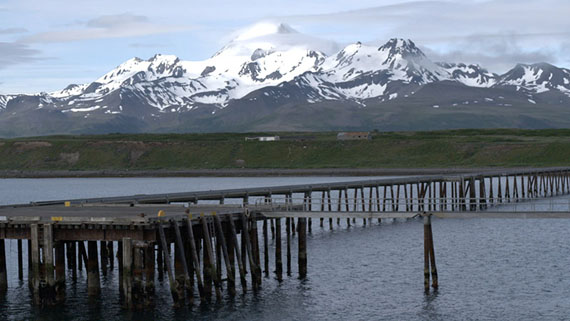
Chamissos Schatten is a magnum opus by any measure. At twelve hours it's half as long again as her epic Taiga, and it's absolutely masterful. Ottinger explores the mainland and islands of the Bering Strait, literally retracing the steps of 18th and 19th century explorers such as Steller, von Chamisso and Cook, whose journal entries serve as narration throughout. It's structured as a geographically organised triptych with "short" (three-hour) chapters flanking a double sized central one in two parts. The first and last chapters, focussed on Alaska and Kamchatka respectively, are more conventionally structured as mixes of historical journal entries (alongside contemporary footage of the areas discussed, which may or may not illustrate the texts), Ottinger's modern reflections, narrated myths (not necessarily authentic), interviews with modern inhabitants and pure observational footage of landscape, wildlife or human activity. The footage is mostly exquisite, and the expansive running time gives Ottinger the luxury of, say, spending five to ten minutes simply observing a bunch of eagles vying for superiority on a rocky beach, or lingering to appreciate light changing on a hillside. Yet it's not exactly leisurely, because the layered structure actually packs an awful lot of information into the running time, which makes its pacing feel a lot different to Taiga, which was, as I recall, intensely observational and less mediated.
The first part of the second chapter is much more in that vein, climaxing in a sequence detailing the (pretty much) traditional hunting, slaughter, butchering, cooking and eating of a sea lion that lasts for more than an hour. As with the rest of the film, none of what's happening on screen is narrated (at best, image and narration act as independent melodic lines that sometimes chime together or work in counterpoint). It's like Eustache's unflinching Le Cochon, and doesn't elide any step of the process or the rituals associated with it. There's a much shorter and more oblique whale-hunting sequence earlier in this part of the film, so this second disc is the one which is likely to be the most challenging for many viewers. But who said subsistence ecology was pretty?
The cinematography throughout is breathtaking, and the transfer is very strong SD (though I'm sure HD would really knock your socks off). The four disc set has English subtitles throughout.
Re: Ulrike Ottinger
Posted: Sun Apr 09, 2017 10:42 pm
by L.A.
I'm interested in seeing Freak Orlando and Johanna d'Arc of Mongolia. Are these available on DVD and with English subs?
Re: Ulrike Ottinger
Posted: Sun Apr 09, 2017 10:49 pm
by knives
Yes, directly from her website though they are absurdly expensive.
Ulrike Ottinger
Posted: Sun Apr 09, 2017 10:54 pm
by TMDaines
They come with the subtitles burnt in too I believe.
Re: Ulrike Ottinger
Posted: Mon Apr 10, 2017 3:21 pm
by L.A.
Thanks for your replies. Really appreciate it.
Re: Ulrike Ottinger
Posted: Mon Apr 10, 2017 5:18 pm
by Tommaso
Thanks for setting this director's page up, zedz! As most of Ottinger's films are very hard to see unless you have unlimited amounts of money to spend to buy her self-released dvds, it's very good and rather surprising that at least the last two ones that you mention above are released via a 'normal' label. I hope this will continue with the next film(s) she'll make.
But as for the moment many people probably haven't seen much of her earlier work, I would like to recommend the fine documentary
Ulrike Ottinger - Die Nomadin vom See, which is a good introduction to the filmmaker and shows quite a few excerpts from her early film. Released by a normal label, and it also has removable English subs.
Re: Ulrike Ottinger
Posted: Wed Jun 01, 2022 5:06 pm
by swo17
A ton of Ottinger's films can now be streamed on Criterion Channel:
Laocoon & Sons (1975)
Madame X: An Absolute Ruler (1977)
Ticket of No Return (1979)
Freak Orlando (1981)
Dorian Gray in the Mirror of the Yellow Press (1984)
Superbia — Der Stolz [segment from Seven Women, Seven Sins] (1986)
Joan of Arc of Mongolia (1989)
Taiga (1992)
Prater (2007)
Chamisso's Shadow (2016)
Paris Calligrammes (2020)