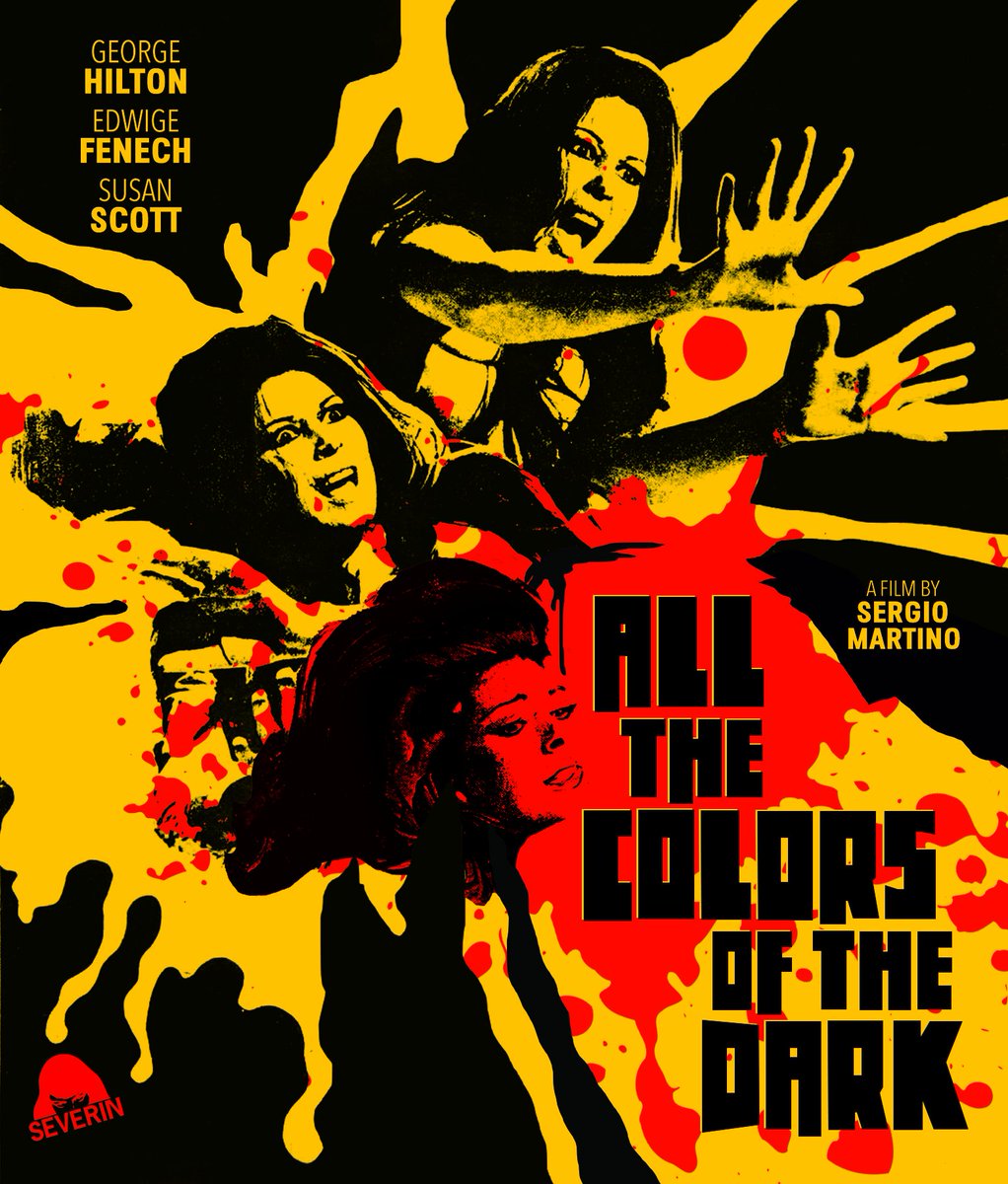
"You have crossed the barriers to reality...You are beyond its limits and you'll never see it again"
"Listen Jane, there are many vitamins that should only be taken on a doctor's prescription. They can be dangerous...and he'll go on feeding you vitamins when all you need is a really competent psychoanalyst"
Major spoilers:
I really liked this, mostly because it throws seemingly every trope for why the heroine is being menaced at the viewer and sort of relies on them to pick their way through the mass of irrelevant (but perhaps contributory?) factors to reach the few important key reasons for the events to be playing out. We get suggestions of a troubled mental state with the opening nightmare sequence that recontextualises trauma from a bad car accident causing painful abdominal surgery and a miscarriage (has Jane gotten over it, or is in the process of finishing working through it as she tells the psychiatrist, or is this loss making her feel anxious about the alterior motives of everyone around her?); then her love for but seeming lack of full intimacy with her partner (significantly not husband) Richard, who is a Pharmaceutical travelling salesman who appears to be forcefully testing out his new line of vitamin pills on Jane to try and make her feel better when he is not regularly abandoning her to travel across the country, or at least to take an 'important telephone call from Liverpool'; what about Jane's sister introducing her to a psychiatrist against Richard's objections?; surely the fur-coat clad neighbour who takes a more than platonic interest in Jane and offers her a quite extreme form of 'alternative therapy' has her best interests at heart? And why does the killer with piercing blue contact lenses from her opening nightmare suddenly start stalking her through the streets and underground stations of London?
This feels like a quintessential giallo in the way it is bundling together all of those tropes, as well as using exotic London as the gloomy location this time around (though I absolutely love the autumnal setting and the many shots of Edwige Fenech peering anxiously out of condensation-shrouded windows at interchangeable figures shrouded in overcoats!). The three main areas causing trouble for a main character that giallos focus on are relationships, psychiatry (or experts in general) and the occult, and all three areas can be where masked killers and/or victims come from! All The Colours Of The Dark features all three aspects, all kind of fighting it out for dominance over who gets to control the heroine, whilst she gets buffeted between them!
On that note, I think the structure of the film is perhaps the most satisfying aspect of it. It starts off interior focused with the accident recontextualised into a nightmare sequence (a bit reminiscent of Mimsy Farmer's hallucinations at the beginning of Autopsy) and then introduces the boyfriend, then the psychiatrist, then the black magic occult worshippers who induct Jane into their dog-loving blood-drinking, all seeing eye sex cult in a sequence that takes place almost at the exact mid-point of the film. Each of those areas have someone else leading Jane into it, with promises that they will solve all of her problems, as if she is being carried into a newly dangerous inner circle. Then after Jane's induction into the cult the film structurally works its way back out of it again, complicating matters even further as it goes, as we get another darker visit to the cult where the sacrifices cut a bit more deeply causing Jane to flee into the arms of the psychiatrist for help (But he's shifty too...or is he...yes, he's lied!...oh, but he was lying to protect a patient from a potentially domineering partner...so maybe he's OK? Oh, never mind, he's dead), and then it becomes about Jane's fears over Richard (equating him with the cult leader, who also may or may not have a part time job as head of the Greater London Police) as well as fears for him getting killed by the cult. But also perhaps by Jane herself as she almost loses all grip on reality by the end, with the repetition of the lift sequence suggesting either someone trapped in cycles of events and also a kind of implied Don't Look Now-premonition of someone's impending death, only averted on a repeat performance by precognitive second sight! I am not sure that the film entirely pulls that kind of 'deepest in at the mid-point, then back out again' structure off with complete clarity, but its kind of novel to see at the very least! I also like the abrupt inconclusiveness of the ending, with the couple falling away from the lover's embrace to freeze on Richard's slightly cold gaze at Jane, though I could see why others might find it frustrating!
I also really like that in the final section the various factions finally stop working Jane over primarily and instead start targeting each other directly! Jane does not really manage to overcome any of the threats herself (just runs away from them, at least when doorknobs do not come off in her hands!) which means that it falls to everyone around her to alternately try and save or attempt to kill her. Or save
then attempt to kill her!
I was thinking a lot about the other film that Edwige Fenech and George Hilton starred in the same year, The Case of the Bloody Iris. That also features Fenech being pursued by a sex cult that will not let her easily resign her membership, so perhaps she was seen as the go-to actress for that kind of great 'naked hallucination orgy as viewed through a kaleidoscope' scene that crops up in both films. But still, it seems very unlucky to escape from one sex cult only to end up right back in another one! (Its kind of funny to see the film these days as about someone trying to escape from Scientology! Which reminds me that I think there is a good argument to be made that Eyes Wide Shut is kind of a very veiled giallo film in itself!)
There are some nice striking visual elements here beyond the orgy scene too. I particularly like that in the second half some rooms get coloured with either blood red or sickly green light (Barbara's room being bathed in the sickly green), almost anticipating some of Argento's more extreme stylisations later on. I also really like the opening credits shot of birdsong over a lakeside landscape slowly fading to black, which was beautiful as well as eerie, even if the cut into the nightmare sequence immediately following it was quite jarring!
More giallo tropes? The overly interested lesbian coded friend/roommate/neighbour aspect is present and correct, though relatively more muted than usual. The trope of walking up a darkened staircase to be confronted by a killer and shots looking up and down stairwells to see potential threats approaching are present (perhaps influenced by Bird With The Crystal Plumage?), and lifts are used for both real and imagined murders, anticipating Deep Red and even Dressed To Kill. Plus falling from heights as a coup de grace, featuring an excellent dummy death!
Oh, and the mandatory appearance of the J&B bottle arrives after the mid-point of the film when Jane is needing something to calm her nerves the most, although the second time the bottle is shot through the flames of the fireplace, suggesting the alcohol is another devillish emissary!
domino harvey wrote:Also, I was legit confused with the discussion about the sister at the end of the film, which made it seem like what we've been shown was part of some kind of defrauding scam to get the protagonist's money. Did we ever see the sister? Why would the filmmakers include a line like "And if I died, she'd get the money?" if we hadn't? So distracting! Speaking of distracting, what's Peter O'Toole's Jesus from the Ruling Class doing leading a bunch of Satanists?
I really wanted her to add an extra line at the end of the scene: "And if we'd both died, who would have inherited it all then?"
I assume that it was an attempt to suggest that Jane is actually kind of happy that her sister Barbara has been bumped off, suggesting that the film has worked its way out from cult-psychiatrist-boyfriend issues back into internalised trauma. But the twist being that it is not the trauma that we saw at the beginning of the film (the one a year back when Richard caused the accident that led to Jane's miscarriage) which Jane rightly says to the psychiatrist at the beginning of the film is not actually the thing that is troubling her but something further back. We eventually get that more repressed (even to Jane) trauma revealed with the revelation of the mother having been a member of the cult and murdered by them, and the sister Barbara (who also incidentally works as the psychatrist's secretary, so she has a foot in both the rational and irrational camps!) has been manipulating Jane towards the cult in order to murder her! So add to the list of giallo tropes swirling around the ones about parental sins visited on their children and people being murdered for inheritances or insurance policy payouts! Plus of course Barbara has been previously coming on to Richard in the couple of scenes where they meet up without Jane!
Incidentally after watching I rewound the film back to that early scene with Richard talking to Barbara and confronting her about taking Jane to the psychiatrist whilst she is getting dressed, and you don't see the cult tattoo on her arm in that first scene that Richard mentions having seen in their final confrontation. I suppose that the filmmakers were assuming that the audience would be more distracted by the nudity in that first scene to look at someone's bare arms anyway! I like the way that scene is played though, with the most explicit nudity being used to suggest both a salacious gaze from Richard and to give the audience some breasts, but which turns out to have factored into the story in a small way later on, as the equivalent of those 'clue moments' in Argento films!
So at the end of the film as it is going from these external characters and with Richard killing Barbara (and the blue eyed man, and the cult leader, meaning that surprisingly Richard (and Jane, albeit forced) kill more people than the cult do!), which Jane slightly suspiciously quickly forgives, we get the sense that we are back in Jane's headspace again now and both the audience and Jane herself understand what was causing all of her anxiety. But is Jane a 'good person' or with the comments about the inheritance does she also reveal an interest in the money too, with her slightly too eager responses when she hears what the solicitor actually wanted to talk to her about. Plus Richard seems happy too, already making plans to move into a bigger house, perhaps one of the size that only a Psychiatrist could otherwise have afforded! So I think Jane and Richard will be fine, as they've beat out all the competition and won their cash money prize by the end!