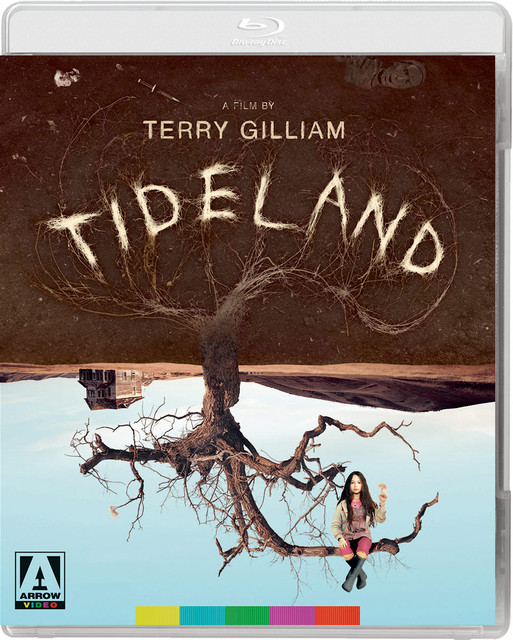
I was there, too. Jodelle Ferland's performance is indeed astonishing. Kids are usually pretty good in Gilliam's films (Sarah Polley in
Munchausen, whats-his-name in
Time Bandits) but Ferland is something else. This would be a difficult film for any actor to carry, and for a 10-year-old to come through it all with a performance like this is pretty staggering. Agreed also on the film's gorgeous look (even as some rather ugly things are happening) and the atmosphere, which is at once fantastic, unpleasant, innocent, and at times suffocatingly horrific.
But I was not disappointed. Though I should take some time to think about it a little more and maybe see it again in a few days, I might be ready to call this Gilliam's best film. I'm still not sure, though. I think it definitely approaches
Brazil's greatness, but they leave me with very different feelings. There were a couple moments in
Tideland where I was actually moved to tears. Normally that's not saying much, as I cry rather readily at movies, but I think it's notable this time because that's never happened to me with a Gilliam film before, and I'm a big fan of his.
I don't know. It's too early for me to say too much about it. I have to let it kick around inside my head first and see what sort of nightmares it gives me.
I do have to say, however, that as great as I think
Tideland may be, I wouldn't blame anyone for walking out on it. Nor do I think it's wrong of anyone to say they wouldn't watch it again or recommend to others. I can completely sympathize with that. I knew so many people were talking about how unpleasant the film made them feel, but "unpleasant" is something of an understatement. There were some voices of dissent even inside my own head telling me to leave during more than a few scenes. Had I been watching this at home it's conceivable that I might have paused the DVD to take a short break.
However, I can't sympathize with anyone who is ready to dismiss the film just because it made them feel that way. This is not directed at you, ka mai, but at the army of critics whose reviews have basically boiled down to "This film is bad because it made me feel icky." This is Gilliam's most uncompromising film, for sure; though he did somehow manage to wedge some effective humor in between all the ugliness, very few bright spots penetrate the darkness, and those that do generally turn into the most unsettling aspects of the film a few scenes later. However, there is no excuse, especially for a professional critic, for disregarding every idea the film is trying to present, or (as is the case with most of the negative reviews) even disregarding the very notion that there are any ideas here at all besides a sadistic desire to make the audience feel uncomfortable.
Is it some sort of defense mechanism? Is the unpleasantness easier to forget if you dismiss it as meaningless? Maybe. Or maybe it's just easier to review without bringing it up.
ka mai wrote:I really don't come away with any clear feeling of what the point of it all was.
I think there are several points, though I'm still sifting through them and working out how they fit together in my head. At least one of them is stated explicitly in Gilliam's comically grave introduction: the idea that children are resilient ("If you drop them, they tend to bounce"). All the other points in the film are connected to this in some way. The child's innocence is one of the things that bolsters her resilience; i.e., if she fully understood what was going on, she would be severely traumatized. The other main point is clearly the importance of fantasy and imagination, the notion that no matter how bad the world around you becomes, there is still a place inside your head that you can escape to where you make up the rules and you decide the outcome.
These are all themes that have been chasing Gilliam throughout his career. He has probably never made a clearer affirmation of a child's resilience than the ending of
Time Bandits, and the idea of escaping into your imagination is something that crops up (and is usually front-and-center) in all of his work. Where
Tideland gets interesting, I think, is that it continues a trend in Gilliam's films that can probably be traced to
Twelve Monkeys that suggests he is growing increasingly troubled by the effectiveness of that sort of escapism.
While Sam Lowry's escape into his mind at the end of Brazil can still be read as a sort of minor triumph, by the end of Tideland the real world has grown so malignant to Jeliza-Rose that when something good finally does happen, her imagination threatens to impede that good because the fantasies she has thought up to cope with her world still carry the spectre of that world. I think the ending suggests Gilliam might be questioning his own outlook: Jeliza-Rose's imagination may have kept her safe in the grotesque, traumatizing world she lived in, but once she has escaped that world her imagination might keep her from setting foot inside the real one again.
At least that's the theory I've developed so far. I'm not sure it holds up yet. As I said, I need a lot more time to think about this film. After saying I shouldn't say too much about it, I've written an awful lot. And somehow I still feel like I've only scratched the surface.