You had a rant about the colour on the Criterion DVD transfer of
Tales of Hoffmann, Dave?!

A 3-strip Technicolor film shouldn't have bleached skin tones - you are right. Skin tones of honkies always looked reddish. DVD Reviewers often complain of reddish skin tones on transfer and this may be causing a bias with telecine operators, who are toning the reddness out of Technicolor-derived film elements during the transfer. Colour-correction is a standard practice now among the better DVD companies today. The recent
Wizard of Oz has a few discrepencies in colour:
DVD Beaver comparisons
Mario Bava films often used to - and still do - turn up on Laser/TV/DVD with ever-changing colour palettes, to the point where even people like Tim Lucas and Troy Howarth didn't know which one was the most accurate representation of Bava's intentions. I still don't know how
Kill, Baby... Kill should look.
Can of worms, but I have always thought of Richard Brooks' adaptation of Capote's,
In Cold Blood as the first mainstream Hollywood film to
use (widescreen Panavision) black and white as an artistic device - nothing to do with budgetary constraints. Conrad Hall proved a triumphant choice and the film remains one of the most visually striking 'stark' films ever made. At this stage, colour was the standard operating procedure in Hollywood (less than 100 American films were shot in black and white were released in 1967 - more than 300 in colour) and
In Cold Blood stands out as a unique American film in late 60s Cinema.
Last Picture Show, Lenny, Paper Moon, Manhattan, Stardust Memories, The Elephant Man and
Raging Bull followed, but it's interesting to note that directors and studios alike were willing to use black and white - to experiment, if you will, but not really at all with colour. The aesthetic in Hollywood in the 70s was
dark, plain and simple. Even
Star Wars lacks vibrant, purposeful primary-colour schemes. John Boorman's,
Point Blank (with a great art dept. crew) also released in 1967, seems to be the last American film to utilise psychological colour schemes before this long run of deliberately drab (and wonderful - don't get me wrong here) adventures in cinematography. De Palma, inspired by Bava, Argento and of course Hitchcock, kept things going to some degree with various cinematographers. As did George Romero with cinematographer Michael Gornick (what ever happened to him - he should have been a A-list Hollywood DP) in
Dawn of the Dead and also, the over-the-top comic-book homage,
Creepshow, which has some amazing moments.
Blade Runner, it seems to me, was the breakthrough. It continues to dazzle and astound me and is proof positive that CGI isn't the be-all and end-all. Paul Schrader's,
Mishima: A Life in Four Chapters is probably the most fascinating film of the 80s, especially in its use of colour and black and white, both with natural lighting and its imaginative representation of Mishima's extraordinary tableuxs. David Lynch's,
Blue Velvet may well be the first American film since Douglas Sirk to present vibrant, symbolic primary colours within a middle-America small town and
Wild at Heart literally explodes with colour.
Things have gotten better in the last few years (
Mulan Rouge?), but maybe it is that vibrant colours don't register very well on TV and video that has affected the thinking and aesthetics of filmmakers, although that is now changing with HDTV and the advanced DVD formats due this year. One of the most visually astounding films of recent years was Vincent Ward's,
What Dreams May Come which is a film that seems to be generally underappreciated. Morricone's score was rejected and Michael Kamen's seems a bit too predictable and the film does sag in places, but visually it is a total triumph.
As digital HD cameras become more widely used, 'films' will begin to look very different to what we are used to and colour will be registered and represented in a totally different way than
all Eastman and Fuji stocks, never mind 3-strip Technicolor!
These posts may be used as a potent sedative before sleep, btw.

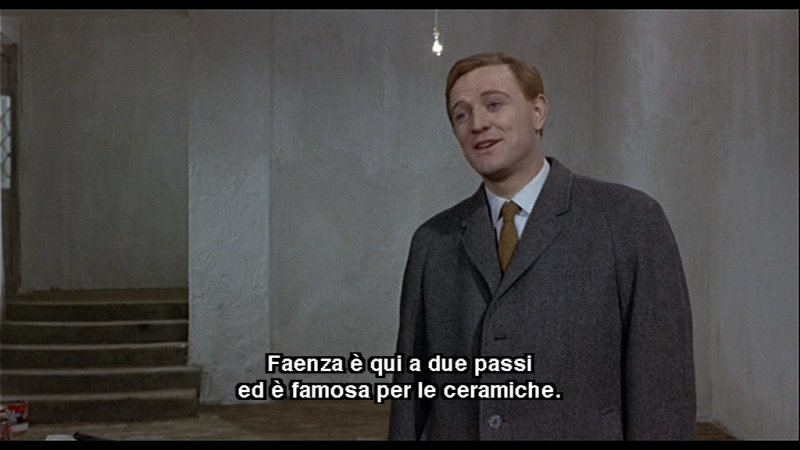


 After learning the meaning of the Russian subs, i now think it would be much better if they weren't translated at all, like in the italian subs. The essence and importance of the sequence has a lot to do with the lack of communication between two people who don't understand each other, and it says lot about the theme of communication that runs throughout the movie as stated in the following snippet from a review i read in beaver: