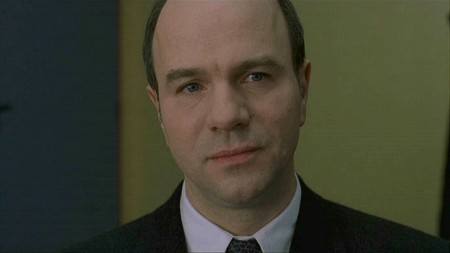
Gordon wrote:Once again, I am at odds with modern Cinema.
Clearly, as I thought it was an absolutely stunning piece of work - and by calling it "that old chestnut - the double-life movie", you reveal that you've seriously missed the point. Though I suspect this is because you seem to be reading it in visual/narrative terms, whereas its real strengths are psychological and sociological. (That said, I thought it was pretty damn effective in the
mise-en-scène department too, especially for a relative newcomer).
I remember seeing it not long after that dismally superficial film about Nick Leeson,
Rogue Trader, and thinking that it was a vastly superior study of the psychology of someone like Leeson - and I suspect there are quite a few of them around.
By which I mean someone under such huge social and financial pressure to succeed, and so conscious of the gulf between his own aspirations and the tedious reality of day-to-day work, that he ends up retreating into his own fantasy version of "success", while at the same time having to continue to engage with the real world - usually with disastrous consequences, especially when the wall of lies constructed to separate these two worlds gets breached.
And the reason the protagonist isn't particularly sympathetic is because he's utterly convincing. Someone like this wouldn't be especially sympathetic, or particularly amusing. And that's another reason I found the film to be so devastatingly effective: Vincent doesn't seem to get any pleasure out of his situation, but once he's in it he can't escape except by telling more lies or running away. I absolutely didn't want to identify with him on any level, but I found that the film was constantly challenging me to admit that I might well have ended up doing something very similar if I'd been stupid enough to get into his predicament in the first place.
The real tragedy is that he'd probably be OK if he simply came clean to his wife, who really does love him - but this would involve admitting his many failures, so he finds it psychologically impossible. In this I'm reminded of one of the most revealing moments of the Barings crisis, when quite by chance Nick Leeson managed to get his account back in the black. He could have stopped trading then - but he would have had to admit that he'd been living a lie for the past two years. The film's full of such quietly telling moments.
One film that it reminded me of very much was Jerzy Skolimowski's marvellous
Moonlighting, which I rediscovered a few years ago after not having seen it since its original release in 1982. That's another film about a man who consciously places himself in an increasingly impossible situation because he thinks it's the easy option at the time - in this case a Polish builder in London who decides to lie about the December 1981 military crackdown to his non-English-speaking colleagues in order to get the job finished. Soon afterwards, he finds that this one major lie has to be topped up with umpteen minor ones on an almost hourly basis until he ends up being forced to shoplift just to feed everyone - and when they find out what's really been going on, as they inevitably do, the consequences are even less pleasant. Again, the protagonist isn't an especially nice character (Jeremy Irons was perfectly cast here) and again, the film isn't remotely funny - but it also rang just as horribly true.