May we also add that whenever a knife/sword/blade of any kind is drawn or picked up it sounds as tho' someone has quickly scraped it edge-wise along a rock.Kinsayder wrote:In a similar way, any shot with a cyclist passing through it gets a tring-tring sound added to the soundtrack. I think it's called OFGS (Over-active Foley Guy Syndrome).bunuelian wrote:Why do filmmakers feel obligated to insert a meow into any shot involving a cat, no matter how incidental the cat is? Very few cats run around meowing constantly, and they usually meow at something - so when a meow is inserted over the shot, it's clear that the cat isn't meowing at all. It would be a pet peeve of mine if it wasn't so absurdly arbitrary and therefore oddly hilarious. I noticed this in The 400 Blows and Mon Oncle recently, to name just two.
Nitpicking the Masters: Tiny Flaws in Great Masterpieces
-
Mr Sausage
- Has Risen from the Grave
- Joined: Thu Nov 04, 2004 1:02 am
- Location: Canada
-
flyonthewall2983
- Joined: Mon Jun 27, 2005 7:31 pm
- Location: Indiana
- Contact:
-
ogygia avenue
- Joined: Mon Nov 28, 2005 8:51 pm
-
HerrSchreck

- Joined: Sun Sep 04, 2005 3:46 pm
-
HerrSchreck
- Joined: Sun Sep 04, 2005 3:46 pm
-
Cinetwist
- Joined: Fri Jun 09, 2006 11:00 am
- Location: England
Wha..?? This shot (and many others) is exactly why I love this film. How is that a flaw but when Toland does the same thing with Ford and then Welles it's not? You should tell your students that's why the film's great....essrog wrote:In M, the seemingly unmotivated extreme low angle of Lohmann sitting and talking on the phone makes my students laugh, then utter a collective "ewwww!" every time.

-
domino harvey

- Dot Com Dom
- Joined: Wed Jan 11, 2006 6:42 pm
-
essrog

- Joined: Tue Nov 02, 2004 11:24 pm
- Location: Minneapolis, Minn.
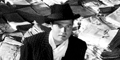
For the sake of argument, I'll use the post-election scene in Citizen Kane as a counterpoint. My (high school -- mostly senior) students would probably say that they aren't assaulted by Orson Welles' and Joseph Cotten's junk in Kane since the camera is at a further remove for most of that scene. I would take the high road and say that the extreme low angle in Kane helps show the emptiness and desolation of Kane's election headquarters as well as provide ironic commentary on his status at that point (just another example of how Kane alternates between looking small and looking huge throughout the film). I can't figure out what the hell Lang is doing with that shot in M. I remember on the DVD commentary that the two scholars had a bit of a discussion when that shot came up about what its purpose/effect might have been -- the DVD is at school so I can't check it but I recall not being satisfied with their guesses. Anyway, like the thread title says, it's a tiny flaw. I love the rest of the expressionistic style of the film.Cinetwist wrote:Wha..?? This shot (and many others) is exactly why I love this film. How is that a flaw but when Toland does the same thing with Ford and then Welles it's not? You should tell your students that's why the film's great....essrog wrote:In M, the seemingly unmotivated extreme low angle of Lohmann sitting and talking on the phone makes my students laugh, then utter a collective "ewwww!" every time.
-
HerrSchreck
- Joined: Sun Sep 04, 2005 3:46 pm
-
essrog
- Joined: Tue Nov 02, 2004 11:24 pm
- Location: Minneapolis, Minn.
I know that Lang called M a documentary, and that portions of it are rigorous in their attention to detail -- the police procedural scenes in particular. However, there are a lot of expressionist touches, too (at least in how I understand small-e expressionism) -- Bordwell cites the scene in which Beckert sees the reflection of a little girl encircled by knives in a shop window, and others I can think of off the top of my head include Beckert's shadowy introduction to Elsie Beckmann and the audience, the long passages with no ambient sound, and the extreme high/extreme low angle shots during the encounter between the harmless man on the street and the suspicious thug. Also, in his BFI monograph on M, Anton Kaes discusses Lang's "expressionist heritage" in his use of sound that helped show "the psyche's power to subjectivise and thus 'distort' the visible world."HerrSchreck wrote:"Expressionistic?"...
I'm gonna be a real douche bag and ask what you teach.
Neither Lang, nor this film, exhibit "expressionism", either in art direction, acting, or mise en scene... beyond the fact that film is art and therefore small-e expressive.
As for what I teach, it's a class called The Art of Film. M is part of a unit on social commentary (focusing on societies in chaos or crisis), along with The Battle of Algiers and Do the Right Thing. For each of the films, we talk about the director's distinct style, and how they go about portraying both sides of particular issues -- mob mentality and the death penalty in the case of M.
-
HerrSchreck
- Joined: Sun Sep 04, 2005 3:46 pm
-
essrog
- Joined: Tue Nov 02, 2004 11:24 pm
- Location: Minneapolis, Minn.
I understand that Expressionism (capital E) was done by the time M came out, but doesn't expressionism (small e) live on? Just as film noir is a historical movement that ended in the mid-1950s, but countless films since have incorporated elements that are unmistakably noir, even if the film itself can't be classified as film noir. I don't know -- I guess I see a difference between calling M an Expressionist film (which it isn't, and I didn't mean to suggest) versus an expressionistic film.
-
HerrSchreck
- Joined: Sun Sep 04, 2005 3:46 pm
Well that's the problem I have in general (and let me just publicly say for anyone reading this, essrog certainly has a lot of academia to back him/her up in the classroom with the loose appellation of expressionism, I'm in no way accusing sacrilege here... it's just a problem I have with the way the word is used when shadows and light interplay in a psychological way)... this idea that "psychologizing" the mise en scene is reminiscent of capital E Expressionism, thereby making vintage noir soaked with small e expressionism. It rubs the wrong way (at least it does me) and to me really and truly-- and I swear to god I mean this (and I'm not singling you out essrog)-- comes off as a mere attempt to help writers and professors in the attempt to maintain psychological control over the classroom of eyeballing kids, so they may sound like They Know What THey're Talking About by throwing around isms and schools of thinking from various eras, rather than saying "the guy made a fucking fantastic film and far be it from me to know where it came from.. inside the mans mind I guess,".
How is chiaroscuro or shadowplay, or psychologized mise en scene a hallmark of Expressionism? Expressionism was a superbrief and very extreme trend in the German Cinema, and its most signal hallmarks were carried out very often not by the director but by the actors and designers... extremely dominant art direction-- including costumes. This would follow since it was introduced to film from the visual arts. Expressionism was Wackyworld.. actors acted like jerky, strange automotons, the mood was one of disconnected strangeness, films from mars. Absolute unreality that is the opposite of the documentary style of M, and if anything the stimmung or mood of M-- in the interior worlds of cigar smoke and alchohol and low/hi characters echoing one-another-- resembles the world of the Kammerspiel more than it does the unreality of Expressionism.
Perfect examples of Expressionism are WAXWORKS, GENUINE, TORGUS, CALIGARI, BACKSTAIRS, DIE STRASSE, SCHATZ.
This whole idea of "making inner-states manifest in the outside world" as the recipe or "key" to expressionism would make the vast majority of not only cinema but all the art forms Expressionist. All forms of art have a motivation, and seek to express something.. but moreover and specifically, every time a camera begins to move in on a character to express his inner concentration... every time a scene of sadness is shot with low key lighting... every time a moment of excitement or kineticism sees a burst of rapid montage... every time music track mimics a heartbeat or ticking clock during moments of tension... every time a love scene takes place in soft gauzy light: every time we have a film that has a surface that changes in correspondance to the humanity portrayed onscreen.. we've got an expressionist film with a small e, which I think is just silly. Expressive is not Expressionism.
How is chiaroscuro or shadowplay, or psychologized mise en scene a hallmark of Expressionism? Expressionism was a superbrief and very extreme trend in the German Cinema, and its most signal hallmarks were carried out very often not by the director but by the actors and designers... extremely dominant art direction-- including costumes. This would follow since it was introduced to film from the visual arts. Expressionism was Wackyworld.. actors acted like jerky, strange automotons, the mood was one of disconnected strangeness, films from mars. Absolute unreality that is the opposite of the documentary style of M, and if anything the stimmung or mood of M-- in the interior worlds of cigar smoke and alchohol and low/hi characters echoing one-another-- resembles the world of the Kammerspiel more than it does the unreality of Expressionism.
Perfect examples of Expressionism are WAXWORKS, GENUINE, TORGUS, CALIGARI, BACKSTAIRS, DIE STRASSE, SCHATZ.
This whole idea of "making inner-states manifest in the outside world" as the recipe or "key" to expressionism would make the vast majority of not only cinema but all the art forms Expressionist. All forms of art have a motivation, and seek to express something.. but moreover and specifically, every time a camera begins to move in on a character to express his inner concentration... every time a scene of sadness is shot with low key lighting... every time a moment of excitement or kineticism sees a burst of rapid montage... every time music track mimics a heartbeat or ticking clock during moments of tension... every time a love scene takes place in soft gauzy light: every time we have a film that has a surface that changes in correspondance to the humanity portrayed onscreen.. we've got an expressionist film with a small e, which I think is just silly. Expressive is not Expressionism.
-
skuhn8

- Joined: Tue Dec 14, 2004 8:46 pm
- Location: Chico, CA
Pre-WWII German film? Let's look for indications of Expressionism. Such a specific and well-defined movement in the history art becomes simplified as: Filmmaking that draws attention to itself.
Pre-1960's American film? Let's look for the noirish elements. Shadow play and a dame of questionable morality...oh, and if there is private dic or law enforcement character BAMM there it is.
This isn't meant to cap on anyone, but it is interesting to hear how certain buzzwords are used to help pigeon hole such diverse films.
Pre-1960's American film? Let's look for the noirish elements. Shadow play and a dame of questionable morality...oh, and if there is private dic or law enforcement character BAMM there it is.
This isn't meant to cap on anyone, but it is interesting to hear how certain buzzwords are used to help pigeon hole such diverse films.
-
colinr0380
- Joined: Mon Nov 08, 2004 8:30 pm
- Location: Chapel-en-le-Frith, Derbyshire, UK
I agree, shouldn't the correct response, if one is needed, be one of awed silence? (!) Terry Wogan had the same troubles earlier this year and surely it only enhanced his reputation!davidhare wrote:I can only add I always admired (from early childhood) the "airing the basket" shot of Lohmann. And it's also a great clean text where Lang in a way merely states the obvious.
These little treasures are all too rare, even with great directors, and I personally vouch for the idea of burning the knickers! If you're built, at all, any which way - let it hang brother!

-
MichaelB

- Joined: Fri Aug 11, 2006 10:20 pm
- Location: Worthing
- Contact:
Er... I think you'll find the jury's still out on that one, Colin!colinr0380 wrote:Terry Wogan had the same troubles earlier this year and surely it only enhanced his reputation!
-
essrog
- Joined: Tue Nov 02, 2004 11:24 pm
- Location: Minneapolis, Minn.
Schreck, you make a lot of excellent points in your thoughtful reply. I will readily admit I haven't seen many examples of Expressionist films -- it's an area I've been meaning to familiarize myself with for awhile. If I had seen more, it's possible I would see these mentions of expressionism in the academic sources I use to study M and dismiss them. That's what's happened with film noir, a style I'm much more familiar with, and one I'm much more comfortable saying "No" to when a student asks, "Is such-and-such a film noir?"
I'll also cop to not really equating little-e expressionism with capital-E Expressionism in my mind. I've often used "expressionistic" as a synonym for "unrealistic" without really thinking of the origin of the word. I'd like to think I'm not guilty of playing the I Know What I'm Talking About card when I do that -- hell, too many students are too busy bitching that they're watching a black-and-white subtitled movie to notice what words I'm throwing around -- but I will now reconsider my use of that term.
I'll also cop to not really equating little-e expressionism with capital-E Expressionism in my mind. I've often used "expressionistic" as a synonym for "unrealistic" without really thinking of the origin of the word. I'd like to think I'm not guilty of playing the I Know What I'm Talking About card when I do that -- hell, too many students are too busy bitching that they're watching a black-and-white subtitled movie to notice what words I'm throwing around -- but I will now reconsider my use of that term.
-
HerrSchreck
- Joined: Sun Sep 04, 2005 3:46 pm
Anyhow, I'm glad we got through that without me accidentally insulting you by saying something abrasive. As I said, you're definitely not alone with this assignation of the Expressionist label.. but I do think if you make a point of seeing some of the films mentioned (many of which are available in some form or another of home video throughout the regions) you'll begin to immediately note the quality that makes expressionism Expressionism. Psychological mise en scene and chiaroscuro have been around since the early/mid-teens i e Italians and Russia (Bauer), Sweden, France (Impressionists in particular) as well as the Soviet avant garde.
And you'd really distinguish yourself as a professor to move against the academic grain and make it a point to see to it that your kids walk out of there not perpetuating such myths (Lang would turn over in his grave hearing the Expressionist tag applied to him... he thought it was faddy bokum.. although some of the decor in the first Mabuse, as well as Destiny flirt w some elements of expressionism). The time is ripe for a scholarly piece of work regarding the silent era in general, correcting a lot of the myths that existed mid-century thru the 80's, based on a desert of information and films then-thought lost now recovered due to cooperating archives, and films re-assembled to their proper length (Langs silents are notorious). Several volumes could be devoted to the German silent era alone.
Back to the Lohmann shot in M, I think it's a great shot.. specifically because so many people cannot "peg" it for it's purpose or intention. That's what poetry is, though in this case it's hard-boiled, gritty and wiped out. Which is what I see there in that shot-- Lohmann's complete flabbergasted state at that phase of the investigation, his rumpled nature, and the shot of his balls to me communicates his a) exposure to possible failure, and b) the huge size of his balls in the symbolic and literal front, promising that even blasted and exhausted as he is, he will not give up.. like some nuclear schnauzer from hell in the form of a detective. I don't see it as a "symbolic" shot per-se, but that's what gets across. It totally distills the essence of the Lohmann character right there. Rumpled, big-sacced, masculine, vulnerable to the ball-crushing nature of his work (at which we are voyeuristically peeking via the most minute and complete details), old, fat, and snarling. And funny too.
And you'd really distinguish yourself as a professor to move against the academic grain and make it a point to see to it that your kids walk out of there not perpetuating such myths (Lang would turn over in his grave hearing the Expressionist tag applied to him... he thought it was faddy bokum.. although some of the decor in the first Mabuse, as well as Destiny flirt w some elements of expressionism). The time is ripe for a scholarly piece of work regarding the silent era in general, correcting a lot of the myths that existed mid-century thru the 80's, based on a desert of information and films then-thought lost now recovered due to cooperating archives, and films re-assembled to their proper length (Langs silents are notorious). Several volumes could be devoted to the German silent era alone.
Back to the Lohmann shot in M, I think it's a great shot.. specifically because so many people cannot "peg" it for it's purpose or intention. That's what poetry is, though in this case it's hard-boiled, gritty and wiped out. Which is what I see there in that shot-- Lohmann's complete flabbergasted state at that phase of the investigation, his rumpled nature, and the shot of his balls to me communicates his a) exposure to possible failure, and b) the huge size of his balls in the symbolic and literal front, promising that even blasted and exhausted as he is, he will not give up.. like some nuclear schnauzer from hell in the form of a detective. I don't see it as a "symbolic" shot per-se, but that's what gets across. It totally distills the essence of the Lohmann character right there. Rumpled, big-sacced, masculine, vulnerable to the ball-crushing nature of his work (at which we are voyeuristically peeking via the most minute and complete details), old, fat, and snarling. And funny too.
-
Kinsayder

- Joined: Mon Oct 10, 2005 10:22 pm
- Location: UK
-
Joe Buck

- Joined: Mon Dec 05, 2005 10:59 pm
- Location: New York
-
fiddlesticks

- Joined: Fri Sep 21, 2007 12:19 am
- Location: Borderlands
Casablanca: The trumpet player in Rick's (or Sam's) band is so filled with patriotic zeal that he manages to begin to play La Marseillaise before the trumpet reaches his lips. Every time I see this, I think "if only you don't look at Rick for his approval, you'll get that horn up in time!" but he never does.
Eyes Wide Shut: After wandering through the orgy, something finally captures Bill's attention, and he stops. Behind him a masked and caped figure stealthily approaches with a naked Amazon. Suddenly the Amazon is replaced with a replicant Amazon, who then approaches Bill. As both women are entirely naked, points of differential are easy to spot (no pun intended), but since they are identically masked, I guess Kubrick figured we wouldn't notice; he wasn't counting on the liberal use of the PAUSE button in this section of the home video version of his film. =P~
Eyes Wide Shut: After wandering through the orgy, something finally captures Bill's attention, and he stops. Behind him a masked and caped figure stealthily approaches with a naked Amazon. Suddenly the Amazon is replaced with a replicant Amazon, who then approaches Bill. As both women are entirely naked, points of differential are easy to spot (no pun intended), but since they are identically masked, I guess Kubrick figured we wouldn't notice; he wasn't counting on the liberal use of the PAUSE button in this section of the home video version of his film. =P~