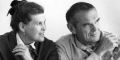
Bernard Herrmann

Discuss individual directors, actors, cinematographers, writers, and more
Post Reply
Message
Author
User avatar
Scharphedin2
Joined: Fri May 19, 2006 11:37 am
Location: Denmark/Sweden

Bernard Herrmann

#1 Post by Scharphedin2 »

Bernard Herrmann (1911-1975)

Image

I count myself an individual. I hate all cults,
fads and circles. I believe that only music that
springs out of genuine personal emotion and
inspiration is alive and important.


Filmography

Citizen Kane (1940)

The Devil and Daniel Webster (1941)

The Magnificent Ambersons (1942) Uncredited.

Jane Eyre (1944)

Hangover Square (1945)

Anna and the King of Siam (1946)

The Ghost and Mrs. Muir (1947)

Portrait of Jennie (1948) Theme adapted by Dmitri Tiomkin. Uncredited.

The Day the Earth Stood Still (1951)

5 Fingers (1952)

On Dangerous Ground (1952)

The Snows of Kilimanjaro (1952)

Beneath the 12-Mile Reef (1953)

King of the Khyber Rifles (1953)

The White Witch Doctor (1953)

Garden of Evil (1954)

The Egyptian (1954) Collaboration with Alfred Newman.

Prince of Players (1954)

The Trouble with Harry (1955)

The Kentuckian (1955)

The Man Who Knew Too Much (1956)

The Man in the Grey Flannel Suit (1956)

The Wrong Man (1956)

Williamsburg: the Story of a Patriot (1957)

A Hatful of Rain (1957)

The Naked and the Dead (1958)

The Seventh Voyage of Sinbad (1958)

Vertigo (1958)

Blue Denim (1959)

North by Northwest (1959)

Journey to the Centre of the Earth (1959)

Psycho (1960)

The Three Worlds of Gulliver (1960)

Mysterious Island (1961)

Cape Fear (1962)

Tender is the Night (1962)

The Birds (1963) Sound Consultant.

Jason and the Argonauts (1963)

Marnie (1964)

Joy in the Morning (1965)

Torn Curtain (1966) Rejected score.

Fahrenheit 451 (1966)

The Bride Wore Black (1967)

Twisted Nerve (1968)

The Battle of Nerevta (1969)

The Night Digger (1971)

Endless Night (1971)

Sisters (1973)

It’s Alive (1974)

Obsession (1976)

Taxi Driver (1976)


Forum discussion

Interesting comments here: Gary Cooper: the Signature Collection
Plus many brief references in the relevant film threads.

Web articles

The Trouble with Benny

Herrmann and Hitchcock: The Torn Curtain

A discussion of the musical language of Bernard Herrmann

North by Northwest: A Case Study of the Bernard Herrmann Style

Bernard Herrmann as Musical Colorist: A Musico-Dramatic Analysis of his Score to The Day the Earth Stood Still

Film Score Rundowns: Herrmann

Supernatural Dreams: Bernard Herrmann on film music

Books

A Heart at Fires Centre: The Life and Music of Bernard Herrmann – Steven C. Smith (University of California Press, 2002)

Bernard Herrmann: Film Music and Narrative - Graham Donald Bruce (Umi Research Pr, 1988)

Bernard Herrmann’s ‘Vertigo’: a Film Score Hand Book – David Cooper (Greenwood Press, 2001)

Bernard Herrmann’s ‘The Ghost and Mrs. Muir’: a Film Score Guide – David Cooper (Scarecrow Press, 2005)

Overtones and Undertones: Reading Film Music – Royal S. Brown (University of California Press, 1994)

_________________________________________________
*This thread compiled and submitted by forum member Rowan
User avatar
Rowan
Joined: Tue Nov 20, 2007 3:05 am
Location: Liverpool, UK

#2 Post by Rowan »

An obvious place to start perhaps, but I thought I’d share a few thoughts on Herrmann’s music for Vertigo, as it never fails to astound me - was a score ever so in tune with the meaning and sensual surface of a film?!

Like much of his other music for Hitch (eg the shower shrieks/stabs in Psycho, of course) the inspired title prelude works as both a ‘representation’ and an ‘abstraction’. The opening ostinato figure thematicises the attraction/repulsion psychosis of the film before we even begin - two mirror-image chords, swirling in contrary motion. This characteristic ambiguous tonality (sometimes referred to as the ‘Hitchcock chord’) is used whenever we get the zoom-in dolly-out and plunging perspectival shots. It’s developed from its original patterned form to give the effect of two chromatically adjacent keys superimposed, accompanied by frenzied harp glissandi (compare this with Taxi Driver).

The love theme grinds into view during the titles as well in the brass, though it’s barely recognised as such amid the restless, undulating main figure. One of my favourite scenes (of many!) in the film is the first glimpse of Madeleine at Ernie’s. Listen to how carefully Herrmann treads around the love theme, without stating it. How incredible is it that the music seems like an extension of the gliding camera moves, and the colour, and the lighting! The same suggestive material is repeated and extended in extremely high registered strings, underpinned by low-humming bass clarinets, during the visit to the graveyard; so high as to be both uncomfortable and beautiful, almost supernatural. The love motif only fully blossoms during Scotty and Madeleine’s first ‘wandering’ together. ‘Motif’ is perhaps better as it’s not at all a fully-fledged melody in the sense we might expect. As always with Herrmann, it’s as spare as it could be - two falling suspensions that suggest erotic release and loss of conscious. This material reaches some kind of manic, sensual apotheosis in the climactic ‘resurrection’ scene (how many climaxes do we get in this film!), complete with Wagnerian tremolo. In fact in the later portion of the film, as it builds to the fantasy recreation, the music takes on more and more of a waltzy character, allowing it to spin with the camera and enclose the characters.

The other significant component of the score is the nagging habanera rhythm and its attendant creeping harmonies, associated with Carlotta. Listen to the violent octave leaps that are worked into this during the nightmare sequence (if there is better nightmare music in a film, I’ve yet to hear it). Very moving too are the subtle high string variations on the Carlotta harmonies that play over Judy’s narration of her confessional letter, and the upward shift to her final resolve.

Midge has always seemed to me to absolutely essential - the pathos of the story is with her really, and she indirectly communicates its tragedy. She is the unglamorous ‘real world’ - emphasised hilariously (and self-consciously) by her self-portrait. She’s associated therefore with diegetic music, with Mozart, that curiously Scotty says gives him a ‘dizzy spell’. He wants it turned off. Her Mozart isn’t the ‘broom that sweeps the cobwebs away’ after all. The early love music does share some of the elegant, airy feeling of the Mozart, though the harmonies are much more Romantic (French even?). Later waltz-like variants, despite their crazed, obsessive qualities, are daintily ornamented in a very Classical way too. The only time (from memory at least) that Midge is accompanied by Herrmann’s ‘psychological’ music is her final moment in the film: as she walks down the corridor in despair, enclosed by the darkness, double basses alone play a mournful vocalise. This truly is amazing film scoring!

A final point: compare the powerful triumphant horn call of the love motif and the major cadence that closes the film to the dissonant convulsions that are the final notes of Psycho. The ‘resolution’ in the music as Scotty stands over the abyss is almost more terrifying. Is it ironic? It’s not that simple. This is a dark fulfilment, but it can’t be experienced so easily. By this point, what has become of Scotty? He’s been obliterated as well, but is left suspended - but the music denies him both!
User avatar
dave41n
Joined: Fri Jan 13, 2006 4:17 am
Location: CO

#3 Post by dave41n »

Excellent analysis. A joy to read. I think you're dead-on in calling sections of Herrmann's music in Vertigo "psychological". Herrmann's score has always felt maze-like to me, mirroring the psychological complexity of Scottie's character (maze of the mind, if you will). Beyond Vertigo and Psycho (which are beyond incredible to me), North by Northwest may be my favorite of his scores. It's a tour de force score -- more repetition than variation -- where Herrmann takes a short motif (which is totally in line with the film) and runs with it. I love the drums and the mania of it. What great scores this man created. I'm currently reading A Heart at Fire's Center: The Life and Music of Bernard Herrmann and, while only half-way through it, I am comfortable in recommending it to those interested in the man and his work.
Post Reply