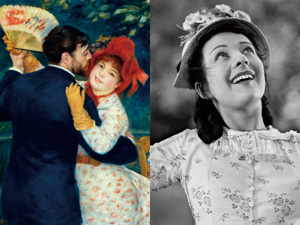
28 Toni

Discuss releases by Eureka and Masters of Cinema and the films on them
Message
Author
User avatar
tryavna
Joined: Wed Mar 30, 2005 8:38 pm
Location: North Carolina

#51 Post by tryavna »

skuhn8 wrote:I definitely would like to save you the bother of trying to get into him via the flaccid entry called La Marseillaise (I'm trying to be generous but GODDAMN did this movie kill me). If his other mid- late- thirties work like Grand Illusion, Lower Depths, Rules of the Game, Partie de Campaigne, Bete Humaine don't pull you in I don't think any of his stuff will.
HerrSchreck wrote:La Marsellaise is good imho, but is subpar versus Regle, Illusion, Lange, Bete Humaine, etc. I honestly don't know where Scorsese is coming from in his huge admiration for the film-- if I recall correct he called it in his opinion the greatest historical film ever made(!). It's a good film, but suffers from some serious klunkiness at times. And those wigs! Even Coco couldn't rescue that with rampant solid costumery.
The reason I suggest La Marseillaise is precisely because it is unlike most of the rest of Renoir's 1930s work. It's not like Toni per se, but the fact that MK has expressed a "contrarian" viewpoint (for lack of a better word) means that he might make more of La Marseillaise than most Renoir fans normally do.

BTW, I happen to like La Marseillaise a lot. I wouldn't go quite as far as Scorsese does, but I think it's a remarkable film. In a sense, it's "contrarian" too: a non-sweeping non-epic, history from a snail's-eye perspective, etc. If I wanted to go a bit further, I might even suggest that it points ahead to the work of Peter Watkins, though in very nebulous form (e.g., no direct interaction between the actors and the camera). But Renoir is most definitely attempting to deflate the conception of history as a grand narrative created by great men. Rather, it's extremely messy, ambiguous, collectively shaped, and entirely conditional -- like the film itself.

If nothing else, the Lionsgate set, which isn't that expensive of an investment, gives a viewer an easy chance to jump around Renoir's career.
User avatar
HerrSchreck
Joined: Sun Sep 04, 2005 3:46 pm

#52 Post by HerrSchreck »

tryavna wrote:The reason I suggest La Marseillaise is precisely because it is unlike most of the rest of Renoir's 1930s work [...] MK has expressed a "contrarian" viewpoint (for lack of a better word) means that he might make more of La Marseillaise than most Renoir fans normally do.
You got me there. I confess I actually thought the same thing. Up/down-black-white etc.
User avatar
HerrSchreck
Joined: Sun Sep 04, 2005 3:46 pm

#53 Post by HerrSchreck »

davidhare wrote:I really wish you guys would stop trying to see Renoir's Les Bas Fonds in the context of the Kurosawa. I consider it central 30s Renoir and my view of that decade is that his entire work through it towers over almost eveything else in cinema.
Speaking personally I'm not trying to see Bas Fonds in the context of the Kuro, but in the context of the source material as a starting point... but as in all workings/reworkings (notwithstanding the liberties taken w the material by Ren) of classic material, comparisons are inevitable. Even Renoir couldn't resist, and confess the shortcomings of his film in and of itself, and also in comparison to the later Kurosawa.

I came to the CC entirely prepared to see the Renoir as the superior work, but the film just didn't work as a whole despite the nice moments between Jouvet & Gabin. And whereas rewatching the Kuro made the film get better and better, the Ren just sat there, limp and partially annoying. Dave you must admit the film suffers from absolutely awful casting, particularly in the female dept.
User avatar
zedz
Joined: Sun Nov 07, 2004 11:24 pm

Kobayashi

#54 Post by zedz »

EDIT: duh!
User avatar
Michael Kerpan
Spelling Bee Champeen
Joined: Wed Nov 03, 2004 5:20 pm
Location: New England
Contact:

#55 Post by Michael Kerpan »

Lower Depths is by Gorky. ;~}

I know I'll drive you nuts, but I just don't care all that much for the actors (or their acting style or whatever) you love so much. ;~{

I simply see them as "actors" -- not as representations of reflections of anyone "real" (even "for pretend" real).
User avatar
ellipsis7
Joined: Tue Nov 02, 2004 5:56 pm
Location: Dublin

#56 Post by ellipsis7 »

LA MARSEILLAISE is IMHO a wonderful film, daring and inspired, if sometimes flawed, in its focus on a series of personal stories which play out against the larger historical background... And all these characters are real and rounded, even the detested king and queen....

LA VIE EST A NOUS is indeed a somewhat clunky and crude piece of propaganda, but the ideas therein feed into dramatic form in the following films, including LES BAS-FONDS, but most especially LA GRANDE ILLUSION, LA MARSEILLAISE and LA REGLE DU JEU... So to witness Renoir's genius see how from the amateurishly staged scene of the bourgeoisie laughingly take pots shots at cutout targets of the proletariat (complete with flat caps) in LA VIE EST A NOUS, Renoir transforms and translates the basic idea into something as sublime, superb, sophisticated and ultimately simple as the shoot sequence in LA REGLE DU JEU... For me - overwhelming!... And isn't Bazin's book wonderful - I was just reading the entry on Madame Bovary (by Rohmer) this week...

What sets Renoir's work above all others, it bears constant revisiting, whence it reveals new depth after new depth... I mentioned how I have come to really like LES BAS FONDS and rate it highly, after first finding it 'minor' Renoir...

As regards, LA MARSEILLAISE, it is as much an historical piece as a film about France in 1937, and the looming threat of Hitler and fascism... It was funded through the leftist Popular Front through public subscription... Renoir worked long and hard to distil the characters and episodes he wished to focus on... I have, in early treatment form a scenario of the film outlining 12 episodes, the script and production evolution can then be followed through Renoir's articles mainly in 'Ce Soir' where he expands his thoughts and relates stories from the making (all these in 'Persistence of Vision - Politics and Cinema of Jean Renoir', 1996).... While 'L'Avant Scene Cinema 383-384', devoted to LA MARSEILLAISE, gives us the script complete with fascinating versions of deleted, unfilmed, edited and extended scenes... Suddenly the process of putting together this film becomes alive... Then 'Cinema et Son No 268 - Il y'a 35 ans La Marseillaise', 1973, brings together a remarkable collection of contemporary documents concerning the production and exhibition of LA MARSEILLAISE, and highlights the poltical controversy surrounding the film from its inception, and the extent of Renoir's political commitment... 2 contemporary interviews confirm Renoir deliberately sought correspondences between his film and the political crisis in the late thirties... There are attacks on the film from from the right, and the left, and Renoir's aggrieved reply in print to the latter, bitterly disillusioned by their lack of solidarity. Renoir is also quoted as saying that Carne & Prevert's QUAI DES BRUMES was fascist propaganda...

Sometimes the rounded amiable humanist persona that Renoir projected in later life, including through Cahiers du Cinema, obscurs that he was at heart quite a political firebrand...
User avatar
MichaelB
Joined: Fri Aug 11, 2006 10:20 pm
Location: Worthing
Contact:

#57 Post by MichaelB »

ellipsis7 wrote:Sometimes the rounded amiable humanist persona that Renoir projected in later life, including through Cahiers du Cinema, obscurs that he was at heart quite a political firebrand...
...something the strongly left-wing Le Crime de Monsieur Lange makes equally clear.

That said, Renoir being Renoir, arguably the most fully rounded and certainly the most immediately likeable character is the evil capitalist Batala, as incarnated so magnificently by Jules Berry: most left-wing propagandists would have gone for a much more caricatured treatment, and the film would have been all the lesser for it.
User avatar
ellipsis7
Joined: Tue Nov 02, 2004 5:56 pm
Location: Dublin

#58 Post by ellipsis7 »

MichaelB wrote:
ellipsis7 wrote:Sometimes the rounded amiable humanist persona that Renoir projected in later life, including through Cahiers du Cinema, obscurs that he was at heart quite a political firebrand...
...something the strongly left-wing Le Crime de Monsieur Lange makes equally clear.

That said, Renoir being Renoir, arguably the most fully rounded and certainly the most immediately likeable character is the evil capitalist Batala, as incarnated so magnificently by Jules Berry: most left-wing propagandists would have gone for a much more caricatured treatment, and the film would have been all the lesser for it.
Berry - Batala, superb performance - great character, and later in the film disguised as the creepy priest, brilliant!...

And while he stands out, he is exceptional but not overwhelming - all the characters live and breathe equally in M. LANGE... Part of the key to the film is the set built round the courtyard where Renoir's climactic flourish - the 360 degree pan which sees through the windows Lange leave the office, walk through the composing room, down the stairs, into the yard, leaving him while the lens circles round by the laundry, concierge's apartment, past the entrance from the street before finding Lange again,advancing to shoot Batala by the fountain.... The camera move and the set expresses the idea that it is the community who kills Batala, not the individual, Lange... Perhaps it is not coincidental that, while Jacques Prevert wrote the screenplay, the original scenario was composed by Renoir and the Set Designer Jean Castanier....
User avatar
Michael Kerpan
Spelling Bee Champeen
Joined: Wed Nov 03, 2004 5:20 pm
Location: New England
Contact:

#59 Post by Michael Kerpan »

davidhare wrote:
I simply see them as "actors" -- not as representations of reflections of anyone "real" (even "for pretend" real).
Well, that's a start to understanding Renoir.

Michael I'm not trying to be offensive, I am completely serious.
Nothing to offend here.

The problem is that I don't _like_ this sort of approach to film making.

I am turned off by most pre-New Wave French cinema in much the same way that I am put-off by most pre-Impressionist 19th C. French painting.

Maybe some people have the capacity to respond strongly to every sort of "great art" imaginable. I do not. I can only assume that some great works are outside the artistic wavelengths I perceive. Consequently, it was an unexpected pleasure to discover that Toni _was_ in my visible range.
User avatar
ellipsis7
Joined: Tue Nov 02, 2004 5:56 pm
Location: Dublin

#60 Post by ellipsis7 »

[quote="Michael KerpanI am turned off by most pre-New Wave French cinema in much the same way that I am put-off by most pre-Impressionist 19th C. French painting. [/quote]

Not to labour the point but Jean Renoir can be considered the filmic equivalent of Impressionist painting, much as he can be equated and compared with his father's work (and wrote himself 'Renoir, My Father')...

See this shot giving the idea of the Cinematheque Francaise's RENOIR-RENOIR exhibition in 2005...

The film clip projected on the wall on the near right is ELENA ET LES HOMMES (1956), on the wall beside it is Pierre-Auguste Renoir's actual canvas 'Ball at the Moulin de la Galette, Montmartre' (1876), and the background I think a scene from FRENCH CAN CAN (or is it LE CAROSSE D'OR?)... You get the idea anyway...

Image
User avatar
Michael Kerpan
Spelling Bee Champeen
Joined: Wed Nov 03, 2004 5:20 pm
Location: New England
Contact:

#61 Post by Michael Kerpan »

I can't think of a single director I was more pre-disposed to like than Jean Renoir. Even so.... ;~{

Toni reminds me much more of the work of Camille Pissaro than of Renoir pere.
User avatar
ellipsis7
Joined: Tue Nov 02, 2004 5:56 pm
Location: Dublin

#62 Post by ellipsis7 »

Michael Kerpan wrote:I can't think of a single director I was more pre-disposed to like than Jean Renoir. Even so.... ;~{

Toni reminds me much more of the work of Camille Pissaro than of Renoir pere.
Fair enough... Each to their own etc...

More pics juxtaposed...

Image

LE DEJEUNER SUR L'HERBE (1959)

Image

ETUDE (1875)

Image

And to show what a modernist influence Renoir Senior was - from Picasso's personal private collection of 7 Renoirs...

Image

P-A Renoir (1895-6)

Which influenced this Picasso painting (1921)...

Image

While a recent exhibition at National Gallery London highlighted the lesser known Renoir landscape work...

Image

The Harvesters (1873)

Image

The Wave (1879)

Image

Les Grands Boulevards (1875)
User avatar
Michael Kerpan
Spelling Bee Champeen
Joined: Wed Nov 03, 2004 5:20 pm
Location: New England
Contact:

#63 Post by Michael Kerpan »

Not a fan of late (Pierre Auguste) Renoir at all. But I do like much of his earlier work (with the exception of ghastly things like the Woman in the Red Kimono -- which resides here in Boston, I believe).
Last edited by Michael Kerpan on Thu Jun 12, 2008 3:58 am, edited 1 time in total.
User avatar
GringoTex
Joined: Wed Nov 03, 2004 9:57 am

#64 Post by GringoTex »

Michael Kerpan wrote:I am turned off by most pre-New Wave French cinema in much the same way that I am put-off by most pre-Impressionist 19th C. French painting.
My quibble with this is that Renoir has nothing to do with any other pre-New Wave cinema. He was the first to film "the actors" rather than "the characters" and the New Wave followed suit: Godard, Truffaut, Chabrol -- they filmed actors.

This is why Renoir was the first modernist filmmaker.

I also think Ozu only filmed actors in his later years.
User avatar
HerrSchreck
Joined: Sun Sep 04, 2005 3:46 pm

#65 Post by HerrSchreck »

Totally agree, Gringo.

Not to mention this is also one of the legion reasons that the Vague worshipped Renoir.

I never understand these "I don't like pre (date) (country) cinema" generalizations, since most national cinemas worth anything (nothwithstanding the incredible vitality and robust variegation and inventiveness of French cinema from the late teens thru the late 50's) are incredible diverse and always resist descriptives like "French cinema prior to (date) was primarily __________." Not to mention the fact that most "inventions" of so many Revolutionary Film Movements are red herrings and albatrosses that were probably old news by the year 1929, but no later than 1939.

Gringo-- what did you mean by "the first to film actors"? I think I know what you mean but I just want to hear for sure what you mean.
User avatar
ellipsis7
Joined: Tue Nov 02, 2004 5:56 pm
Location: Dublin

#66 Post by ellipsis7 »

A couple of points re father & son, regardless of how you like the elder's paintings...

Pierre-Auguste encouraged the young Jean to become a potter - I've seen several of JR's pots - it was not a career he was going to excel in, but it was an initial mode of artistic expression, and an exploration of creativity....

The paintings JR inherited from his father literally paid for JR's first films - he sold them off first piecemeal, and then in quantities to pay for the commercial disaster and indulgence of his wife that was NANA - squandering his inheritance?... I think not...

JR's first wife Catherine Hessling was his father's model, and that's how he met her. In 1917 she was 17 and modelling at the Academie de Peinture at Nice. Matisse asked the Academie to send him a young female model, and Dedee (Catherine) was sent to him. Matisse took one look at her and said, "You're a Renoir", and told her to visit Auguste Renoir at Les Collettes on his behalf. Renoir pere saw a likeness to his recently deceased wife, and took her on. Jean & Dedee married in January 1920 just 7 weeks after his father's death in December 1919.

The book JR wrote at the end of his career, RENOIR, MY FATHER can be read as his own artistic manifesto as well as a memoir of Renoir pere... Certainly his father was a major influence in the manner in which JR engaged artistically with the world, his down to earth approach and focus on the quotidien...

"I have spent my life trying to determine the extent of the influence of my father upon me, passing over the period when I did utmost to escape from it to dwell upon those when my mind was filled with precepts I had gleaned from him." - JR, 'My Life & Films', 1974


On the other point, influence on the French New Wave etc., a key post 1968 text, is the passionately a politically committed book by Francois Poulle, 'Renoir 1938 ou Jean Renoir pour rien?' (1969)... Final page is a pic of Godard with Renoir with the quote, "Les personnes formees cinematographiquement le sont rarement politiquement, et vice versa" - JLG , 1967
User avatar
ellipsis7
Joined: Tue Nov 02, 2004 5:56 pm
Location: Dublin

#67 Post by ellipsis7 »

Lovely story, David, very funny indeed... I must remember that, "Don't look at the fuckface..."
User avatar
Michael Kerpan
Spelling Bee Champeen
Joined: Wed Nov 03, 2004 5:20 pm
Location: New England
Contact:

#68 Post by Michael Kerpan »

I can't claim to understand my lack of "sympathy" for pre-NW French cinema. It is just something that happens to exist. I don't make any real attempt to justify it. I f asked for an explanation, I will say what I can -- but even I know that my answer is partial (at best). (yes -- I know that JR is different from his contemporaries -- which was why I had higher hopes of liking his work).

The mystifying thing about JR is that I really do like HIM. I love his performance in Rules, I love listening to his interviews. And yet -- so far -- none of his films (other than Toni) have really resonated. It is not only a mystery -- but an annoyance.
User avatar
MichaelB
Joined: Fri Aug 11, 2006 10:20 pm
Location: Worthing
Contact:

#69 Post by MichaelB »

ellipsis7 wrote:The paintings JR inherited from his father literally paid for JR's first films - he sold them off first piecemeal, and then in quantities to pay for the commercial disaster and indulgence of his wife that was NANA - squandering his inheritance?... I think not...
As a footnote to this, he sold the paintings but kept the empty frames, which remained hanging on his wall as a reminder of what he'd sacrificed for his career.

Fortunately, in his case, it was well worth it.
Jonathan S
Joined: Sat Jun 07, 2008 7:31 am
Location: Somerset, England

#70 Post by Jonathan S »

HerrSchreck wrote:And Mike I totally agree w you-- the Kurosawa Lower Depths is imho endlessly superior film versus the Renoir
Oddly enough, for me it's the other way round. I love the Renoir and find the Kurosawa almost unwatchable (the only other Kurosawa I feel that way about is Dodeskaden).

I suppose it's because I got to know the earlier version in the 1970s in the context of other Renoirs (I don't even think of it as a Gorky adaptation!) I recall the BBC televising it twice, the second time in the massive Renoir retrospective after he died in 1979. The films were shown at peak time and the season was so long and comprehensive there were jokes in satirical TV shows and mags on the lines of: "Tonight, a very special event on BBC2: a film not directed by Jean Renoir..."

Unimaginable in the world of today's television, sadly....
User avatar
Saarijas
Joined: Sun Sep 03, 2006 7:03 pm
Location: CT

#71 Post by Saarijas »

tavernier wrote:Jones and Lopate together must be audio commentary hell.
While I'm not a huge fan of the commentary on this disc; knowing Lopate personally. He is really an entertaining guy and isn't condescending at all. He really is perfect for conversation cause he knows everything about everything, btu will talk about it at whatever level is required of him. No matter how relatively simpleton the subject is. Really a cool guy, I had higher hopes for the commentary.
User avatar
ellipsis7
Joined: Tue Nov 02, 2004 5:56 pm
Location: Dublin

#72 Post by ellipsis7 »

Saarijas wrote:While I'm not a huge fan of the commentary on this disc; knowing Lopate personally. He is really an entertaining guy and isn't condescending at all. He really is perfect for conversation cause he knows everything about everything, btu will talk about it at whatever level is required of him. No matter how relatively simpleton the subject is. Really a cool guy, I had higher hopes for the commentary.
I actually like the commentary here and the hidden egg supplement... Sometimes they stretch the bubble a little too far (too many other names, cross references and analogies which actually are quite stimulating) but it is clear when and they return soon to topic which is informative, informed and provoking - they do know their stuiff.. Only glaring error - JR was born in 1894 not 1888/89 as insisted by I think Kent Jones...
User avatar
HerrSchreck
Joined: Sun Sep 04, 2005 3:46 pm

Re: 28 Toni

#73 Post by HerrSchreck »

So according to Geoff Andrew on his vidpiece, one of Ren's early sound films that preceded Toni was-- along with La Chienne, Madame Bovary-- N a n a?

Ouch. #-o
User avatar
Drucker
Your Future our Drucker
Joined: Wed May 18, 2011 1:37 pm

Re: 28 Toni

#74 Post by Drucker »

According to DVDBeaver, this is Region 0. Doesn't that mean Universal? According to amazon.uk it's Region 2. Does anyone know what it actually is?
peerpee
not perpee
Joined: Tue Nov 02, 2004 7:41 pm

Re: 28 Toni

#75 Post by peerpee »

Never go off Amazon for any information. 9 times out of 10 it's wrong. DVDBeaver isn't always correct, but 9 times out of 10 it is!

TONI is R0, region-free, but it's a PAL disc. So if you're not in a PAL territory, make sure you can play PAL!
Post Reply