25 Vampyr

Discuss releases by Eureka and Masters of Cinema and the films on them
Message
Author
User avatar
Tommaso
Joined: Fri May 19, 2006 2:09 pm

#301 Post by Tommaso »

ltfontaine wrote: Vampyr is drained of the strong, subtle undercurrent of eroticism that runs through so many of Dreyer’s other films, I think for the reason you suggest—that it denatures the proceedings, makes them less recognizably human, less permeable to analysis.
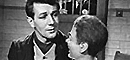
If you concede this, I'm surprised about your dislike of Ginzburg in the film. I would indeed agree with anyone who describes his playing as "suitably blank", and if you say that Dreyer took care that the faces of his actors are in tune or expressive of the quality of the character they embody, I would argue that this is true of Ginzburg here, too. We do not learn much about Allan Gray's background and motivations, though we can guess that he's someone who investigates the occult arts;I don't remember now whether this is expressedly said in the film or not. But all in all, he is an 'empty' character to whom things just HAPPEN, and who, as Sloper argues above, stays calm and comparatively passive throughout the film. This is nicely expressed in the 'etherial' quality of his face, and this 'etherial' quality only adds to make him "less recognizably human" and "less permeable to analysis", i.e. it just underlines the general tone of the film.
ltfontaine wrote:Dreyer effectively neutralizes the potential for romantic chemistry between Allan and Gisele to the extent that the denouement in the forest feels oddly perfunctory, even ironic—although it’s hard to say whether another actor in the lead role might have altered this.
I don't think another actor would have changed the impact. I don't believe it is meant to be ironic, but it is an attempt to continue the dream-like quality of the film, as if the dream isn't over although Chopin and the doctor are gone. The world of "Vampyr" remains haunted by transcendent forces, though perhaps now of a different kind. But there's no re-establishement of everyday reality after the intrusive occult forces are conquered, unlike in "Dracula" or even "Nosferatu".
ltfontaine wrote:I think Dreyer’s later films, especially, are remarkable for evoking a range of human experience in which the physical dimension, even the carnal, is in harmony with the spiritual.
Would you say that about "Gertrud", too? It seems to me that in this film this harmony is not there, or rather, that it is held in a catatonic limbo where nothing, neither the erotic nor the spiritual, are allowed to express itself or develop fruitfully.
User avatar
ltfontaine
Joined: Mon Nov 08, 2004 7:34 pm

#302 Post by ltfontaine »

Tommaso, you eloquently sum up the defense that is often raised on behalf of de Gunzburg in relation to Dreyer’s agreement to cast him in Vampyr, and maybe this truly is a matter of subjective response. I am pained to say anything negative about a film that I otherwise love and admire, but for me, the Baron’s incongruity among the cast, as a presence as much as a performer, surpasses what is required to convey his role as a semi-somnambulant dreamer caught between fantasy and reality, as the prologue and printed program describe him. He moves so awkwardly before the camera, and his facial expressions are often so goofy, that he disrupts the meticulously conceived pace, rhythms and atmosphere orchestrated by Dreyer and Mate. If one thinks of Dreyer’s extreme care in choreographing the simplest movements of Preben Lerdorff Rye in Ordet, as just one example, it’s hard to imagine him being satisfied with de Gunzburg’s clumsy, self-conscious performance. Or think of how much Dreyer and Ralph Holm agonized over the casting of the doctor before discovering Jan Hieronimko. Perhaps this is one instance in which Dreyer compromised his perfectionism in exchange for the artistic freedom he hoped to realize through his new production company, funded by de Gunzburg. (It’s not clear from various sources whether de Gunzburg stipulated that he must be permitted to play “a role” or “the leading role” in exchange for his financial support.)

Is it overstating the emphasis that the film places on the actors’ abstract qualities to note that the credits designate them as “die Gestalten des Films,” or is this terminology ever employed in other German films of the period? I don’t recall any.
Tommaso wrote:I don't think another actor would have changed the impact. I don't believe it is meant to be ironic, but it is an attempt to continue the dream-like quality of the film, as if the dream isn't over although Chopin and the doctor are gone. The world of "Vampyr" remains haunted by transcendent forces, though perhaps now of a different kind. But there's no re-establishement of everyday reality after the intrusive occult forces are conquered, unlike in "Dracula" or even "Nosferatu".
This is a canny observation about the conclusion of the film, which does not, as you say, end the dream, even if it ends the nightmare. Whether or not the casting of another actor whose demeanor could have ignited a credible sense of attraction between Allan and Gisele would have altered the way that Dreyer frames the scene, and whether it would have improved or detracted from the overall impact of the narrative, is a matter of conjecture. For me, de Gunzburg is, as I said before, an active distraction and does not represent the ideal candidate for his role.
Tommaso wrote:Would you say that about "Gertrud", too? It seems to me that in this film this harmony is not there, or rather, that it is held in a catatonic limbo where nothing, neither the erotic nor the spiritual, are allowed to express itself or develop fruitfully.
“Harmony” was a poor word choice, as I did not mean to suggest that the characters in the later films achieved an effective or fulfilling affirmation of spiritual experience (although this may occur to some degree at the conclusion of Ordet). Rather I meant that, in these films, Dreyer manages to render fully dimensional humans who navigate real, recognizable confluences of the body and the spirit. The most remarkable thing about Gertrude, specifically, is that Dreyer achieves this through audacious formal means, especially the highly stylized performances of his cast, which are anything but “natural.”
User avatar
Tommaso
Joined: Fri May 19, 2006 2:09 pm

#303 Post by Tommaso »

ltfontaine wrote: maybe this truly is a matter of subjective response. [...]He moves so awkwardly before the camera, and his facial expressions are often so goofy, that he disrupts the meticulously conceived pace, rhythms and atmosphere orchestrated by Dreyer and Mate.
Yes, it might very well be a matter of subjective response. Your description of Gunzburg's acting is to the point, but for me it enhances the hallucinatory feel of the film rather than distracting from it (especially his facial expressions). Of course we'll never know whether Dreyer let Gunzburg get away with it because without Gunzburg there wouldn't have been a "Vampyr" at all, or whether Dreyer simply put to use the Baron's limited capabilities to greater effect; for me this doesn't necessarily conflict with the meticulous casting of the doctor. But I believe we will not come to an agreement about this.
ltfontaine wrote: Is it overstating the emphasis that the film places on the actors’ abstract qualities to note that the credits designate them as “die Gestalten des Films,” or is this terminology ever employed in other German films of the period? I don’t recall any.
I don't recall any at the moment either, but the phrasing doesn't seem at all unusual to me for a German film of that time. Old German credits often used words and phrases that sound somewhat unusual today, probably because the language has changed more than English did in the 20th century, and also because often terminology was taken over from stage productions. That is one of the foremost reasons why I object against English title cards in German silents, for example: the translation inevitably loses this specific 'old-fashioned' quality; "directed by" or "direction" is a correct translation of "Spielleitung", but it doesn't conjure up the feeling that makes "Spielleitung" different from "Regie".

Oh, and thanks for the explanation of 'harmony' in the later films and "Gertrud". I couldn't agree more.
User avatar
HerrSchreck
Joined: Sun Sep 04, 2005 3:46 pm

#304 Post by HerrSchreck »

Interesting that the banner running at the bottom of the page is for a Chinese company that manufactures DRYERS.

I couldn't help but comment on the idea of de Gunzberg as a distraction to the proceedings in Vampyr.

I think it's clear that you've held out watching the film until a suitable edition came out, and this is more than likely your first brush with the title? I ask because it's a common initial response to De Gunzberg when first viewing the film. I kind of had the same response at the first time, as well.

But as my viewings increased I began to understand-- or at least theorize-- what it was that led Dreyer to be pleased or at least content with this performance:

Grey's character is an intruder to a world into which he seems to have accidentally broken in to. From the beginning, all he seems to earn are strange looks, ill-will, he sees things he's not 'supposed' to see, hears things he's not 'supposed' to hear. In terms of narrative, he's one of the most impotent characters ever to be at the helm of any film. He's like a deep sea diver breaching the tough entry to some obscure underwater cave miles under the surface, and getting odd looks from the weird-eyed denizens of the deep as they go about their business. His impotence is manifested to the degree of literal transparency, until finally at the end the possibility of a positive action with conclusive repercussions presents itself (the driving of the stake, etc).

With this in mind, it makes sense that Grey doesn't 'work'. He doesn't fit in, doesn't integrate with his surroundings. I see de Gunzberg as a human manifestation of the camera itself. Not the photographs that the camera takes, with all of the high subjective liberation of Mate's execution of the film, but the physical apparatus of the camera itself.. it's gears and rollers, lenses and iron compartments. The same way the actors and sets and lighting are put together and set off to operate in glorious synch for the benefit of the camera that will duly record the proceedings of each take, and turn them into something magical and coherent and unified... so do the narrative surroundings, all these stranded elements in otherworldly way-stations biding or wasting time, gain meaning in the film, simply via the mere presence of an extremely passive Grey. He observes them like the camera, and like the camera he moves in, moves out, looks a little closer, turns this way, and with each active/passive (he is both at the same time) move he makes, he sets off and defines the narrative.. not by acting, but simply by beholding something or other. He really is, for the first two thirds of the film, quite a unique narrative driver in the annals of the cinema.

And in the end of course, there are no real blazingly effective performances in this film. I-- to this day-- think that the casting of Hieronimko was hopelessly naiive, as he looks to me more like a kindly old sweets shop owner than some sinister killer of a doctor. Sybille has her moments, but she can seem overwrought at times. The girl who plays Gisele is utterly dreadful, with euthanized doe eyes completely vacant of intent or substance. I'd say Maurice Schutz comes closest to delivering a real "performance" among the sum cast.

But everything is unusual here in this film, which is not about performance. Everything we hold so dear about Vampyr is set off by these non-performances and the borderline-frustrating aspect they donate to the film. Everything is so stilted and unlike anything Dreyer-- or anyone else, notwithstanding the obvious tributing Epstein, Impressionism in general, and Usher specifically-- that it's very difficult to know how much of a traditional style of cinematic performance Dreyer would have wanted.. if he, say, had an experienced and talented film actor available to play the part with Gunzbergs acquiescence. I for one think a "good" performance would negate much of the avant garde obscurity of the film's stubbornly dense surface, and remove much of the unease from the viewer, who, as it stands now viz de Gunz, feels stranded in a strange and unfamiliar-- and unforgiving-- place. The surroundings are already alien and rendered with an avant sensibility.. but with no primary narrative ally, or lead persona to inhabit comfortably and with sympathy, and with all the standard narrative anticipatory earmarks, the viewer is left doubly stranded, and more subject to the strangeness of the rhythms and denizens of the goings on. It's almost like there is no actual Alan Grey-- because we are Alan Grey. de Gunzberg is simply our own HELLO MY NAME IS tag as we enter DReyer's world.
User avatar
ltfontaine
Joined: Mon Nov 08, 2004 7:34 pm

#305 Post by ltfontaine »

I first encountered Vampyr sometime in the Seventies, when it used to play regularly on a funky UHF channel in Detroit that filled hours of airtime into the wee hours with crummy prints of films in the public domain. Joan would show up there too, occasionally, so I guess these are the first two Dreyer films I ever saw. What can I say about my first impressions? Vampyr is a movie that messed with my mind, filled me with dread, less on the basis of its “plot” than its obstinate, eerie perversity. And maybe that initial uneasiness did derive partially from the ultra-peculiar, rubber-faced presence of the Baron. But even before I came to know the story of how de Gunzburg ended up in Vampyr, watching it over the years on a succession of lousy VHS tapes, I began to feel that he wasn’t out of place on purpose, he was just out of place.

Schreck, you’ve beautifully amplified on the thesis that Dreyer deliberately and deftly deployed de Gunzburg to capitalize on the Baron’s blank, passive, discomfiting screen presence. Dreyer did, by all accounts, instruct the actors in Vampyr to behave as in a dream—direction that resulted in subdued, unnatural performances that seem to have been transmitted from another world. Gray is, as you say, a watcher; and I think the film’s cold, dispassionate, disembodied POV, often furtively guiding our own view along a route, or in a direction, independent of Gray’s, functions as a malevolent presence that always knows where to look when Gray does not. Gray is lost and confused, but the camera never is. So I don’t necessarily agree that de Gunzburg is “a human manifestation of the camera,” but I do think that the tension between Gray’s gaze and the camera’s is part of what makes the film so disturbing.
HerrSchreck wrote:Everything is so stilted and unlike anything Dreyer-- or anyone else, notwithstanding the obvious tributing Epstein, Impressionism in general, and Usher specifically-- that it's very difficult to know how much of a traditional style of cinematic performance Dreyer would have wanted.
I agree that Dreyer manifestly did not want a traditional performance from any of his “figures,” which is why I raised the question earlier about the credits’ use of “gestalten” to designate the film’s players. Dreyer was clearly after something unique and disorienting from his performers, de Gunzburg included. I just wonder whether what he got from his patron was less in synch with the director’s vision, as evident elsewhere in the film, than he had hoped. What was Dreyer going to do, recast the role?
User avatar
Sloper
Joined: Wed May 30, 2007 2:06 am

#306 Post by Sloper »

Fascinating discussion; a few long-winded thoughts:

Watching Sjostrom’s The Phantom Carriage the other night, it struck me there was a kind of similarity between that film and Vampyr. Sjostrom makes constant use of in-frame light sources that bathe the settings and the actors in a kind of numinous, unearthly light, so that even during those gruelling scenes of cruelty, drunkenness, and worldly degradation, it is as though the spiritual drama behind all this is constantly manifested through the cinematography. The same effect is achieved more obviously by the shots of the ‘transparent’ dead souls moving about among the living. This is what The Phantom Carriage is all about: the spiritual implications of our actions on earth. The lead character has to get to a point where he can perceive this dimension to his existence, and alter his behaviour accordingly.

Clearly, Dreyer isn’t being so didactic in Vampyr, but in a way a lot of his films deal with this same theme. I guess Joan and Ordet are the most obvious examples – they’re about acknowledging a transcendent reality, and giving this priority over the physical and the mundane. Del Toro makes a big deal out of the ‘whiteness’ in Vampyr, and the fact that de Gunzberg’s character is called ‘Gray’. Gray’s expressionless face obviously contributes to the overall hazy, whited-out look of the film. It’s comparable to that ‘I’m somewhere else right now’ look that Falconetti does again and again in Joan, and as in that film the starkness and realism of the performance fitted perfectly with the stark white backgrounds, so de Gunzberg’s doped-up expression blends in with the hazy, ill-defined objects that surround him. Its otherworldly look also manifests Gray’s immersion in otherworldliness.

In an obvious sense it’s a lousy performance, but it works, I think, because it embodies the ‘somewhere else’ theme at the heart of the film. The ultimate, and most brilliant, expression of this is of course the premature burial scene, where, as in Sjostrom’s film, the hero observes his own dead body, and is completely enveloped by the other world. The fact that Gray’s out-of-body self then disappears, and he sees from inside the coffin; and then, as the coffin passes the bench, his slumped form is transparent, crystallising into the opacity of earthly existence only as the pallbearers disappear; and then he stakes the vampire, causing its spiritual death to be manifested physically… I’m too small to impose any kind of ‘interpretation’ on such a richly suggestive piece of film-making, but it’s clearly playing around with these ideas about liminality, the unrealness of the real world, the (perhaps) more meaningful reality that lies beyond it, and de Gunzberg’s job is simply to be a physical presence whose true being is invisible to the naked eye. The moments where the camera seems to show Gray’s point of view, but then turns out to be going in a different direction from him, contribute to this effect beautifully – it’s a bit like the spirit that is doing something different from the body.

Schreck’s comment about the ‘HELLO MY NAME IS’ tag made me realise what de Gunzberg reminds me of. He looks, and moves, just like a character in a computer game, one of those beautifully rendered but not quite human 3-D figures who wonders around with the same stupid look on his face whatever is happening. As well as being an intrusive stranger in the world he enters, however, he also fits right in, enjoying that ambiguous makes-sense-but-also-doesn’t relationship with his surroundings as we all do in our dreams.
User avatar
ltfontaine
Joined: Mon Nov 08, 2004 7:34 pm

#307 Post by ltfontaine »

Vampyr is, absolutely, a delirious, evanescent liminal space, sublime in the literal sense, invoking awe of forces and experience beyond our understanding. The film plays on our fears not only of what might lie across the border, but of how easily we might slip across it, like Allan Gray, to find ourselves adrift in a place where the rules do not apply or keep us safe. It’s a fear not just of death, but of madness, or something even worse than we can imagine.

Isn’t liminality at the core of Dreyer’s method, especially in the later films? He revels in the undefined spaces between and in the cinema’s uniquely suited means to explore them, to show us something that defies our capacity to define and control.

Tommaso, Schreck, Sloper, I fully endorse your collective thoughts on the function of Allan Gray in Vampyr, I just sometimes wish he’d been brought to (half) life by someone a bit less clumsy in front of the camera. Gray is certainly out of his depth, but I’m not sure his portrayer needed to be.
User avatar
Tommaso
Joined: Fri May 19, 2006 2:09 pm

#308 Post by Tommaso »

ltfontaine wrote:Vampyr is, absolutely, a delirious, evanescent liminal space, sublime in the literal sense, invoking awe of forces and experience beyond our understanding. The film plays on our fears not only of what might lie across the border, but of how easily we might slip across it, like Allan Gray, to find ourselves adrift in a place where the rules do not apply or keep us safe. It’s a fear not just of death, but of madness, or something even worse than we can imagine.
Absolutely. But while I agree that this liminality is indeed a main part of Dreyer's films, "Vampyr" is perhaps the one that reflects this most directly in terms of filmic disorientation. Your remark above suddenly reminded me of the words of a friend of mine who watched "Vampyr" for the first time recently and who said that the film forcibly reminded him of Lynch's "Inland Empire". And in a way, I find that a very acute perception if I think of the steady passages of Allan through rooms that always seem to lead elsewhere than expected, the doubling or tripling of Gray in the burial sequence, etc. In this respect, "Vampyr" is an astonishingly modern film.
User avatar
Darth Lavender
Joined: Sun Aug 13, 2006 6:24 pm

#309 Post by Darth Lavender »

Just out of curiosity, has it been confirmed that Criterion's one and only soundtrack is the 'restored'?

(Personally, on a movie like Vampyr, I think unrestored would actually be better. It's subtitled, so intelligibility of the dialogue isn't an issue, and all that crackling, etc. certainly suits the film)

Still happy with my gorgeous Criterion, regardless.
User avatar
DignanSWE
Joined: Tue Jun 17, 2008 3:30 pm
Location: Sweden

Review -- TV4

#310 Post by DignanSWE »

MoC'dvd was reviewed on Swedish tv-channel TV4 today. The reviewer didn't quite convince the hosts that it was an interesting movie:

"Vad är det du gillar hos de här vampyrfilmerna från 30-talet; vad är det som är så speciellt med dem?"
'What is it that you like about these vampire movis from the thirties? What's so special about them?'

"Den känns lite långsam."
'It seems to be boring.'

"Orkar man se den här filmen? [....] Orkar man se en svartvit rulle?"
'Can you see this movie without falling asleep? [...] Can you really watch a black and white movie without falling asleep?'

"Lyfter filmen av det*?"
'Is the film more interesting to see if you know that*?'

"Droppar man lite om den här franske killen Dreyer..."
'??????? a little about this French guy Dreyer...'

*that Baron Nicolas de Gunzburg became an editor at Vogue
User avatar
Tommaso
Joined: Fri May 19, 2006 2:09 pm

#311 Post by Tommaso »

Unbelievable. These guys really should get that flour mill treatment. Or become editors of Vogue.
hellochas
Joined: Fri Mar 14, 2008 7:29 am

#312 Post by hellochas »

I saw this as well today, and kudos to the reviewer: Fredrik Strage (a journalist who more often than not leaves me baffled at some of the things he praises - in this clip he considers New Order's Technique album their best...) for highlighting this important release and offering himself as a contact person if potential buyers have problems sourcing the DVD. You can't say fairer than that!

Slightly improved subtitles (no criticism implied to you DignanSWE):

"Den känns lite långsam."
'It seems a bit plodding.'

"Orkar man se den här filmen? [....] Orkar man se en svartvit rulle?"
'Could one be bothered seeing this film? [...] Is it worth watching a black and white movie?'

"Lyfter filmen av det*?"
'Is the film better for it*?'

"Droppar man lite om den här franske killen Dreyer [på ett cafe]"
'A little name-dropping of this French guy Dreyer [at a cafe]'

*that Baron Nicolas de Gunzburg became an editor at Vogue

What a pair of planks those two hosts are!
User avatar
MichaelB
Joined: Fri Aug 11, 2006 10:20 pm
Location: Worthing
Contact:

#313 Post by MichaelB »

That sounds even more toe-curling than Jeremy Paxman's Bergman obit - and that was bad enough!
User avatar
DignanSWE
Joined: Tue Jun 17, 2008 3:30 pm
Location: Sweden

Les Vampires

#314 Post by DignanSWE »

Fredrik Strage reviewed Artificial Eye's release of Les Vampires earlier this year (-- it was the same hosts... ):

"Du har något gammalt gammalt med dig..."
Host: 'You've brought something really really old with you...'

"Det är ganska fascinerande faktiskt att en thriller från 1915 fortfarande funkar."
"Har du något bevis på det?"
Strage: "It's pretty fascinating that a thriller from 1915 still works."
Host: "Do you have any proof?"

"Det här var inget fel, jag ska bara säga det till den moderna publiken. Det var en stumfilm."
Host: 'I have to tell the modern audience, this actually is supposed to be like this. It's a silent movie.'

"Det här är en riktig kriminalklassiker."
Strage: 'This is a classisc among crime movies.'
Host bursts into laughter.

"Men är det här för cineaster, folk som gillar skräckfilmshistoria eller bara super..."
"Om man gillar deckare så är det väldigt kul."
"Jaha, Morden i Midsomer eller......Les Vampires."
Host: 'So, is this for movie freaks, people who like horror movie history, or just super...'
Strage: 'It's really entertaining if you like crime movies.'
Host: "Well, Midsomer Murders or......Les Vampires."

"En del skådespelare som har jobbat på teatern har en tendens att titta rakt in i kameran också."
"Som en politiker."
Starge: 'Some actors who have worked in the theatre tend to look straight into the camera.'
Host: 'Like a politician.'
Host bursts into laughter.

"Stumfilmsskådespeleri anses ju ofta bättre än än ljudfilms[skådespeleri]."
Strage: 'Acting in silent movies is ofen considered better than acting in sound movies.'
Host bursts into laughter.

"Har du någonting med ljud, eller?"
Host: 'Do you have anything else, with sound, or...?'
User avatar
TheGodfather
Joined: Sun Sep 17, 2006 8:39 pm
Location: The Netherlands

Re: 25 Vampyr

#315 Post by TheGodfather »

I watched the film with the del Toro commentary track today. Really liked it. Informative and humourous with a voice that`s pleasant to listen to.
Well recommended to listen to.
Sheriff Chambers
Joined: Tue May 13, 2008 8:53 pm

Re: 25 Vampyr

#316 Post by Sheriff Chambers »

This doesn’t relate to MOC’s disc but thought this might be the place to mention the following.

The Barbican Centre in London is running another of its Silent Film and Live Music seasons, 20 September to 13 December, and includes a screening of Vampyr on Sunday 18 October, 4pm, with live accompaniment by HarmonieBand - Vampires and Phantoms in Silent Film – Part I.

Vampyr is a sound film, not a silent film – however unusual its approach to sound/dialogue may seem to some contemporary audiences. And why would anyone think it necessary to do away with Wolfgang Zeller’s score? Does anyone know what’s going on here?

http://www.barbican.org.uk/film/series.asp?id=263" onclick="window.open(this.href);return false;
User avatar
Matt
Joined: Tue Nov 02, 2004 4:58 pm

Re: 25 Vampyr

#317 Post by Matt »

Kristin Thompson has a very nice appreciation of Del Toro's commentary.
User avatar
neilist
Joined: Wed Nov 30, 2011 9:09 am
Location: Cambridge, UK

Re: 25 Vampyr

#318 Post by neilist »

'Vampyr' is getting a bit of a run in UK cinemas next year, courtesy of a new soundtrack from former Siouxsie and The Banshees member Steven Severin, although his Facebook page says they'll just showing a DVD of the film rather than a print.

picturehouses.co.uk has some details and the complete list of showings is up.

Sad it's not on at the Cambridge Picturehouse, but I guess it was shown at the film festival there with another live soundtrack a few years ago. I remember it being well attended though, you'd think they'd give this one a go, but then again I think I'd prefer to just see it with the original soundtrack anyway.
User avatar
zedz
Joined: Sun Nov 07, 2004 11:24 pm

Re: 25 Vampyr

#319 Post by zedz »

Oh dear, another instance of that unfortunate phenomenon of people assuming that any film that's old and black-and-white is a 'silent'. Somebody should politely point out that there are thousands of actually soundtrack-less films ready and waiting for creative accompaniment.
User avatar
matrixschmatrix
Joined: Wed May 26, 2010 3:26 am

Re: 25 Vampyr

#320 Post by matrixschmatrix »

Where does it say anyone thinks it's a silent? Beauty and the Beast got an alternate soundtrack, and I don't think anyone ever thought that about it.
User avatar
zedz
Joined: Sun Nov 07, 2004 11:24 pm

Re: 25 Vampyr

#321 Post by zedz »

Well, duh. My point is that the integrity of the original film should be respected. Stripping off the soundtrack is a worse violation of that integrity than colorization would be.
User avatar
matrixschmatrix
Joined: Wed May 26, 2010 3:26 am

Re: 25 Vampyr

#322 Post by matrixschmatrix »

I don't see where using the visuals of an existing movie to create a new work is in any way a violation. The original soundtrack is still there.
User avatar
mfunk9786
Under Chris' Protection
Joined: Fri May 16, 2008 8:43 pm
Location: Miami, FL

Re: 25 Vampyr

#323 Post by mfunk9786 »

Zedz and I don't agree on a lot, but fuck this noise
User avatar
neilist
Joined: Wed Nov 30, 2011 9:09 am
Location: Cambridge, UK

Re: 25 Vampyr

#324 Post by neilist »

He also appears to have similarly toured performing a soundtrack to Cocteau's 'Le Sang d'un Poète', so seemingly has a thing for overwriting the audio of early sound films.
User avatar
zedz
Joined: Sun Nov 07, 2004 11:24 pm

Re: 25 Vampyr

#325 Post by zedz »

mfunk9786 wrote:Zedz and I don't agree on a lot, but fuck this noise
(attempts to high-five mfunk, misses, slips, and breaks nose)
Post Reply