As a huge admirer of Honour of the Knights I couldn't possibly be more enthused about Serra's new one, a low quality clip of which can be seen here.
For now though I wanted to post to an excellent assessment of the film over at The Evening Class, complete with interview with both Serra and Mark Peranson, and which references the Bazinian root of the picture's aesthetic as alluded to elsewhere by our own foggy eyes.
Speaking of which, have you seen this one yet, foggy? Zedz? Franco? It seems like something you guys would all enjoy.
Birdsong (Albert Serra, 2008)
-
John Cope
- Joined: Thu Dec 15, 2005 9:40 pm
- Location: where the simulacrum is true
-
franco
- Joined: Wed Nov 03, 2004 11:32 pm
- Location: Vancouver
You know me well John. Obviously, this has been my most anticipated film of the year. Unfortunately and again, when someone builds too much enthusiasm, it's almost inevitable to end up with some kind of disappointment. My problem is that I saw a film very different from the imagination that I had been constructing for 6 months.
The visual scheme of El cant dels ocells is more Straubian than what the teaser clip could suggest. Almost half of the film involves people sitting or standing around in almost complete darkness. Contrary to my daydreams, none of the production stills refers to actual scenes - and there is hardly as much movement as I imagined from watching the clip (which includes 2 most conventionally beautiful shots in the film). In terms of the very few words spoken, to me they are not as significant to the characters and situations as those in Honor de cavalleria.
In any case, I am still pondering. I saw the film twice, and the second viewing added even more to my uncertainty. It was fun hanging around with Mark and Albert, and Michael's article predicted most of the dialogue that took place here in Vancouver as well. Surprisingly, no one here in the audience felt compelled to demonstrate any arrogant stupidity (since most of these people would have walked out already). One of the few accusatorial questions came from a young woman asking whether it was Albert's intention to make the audience uncomfortable by having such long takes. Albert silenced her by saying that he actually trimmed them down from much longer durations.
Ultimately, I prefer Honor de cavalleria. My thoughts are kind of useless, especially when I am infatuated with a vampire girl. Foggy must have seen the film by now.
As for Waiting for Sancho, I heartily recommend it - one of the best "sort of a making of" movies I have ever seen.
The visual scheme of El cant dels ocells is more Straubian than what the teaser clip could suggest. Almost half of the film involves people sitting or standing around in almost complete darkness. Contrary to my daydreams, none of the production stills refers to actual scenes - and there is hardly as much movement as I imagined from watching the clip (which includes 2 most conventionally beautiful shots in the film). In terms of the very few words spoken, to me they are not as significant to the characters and situations as those in Honor de cavalleria.
In any case, I am still pondering. I saw the film twice, and the second viewing added even more to my uncertainty. It was fun hanging around with Mark and Albert, and Michael's article predicted most of the dialogue that took place here in Vancouver as well. Surprisingly, no one here in the audience felt compelled to demonstrate any arrogant stupidity (since most of these people would have walked out already). One of the few accusatorial questions came from a young woman asking whether it was Albert's intention to make the audience uncomfortable by having such long takes. Albert silenced her by saying that he actually trimmed them down from much longer durations.
Ultimately, I prefer Honor de cavalleria. My thoughts are kind of useless, especially when I am infatuated with a vampire girl. Foggy must have seen the film by now.
As for Waiting for Sancho, I heartily recommend it - one of the best "sort of a making of" movies I have ever seen.
-
yoshimori
- Joined: Wed Nov 03, 2004 6:03 am
- Location: LA CA
Neither foggy, franco, nor zedz here - I hope you don't mind my chiming in uninvited - but I saw the film at Cannes last May and reacted quite differently than franco. First of all, I had low expectations since I'd found Knight's Honor a tad too painful and because I had stood in line the day before (for Liverpool) next to Mr Serra who was a bit of a pretentious jerk!
But Birdsong was a pleasant surprise for me. First of all, the artistic quality of the image was worlds beyond that of the earlier film - amazing b&w, especially in the low light conditions in the sandstorm. The content was more engaging, funnier, for me too, with its three bumbling, bickering kings searching for the baby Lord. Even the compositions were often funny. There is, however, as franco notes, a lot of sitting around, especially in the middle section of Mary and Joseph at home.
The movie is playing at the ICA in London, so we can probably expect a DVD from the ICA label.
But Birdsong was a pleasant surprise for me. First of all, the artistic quality of the image was worlds beyond that of the earlier film - amazing b&w, especially in the low light conditions in the sandstorm. The content was more engaging, funnier, for me too, with its three bumbling, bickering kings searching for the baby Lord. Even the compositions were often funny. There is, however, as franco notes, a lot of sitting around, especially in the middle section of Mary and Joseph at home.
The movie is playing at the ICA in London, so we can probably expect a DVD from the ICA label.
-
franco
- Joined: Wed Nov 03, 2004 11:32 pm
- Location: Vancouver
Thanks for chiming in, yoshimori. Your Cannes note is actually one of the sources that elevated my expectation to its ridiculous peak. On the other hand, it's fascinating how consistently dichotomous our appreciations are - and I am sure it would be quite evident when someone starts a Liverpool thread 
I am pretty sure this would be an unwatchable mess on DVD, unfortunately.
I am pretty sure this would be an unwatchable mess on DVD, unfortunately.
-
PimpPanda
- Joined: Fri Feb 22, 2008 2:47 am
A tale from a Toronto Q & A:
Someone in the audience asked Serra, "Why?". Serra retorted, "Why do you live?". The guy said, "Don't answer my question with another question. You know, I've read Beckett too!" Then Serra started talking about how Birdsong is a masterpiece and when the guy is dead it'll be seen that way, to which the guy replied, "Bullshit!"
Great movie.
Someone in the audience asked Serra, "Why?". Serra retorted, "Why do you live?". The guy said, "Don't answer my question with another question. You know, I've read Beckett too!" Then Serra started talking about how Birdsong is a masterpiece and when the guy is dead it'll be seen that way, to which the guy replied, "Bullshit!"
Great movie.
-
rs98762001
- Joined: Mon Jul 25, 2005 10:04 pm
-
foggy eyes
- Joined: Fri Sep 01, 2006 1:58 pm
- Location: UK
Yes, I've seen it now (twice), and believe it to be some kind of masterpiece - a real 'trance' movie. Great to see a thread here (thanks for your thoughts, yoshi & franco). I should come back and write more when I have time, but a few thoughts for now:
1. Certainly as 'minimalist' or 'contemplative' as Honour of the Knights, but quite different and more ambitious formally. The first striking departure is the use of considerably longer takes - there are only 80 shots here, compared to 176 in Honour, and the sensation and affect of duration within the shot assumes a far more prominent presence. Lots more 'cosmic' long shots too. The 9-minute plan-sequence where the Magi trudge towards the horizon, disappear and re-appear atop the next ridge before circling back is extraordinary, and produced nervous/astonished laughter in the audience - the audacity of making us watch this! (Serra fitted the 3 'actors' with walkie-talkies, and they started to wander back in disarray after he called to shout nonsense at them). The manner in which the central 'event' of the Magi's arrival is filmed is crucial to understanding the film's mode of de-dramatisation: the 3 men simply shuffle in from the bottom-left corner of the frame in long shot - a very cunning suppression of 'high drama' to maintain the illusion of 'reality' (or, the Bazinian real).
2. The sequence where the Magi lie amidst the bushes and Lluis 1 (Don), quite clearly uncomfortable, encourages Lluis 2 (Sancho) to shift position (with negligible results) is nothing short of hilarious. Lluis 2 & 3 (Sancho and his [real] father) have the most terrific and unusual bodies; a pair of human dumplings with short, stubby legs. Serra devotes huge slabs of time to their shape, gestures and rhythm - this is deeply corporeal cinema. I could probably watch them fall over, roll down hills or flail about in water for hours.
3. Narrative: There is central conflict here! Unlike Honour, Birdsong is structured around a central quest, which I think makes it easier for audiences to slip into / get a hold on. In Honour, storytelling is reduced to nothing more than a series of events linked not by causality but the passage of time - both films are full of dilatory wandering, but there is a much keener sense of purpose here. Also, I think what frustrates many people about Honour is that Serra cuts to different shot scales or scenes in new locations quite often, but new information (or narrative progression) is never revealed. He only cuts to more directionless wandering, whereas in Birdsong the physical exertion, confusion and duration of the quest becomes an all-encompassing event - as a result, the central narrative drive is much more focussed, and (potentially) less frustrating for audiences. [Haven't really thought this through yet.]
I got the chance to talk to Serra for over an hour after the second screening at LFF, and although I won't entirely disagree with yoshimori that he is "a bit of a pretentious jerk", I found this side of his character to be rather endearing. Thanks so much for the link to the Evening Class article, JC - I haven't been able to keep up with the (so-called) blogosphere for the last couple of weeks, and would probably have missed it. There is also a very brief interview with Serra on the LFF site here. That Youtube clip is the first two shots of the film, btw.
yoshimori - have the ICA definitely picked it up for (limited) release? Serra said they were in talks with Artificial Eye, but I'm not surprised that anything didn't come of that. Hopefully the ICA will pick up Kore-eda's (great) Still Walking as well, then.
So, where's the Liverpool thread?
1. Certainly as 'minimalist' or 'contemplative' as Honour of the Knights, but quite different and more ambitious formally. The first striking departure is the use of considerably longer takes - there are only 80 shots here, compared to 176 in Honour, and the sensation and affect of duration within the shot assumes a far more prominent presence. Lots more 'cosmic' long shots too. The 9-minute plan-sequence where the Magi trudge towards the horizon, disappear and re-appear atop the next ridge before circling back is extraordinary, and produced nervous/astonished laughter in the audience - the audacity of making us watch this! (Serra fitted the 3 'actors' with walkie-talkies, and they started to wander back in disarray after he called to shout nonsense at them). The manner in which the central 'event' of the Magi's arrival is filmed is crucial to understanding the film's mode of de-dramatisation: the 3 men simply shuffle in from the bottom-left corner of the frame in long shot - a very cunning suppression of 'high drama' to maintain the illusion of 'reality' (or, the Bazinian real).
2. The sequence where the Magi lie amidst the bushes and Lluis 1 (Don), quite clearly uncomfortable, encourages Lluis 2 (Sancho) to shift position (with negligible results) is nothing short of hilarious. Lluis 2 & 3 (Sancho and his [real] father) have the most terrific and unusual bodies; a pair of human dumplings with short, stubby legs. Serra devotes huge slabs of time to their shape, gestures and rhythm - this is deeply corporeal cinema. I could probably watch them fall over, roll down hills or flail about in water for hours.
3. Narrative: There is central conflict here! Unlike Honour, Birdsong is structured around a central quest, which I think makes it easier for audiences to slip into / get a hold on. In Honour, storytelling is reduced to nothing more than a series of events linked not by causality but the passage of time - both films are full of dilatory wandering, but there is a much keener sense of purpose here. Also, I think what frustrates many people about Honour is that Serra cuts to different shot scales or scenes in new locations quite often, but new information (or narrative progression) is never revealed. He only cuts to more directionless wandering, whereas in Birdsong the physical exertion, confusion and duration of the quest becomes an all-encompassing event - as a result, the central narrative drive is much more focussed, and (potentially) less frustrating for audiences. [Haven't really thought this through yet.]
I got the chance to talk to Serra for over an hour after the second screening at LFF, and although I won't entirely disagree with yoshimori that he is "a bit of a pretentious jerk", I found this side of his character to be rather endearing. Thanks so much for the link to the Evening Class article, JC - I haven't been able to keep up with the (so-called) blogosphere for the last couple of weeks, and would probably have missed it. There is also a very brief interview with Serra on the LFF site here. That Youtube clip is the first two shots of the film, btw.
yoshimori - have the ICA definitely picked it up for (limited) release? Serra said they were in talks with Artificial Eye, but I'm not surprised that anything didn't come of that. Hopefully the ICA will pick up Kore-eda's (great) Still Walking as well, then.
So, where's the Liverpool thread?
-
yoshimori
- Joined: Wed Nov 03, 2004 6:03 am
- Location: LA CA
My mistake. Apologies. I was certain I'd seen a notice at the ICA that Birdsong was going to get an ICA-sponsored run there after the LFF, but when I was there again today - to see a horrible Korean film that ICA IS releasing - no sign of such a notice. Again, apologies.foggy eyes wrote:have the ICA definitely picked it up for (limited) release? Serra said they were in talks with Artificial Eye, but I'm not surprised that anything didn't come of that.
Thanks for reminding me of two of the most hilarious scenes in the new Serra. Was that shot really only nine minutes?! It was too too funny, in that are-the-filmmakers-really-going-to-continue-to-torture-us-with-this-extreme-wide-shot-of-tiny-black-specks-moving-over-a-white-background kind of way that we all love!
[This will cause a riot in Palm Springs where I once saw dozens of the octagenarians who make the city's festival possible hold a shouting match in the middle of Tsai's Goodbye Dragon, Inn. I like the movie, but that audience - one elderly man's excoriation of the film brought him to the verge of heart failure, no lie - was ten times more entertaining.]
-
foggy eyes
- Joined: Fri Sep 01, 2006 1:58 pm
- Location: UK
No worries. I guess it's a possibility, but doubtful. I wish the ICA would release things like this rather than art-cinema-by-numbers fluff like Delta anyway.yoshimori wrote:My mistake. Apologies. I was certain I'd seen a notice at the ICA that Birdsong was going to get an ICA-sponsored run there after the LFF, but when I was there again today - to see a horrible Korean film that ICA IS releasing - no sign of such a notice. Again, apologies.
Just over nine minutes according to Serra (and my watch). At the first LFF screening in NFT3, there were a couple of large flies buzzing around during most of the film, and one of them settled on the screen above one of the Magi at their greatest distance from the camera - the two specks on the screen were pretty much the same size!Thanks for reminding me of two of the most hilarious scenes in the new Serra. Was that shot really only nine minutes?! It was too too funny, in that are-the-filmmakers-really-going-to-continue-to-torture-us-with-this-extreme-wide-shot-of-tiny-black-specks-moving-over-a-white-background kind of way that we all love!
Terrific. I assume this is the same Palm Springs where Honour of the Knights cleared the auditorium entirely, leaving only Doug Cummings for the Q&A after the credits had rolled...[This will cause a riot in Palm Springs where I once saw dozens of the octagenarians who make the city's festival possible hold a shouting match in the middle of Tsai's Goodbye Dragon, Inn. I like the movie, but that audience - one elderly man's excoriation of the film brought him to the verge of heart failure, no lie - was ten times more entertaining.]
-
franco
- Joined: Wed Nov 03, 2004 11:32 pm
- Location: Vancouver
Off topic... but you actually saw Delta?foggy eyes wrote:No worries. I guess it's a possibility, but doubtful. I wish the ICA would release things like this rather than art-cinema-by-numbers fluff like Delta anyway.
I really enjoyed reading your thoughts. They make me appreciate the film from a more objective position, ridding myself of the fixation on the missing scenes I imagined from staring at production stills for months.
What are your (and anyone's) thoughts on the last shot? During our Q&A sessions people raised questions for its significance, and Albert explained that the composition graphically resembled a chalice (or goblet, or anything in that category). It was simply something he found beautiful and relevant. I admit that I still could not visualize the graphical similarity after two screenings.
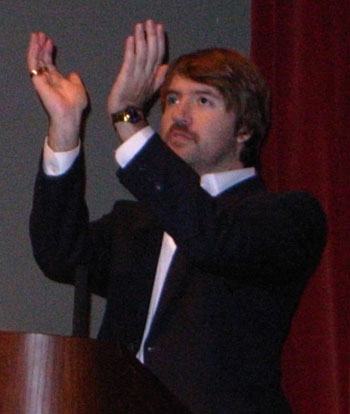
Albert was also amused that people have been consistently walking out during the last shot. If one stays almost to the end, why not stay all the way towards the credits?
-
foggy eyes
- Joined: Fri Sep 01, 2006 1:58 pm
- Location: UK
Yes, but didn't take to it unfortunately. Peter Hames called it "unashamedly an 'art' film" in the festival catalogue, and I think it ends up carrying all the negative implications that such a statement suggests. Familiar/established stylistic tropes of 'art cinema' are employed merely to give an illusion of weight and depth that is ultimately sorely lacking: long takes, minimal dialogue/communication, lack of psychological motivation, suppression of dramatically-charged situation, etc. [See also: Three Monkeys - sorry!] To be fair, I found it quite pleasant and inoffensive for the most part (some attractive cinematography, set-pieces like the riverboat funeral and the ongoing construction of the house), but it left a rather sour taste in my mouth by the end. The last act is nasty, and the film just doesn't earn it (if that makes any sense).franco wrote:Off topic... but you actually saw Delta?
I don't see the resemblance either, but the last shot was the ultimate 'trance' moment for me - the light level is so low that even though it's possible to make out the central action, quite a bit of effort is required to keep it in focus. This means that the rest of the frame becomes strangely 'negative' (or 'de-activated') when focussing on the Magi, and (whilst zoning in and out) I started to create graphic patterns of the entire image that weren't quite there but might well have been.What are your (and anyone's) thoughts on the last shot? During our Q&A sessions people raised questions for its significance, and Albert explained that the composition graphically resembled a chalice (or goblet, or anything in that category). It was simply something he found beautiful and relevant. I admit that I still could not visualize the graphical similarity after two screenings.
Just curious - is that your picture in the full Bordwell blog entry then, fran(k)o?
-
franco
- Joined: Wed Nov 03, 2004 11:32 pm
- Location: Vancouver
Completely agree, although sometimes I'd rather look at beautiful pictures and experience careful sound design than watching something with no visual and no sound like The Edge of Heaven. It has probably taken 40 years for the tropes you described to earn enough familiarity and become cliches (if used in a way to disguise the lack of depth). Perhaps a few more years later, it would be typical for art films to be consisted of static takes with very little movement, extended dialogue of opaque narrative relevance, extreme long shots where actions can hardly be identified, and most importantly, challenging compositions that are difficult to appreciate with a traditional sense of aesthetics. (No, I am not referring to Birdsong; I am just imagining habits that could be inspired by Straub, Akerman, Costa, Serra, Oliveira, Weerasethakul...)foggy eyes wrote:Familiar/established stylistic tropes of 'art cinema' are employed merely to give an illusion of weight and depth that is ultimately sorely lacking: long takes, minimal dialogue/communication, lack of psychological motivation, suppression of dramatically-charged situation, etc. [See also: Three Monkeys - sorry!]
I am glad that I am not the only person who can't see the graphical symbol in the last shot. However much atmosphere it offers, I was still mildly disappointed because Bordwell described it in a much more impressive way a few days before the first screening. It's probably a good idea for me to stop forming my own imaginations of films before seeing them. And yes, Bordwell took a picture of me...
-
foggy eyes
- Joined: Fri Sep 01, 2006 1:58 pm
- Location: UK
Probably in considerably less time than that - Bordwell's Art Cinema as a Mode of Film Practice (published in 1979) serves as a reminder that all this has been deeply entrenched for quite a while. I agree that the 'superficial' employment of these tropes seems to be much more prevalent now - Delta, Wonderful Town and The Sky, the Earth & the Rain (both of which I liked a lot more) were the prime examples at LFF for me.franco wrote:It has probably taken 40 years for the tropes you described to earn enough familiarity and become cliches (if used in a way to disguise the lack of depth).
Fine by me! (Although I'd probably regret saying that.) On a related note, I was just reading an interview with Benedek Fliegauf about Milky Way in the new issue of Vertigo, and it sounds exactly like what you outline above. Could be a very interesting companion to Kiarostami's Five. [If anybody wants the text, let me know - you have to be a subscriber to view it online.]Perhaps a few more years later, it would be typical for art films to be consisted of static takes with very little movement, extended dialogue of opaque narrative relevance, extreme long shots where actions can hardly be identified, and most importantly, challenging compositions that are difficult to appreciate with a traditional sense of aesthetics.
-
Doug Cummings
- Joined: Tue Nov 09, 2004 6:48 pm
- Location: Los Angeles
- Contact:
Re:
Absolutely true story, by the way. It was the most contentious screening I've ever attended. As to Serra being pretentious, I can only say that he was very warm and engaging with me both at that screening and a couple nights ago at Birdsong, a film I absolutely loved. It's similar to Honor of the Knights in many ways, but it's also different in its Bazinian clarity--more so than the previous film, this really needs to be seen on a big screen to fully appreciate what it's doing. The folks I talked to at our screening couldn't believe it was shot on DV.I assume this is the same Palm Springs where Honour of the Knights cleared the auditorium entirely, leaving only Doug Cummings for the Q&A after the credits had rolled...
The big news with the AFI FEST is that this is only the second time the film has screened at a festival in concert with Peranson's documentary.
-
zedz

- Joined: Sun Nov 07, 2004 11:24 pm
Re: Birdsong (Albert Serra, 2008)
I saw this last night and loved its hypnotic effect. Serra’s films have a similar ‘problem’ to Paradzhanov’s, in that they’re so different from anything else that it’s easy to lump them together and overlook the differences between them. Although Birdsong is probably more like Honour of the Knights than any other film, it’s also vastly different, and arguably less aggressively off-putting.
I loved Honour as well, for the rigour of its aesthetic, its mesmerising intensity and, in the final analysis, for its emotional core. The most powerful impression I took away from that film was the intimacy and tenderness of the relationship between the Don and Sancho, and the desperation that pervades the film when they’re separated. Once I latched onto that I could see exactly why Serra needed to strip the incident out of his adaptation in order to expose that vulnerable flicker at its centre. It was as if he were removing everything from the film (in some cases even – almost – the image) except the characters’ rapport.
Birdsong, on the other hand, delivers much much more in the way of spectacle (a bizarre word to use in connection to such an etiolated film, but them’s the breaks), and while the relationship between the three kings is important, it’s not the most important thing here. First off, this is a much more artfully composed film, both in terms of its extraordinary black and white mise en scene, with all those effortless references to centuries of western art (a no-brainer, given the subject matter) and its soundtrack. Where Honour was relentlessly raw and literal – using wild sound and shooting in natural light even when there was no natural light – Birdsong continually sculpts its time and space into compositions of intrinsic drama. This is true even when nothing’s happening, as with that stunning opening shot of the three tiny figures in the mountains, with the shadows of clouds scudding across the muscular landscape, or the poignant closing one, three tiny figures at its centre, swallowed by the dark of the forest. The soundtrack is similarly carefully tailored (hey, there’s even a music cue, which descends on the film like a miracle), with a smart and strategic use of silence. The scene of the men swimming around the boat, shot from below and perfectly soundless, is one of the most exquisite passages I’ve seen in years.
So my initial reactions are really positive, though they’re also visceral. I just let the film lap over me, basking in its sheer visual beauty and sensory evocativeness. I’ll need to see it a second time to reflect more deeply on its content – unless I get seduced away by those calm, cooling surfaces again.
I loved Honour as well, for the rigour of its aesthetic, its mesmerising intensity and, in the final analysis, for its emotional core. The most powerful impression I took away from that film was the intimacy and tenderness of the relationship between the Don and Sancho, and the desperation that pervades the film when they’re separated. Once I latched onto that I could see exactly why Serra needed to strip the incident out of his adaptation in order to expose that vulnerable flicker at its centre. It was as if he were removing everything from the film (in some cases even – almost – the image) except the characters’ rapport.
Birdsong, on the other hand, delivers much much more in the way of spectacle (a bizarre word to use in connection to such an etiolated film, but them’s the breaks), and while the relationship between the three kings is important, it’s not the most important thing here. First off, this is a much more artfully composed film, both in terms of its extraordinary black and white mise en scene, with all those effortless references to centuries of western art (a no-brainer, given the subject matter) and its soundtrack. Where Honour was relentlessly raw and literal – using wild sound and shooting in natural light even when there was no natural light – Birdsong continually sculpts its time and space into compositions of intrinsic drama. This is true even when nothing’s happening, as with that stunning opening shot of the three tiny figures in the mountains, with the shadows of clouds scudding across the muscular landscape, or the poignant closing one, three tiny figures at its centre, swallowed by the dark of the forest. The soundtrack is similarly carefully tailored (hey, there’s even a music cue, which descends on the film like a miracle), with a smart and strategic use of silence. The scene of the men swimming around the boat, shot from below and perfectly soundless, is one of the most exquisite passages I’ve seen in years.
So my initial reactions are really positive, though they’re also visceral. I just let the film lap over me, basking in its sheer visual beauty and sensory evocativeness. I’ll need to see it a second time to reflect more deeply on its content – unless I get seduced away by those calm, cooling surfaces again.
-
foggy eyes
- Joined: Fri Sep 01, 2006 1:58 pm
- Location: UK
Re: Re:
I should say that, regardless of the whiff of pretension, I too found Serra to be tremendously warm, engaging and forthcoming - I'm quite sure he had better people to knock back free champagne with than an over-eager film student. I really should have clarified that in my post above.Doug Cummings wrote:Absolutely true story, by the way. It was the most contentious screening I've ever attended. As to Serra being pretentious, I can only say that he was very warm and engaging with me both at that screening and a couple nights ago at Birdsong, a film I absolutely loved.
HD this time.yoshimori wrote:Does anyone know the details? DV? HDV?
I know what you mean, zedz. Thanks for your thoughts - a lot to digest. I love the way Robert Koehler puts it: 'The big lie, by the way, is that this is "minimalism". [...] No – this is maximalism, a cinema containing everything needed for its own value and purpose, and that has the effect of growing in the mind, either as the viewer recalls it, or sees it again.'zedz wrote:Birdsong, on the other hand, delivers much much more in the way of spectacle (a bizarre word to use in connection to such an etiolated film, but them’s the breaks)
I was thinking about this after coming out of Quantum of Solace the other day (a polar opposite of course, especially as it turns out to be heavily indebted to the Bourne school of hyper-intensified continuity). Bond is 'big': it has all sorts of conflict, explosions, car chases, a convoluted international storyline, accelerated editing, things we most readily associate with 'spectacle'. But to me it feels so small, because it doesn't engage on anything other than an utterly superficial level (which is also why it isn't very enjoyable - it's completely self-contained and blind to anything beyond itself). Birdsong, however, has none of these tropes of size and speed, so is 'small', 'minimalist' and 'slow', whatever. But no! It's huge. It gives you everything - cavernous expanses of space and time, bodies and landscapes, gestures and elements. It is genuinely spectacular.
JC, have you been able to see it by now?
-
franco
- Joined: Wed Nov 03, 2004 11:32 pm
- Location: Vancouver
Re: Birdsong (Albert Serra, 2008)
That is likely the reason why I will always prefer Honour, although I should really stop comparing apples with oranges. For a film that emphasizes so much on its own spectacle and willfully avoids cultivating emotional depths among its characters, one really needs to love the spectacle to love the film. Following foggy's clever comment on the sensory richness in these wrongly labeled "minimalistic" films, I'd watch them any time, any moment rather than boring junk like The Dark Knight.zedz wrote:I loved Honour as well, for the rigour of its aesthetic, its mesmerising intensity and, in the final analysis, for its emotional core. The most powerful impression I took away from that film was the intimacy and tenderness of the relationship between the Don and Sancho, and the desperation that pervades the film when they’re separated.
He is an adorable character. I probably did the most useless thing an audience could ever do to him, that is - getting his autograph, in Catalan.foggy eyes wrote:I should say that, regardless of the whiff of pretension, I too found Serra to be tremendously warm, engaging and forthcoming - I'm quite sure he had better people to knock back free champagne with than an over-eager film student.
Rumour suggests that his next project may involve Fassbinder, Jesus, and Fox and His Friends.
-
zedz
- Joined: Sun Nov 07, 2004 11:24 pm
Re: Birdsong (Albert Serra, 2008)
Which reminds me: nice avatar. (Talk about sensory richness)franco wrote:Following foggy's clever comment on the sensory richness in these wrongly labeled "minimalistic" films, I'd watch them any time, any moment rather than boring junk like The Dark Knight.
-
franco
- Joined: Wed Nov 03, 2004 11:32 pm
- Location: Vancouver
Re: Birdsong (Albert Serra, 2008)
Thanks, and I forgot to mention that I really appreciate your sharing your thoughts. The experience is so visceral that it's difficult to put into words.
Has anyone seen Mark Peranson's documentary?
Has anyone seen Mark Peranson's documentary?
-
John Cope
- Joined: Thu Dec 15, 2005 9:40 pm
- Location: where the simulacrum is true
Re: Birdsong (Albert Serra, 2008)
I want to thank everyone for the great responses and, no, to answer your question foggy I have not yet had the pleasure of seeing this one. It didn't play the Chicago Fest as far as I know so I'll just have to keep an eye out. As to Peranson's doc, I hope it turns up on the eventual DVD.
-
foggy eyes
- Joined: Fri Sep 01, 2006 1:58 pm
- Location: UK
Re: Birdsong (Albert Serra, 2008)
I have an article on 'slow'/'contemplative' art cinema in the new issue of 16:9, and couldn't resist including a paragraph about Birdsong. (Shameless self-promotion, I know, but feedback [particularly negative] is welcome!)
-
foliagecop

- Joined: Wed Jan 09, 2008 1:42 pm
- Location: Scotland
Re: Birdsong (Albert Serra, 2008)
Thoroughly good article, Matthew. Timely, too. Under 'A Cinema Of Walking' I'd also have included the walk across the empty swimming baths in Tarkovsky's 'Nostalghia', but that's a (very) minor gripe.
Nice work.
Nice work.
-
foggy eyes
- Joined: Fri Sep 01, 2006 1:58 pm
- Location: UK
Re: Birdsong (Albert Serra, 2008)
Thanks for the kind words, foliagecop. I think the notion of a 'cinema of walking' could run and run, and that's a great example - not one of the first things that popped into my head, actually!
-
franco
- Joined: Wed Nov 03, 2004 11:32 pm
- Location: Vancouver
Re: Birdsong (Albert Serra, 2008)
Matthew, that is a great article. I have no negative feedback for you; I just wish I could articulate my feelings and experiences as well as you do.