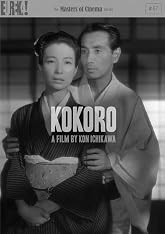
Perkins Cobb wrote:This is, unfortunately, a poor choice - one of Ichikawa's most sentimental and therefore least typical films of the '50s.
I couldn't agree less. The movie is restrained and at times almost Dostoevskian. It's also one of those rare adaptations that perfect captures the heart (or shall we say kokoro?) of its source material. As far as literary adaptations it's as masterly as Ichikawa's
Enjo. And the film, with its emphasis on obsessed loners wracked by long-standing neuroses, fits perfectly with the themes Ichikawa explored in all of his best work, and suits him better than it would Ozu or Naruse.
JonathanM wrote:I took homosexuality to be pretty much a straightforward interpretation.
The student's relationship with sensei is, as you say, fascination but I think there's a hint of something more but I wouldn't say they were lovers. As for the Sensei and his friend, I think they were definitely 'up each other'. It explains the moodiness and how the friend would blow hot and cold as well as his absurd obsession with self denial and spiritual purity... clearly he was over-compensating for the 'dirty' things he got up to with his best friend. It also explains why he suddenly opted to fall in love with the girl and why sensei swooped in and gazumped him. He wanted to get away from sensei and thought that by getting married he would be free and sensei just moved to cut off that escape route.
If you read the book I'd be interested in knowing if the book is quite as evasive.
You know, I read this book in a college class, and we had to do presentations on it. One group got up and with bright smiles on their faces announced that they'd unlocked the secret of the book--the characters were all gay! All I could think was how reductive and dull such an explanation was.
The book isn't "evasive" about homosexuality because it's not the main issue--
Kokoro is about a much deeper kind of loneliness, and deciding that it all boils down to unhappiness in sexual matters is an unsatisfying way of cutting the book and film down to size. I certainly
don't wish to deny an element of homoeroticism in the character's relationships, but I suspect this is an element that exists in close male friendships even among "straight men", let alone "gay" ones.
The "hint of something more" that you detect in the sensei/student relationship might be sexual attraction, but it could just as well be a paternal one. Sensei, whose soul is guilt-ridden and corroded, responds to the innocence and youth of the student for the same reason any jaded, self-loathing person might desire the company of someone untouched by what has scarred him, someone to whom he might even confide in.
Perhaps Ichikawa did not express this element as well as he could, but K's passion for self-control and self-denial hardly seemed absurd--he is after all the son of a Shinshu priest and his moodiness is also partly due to having been disowned by his family. Additionally, his grief is less over the conflict between his religion and supposed love for Sensei than between his desire for self control versus the love he can't feeling for Ojosan. K's nature contrasts with Sensei's own venal nature, since what drives the novel is Sensei's grief over his suspicious mind, which makes him think worse of others than they really are. He does this with K, by refusing to console him and stealing away Ojosan, and this blows up in his face and leaves him with enough guilt and self-hatred to poison the rest of his life, so that he cannot even enjoy living with his wife, from whom he must conceal his guilt. He's thus left more alone than ever, and unable to fully reach the student, the on person who might have given him peace of mind, except in death, with a posthumous letter.
Again, I think it would certainly a mistake to count out an element of homoeroticism in the character's relationships, but to suddenly decide that the
key to Kokoro is frustrated homosexual longing is to reduce everything down to an easy explanation and leave yourself with a reduced experience of the film. I realize how fun it is to look for repression, and nowadays we've all been trained to sniff out supposedly transgressive material, but sometimes such interpretations can flatten the film. In that respect,
Kokoro reminds me of a book from my high school days,
A Seperate Peace. Now, it's quite likely that on some level Gene
was sexually attracted to Finny, but his actions can't simply be explained away as a thwarted desire to get in Finny's pants. It stretches farther back, to the guilt of someone who hates himself for having thought worse of a better man than himself and injured him. That is true of both books.