This isn't the first time Vitali has turned into a shill for WHV. 12 years down the line one has to wonder hw much he cares anymore... Biggest case in point: the 5.1 remixes, which Kubrick would almost certainly never have approved, including the 5.1 mix for Eyes Wide Shut, which reliable sources tell me would have been released in mono if Kubrick hasn't died, despite Vitali's frequent statements to the contrary.
If Barry Lyndon is 1.77:1 then:
1/ Why did Michael receive a written note from Kubrick that the film was supposed to be projected at 1.66:1?!!
2/ Why do the BFI Southbank also persist in screening the film at 1.66:1?
3/ Why have all previous home video releases, including the transfers approved by Kubrick, been 1.66:1 (or even wider at 1.59:1)? That Vitali is plain wrong on this fact calls everything else he says into question and no amount of half-incoherent gibberish about people annoying him at parties is going to bolster his argument.
4/ Why does the 1.77:1 framing so obviously screw up the composition (tops of heads and flags lost, etc).?
Regarding the Harris comments, why is A Clockwork Orange 1.66:1 then, released only four years earlier? Answer = 1.66:1 was the European standard at the time both films were released.
Stanley Kubrick Collection
-
Gregor Samsa

- Joined: Sun Aug 06, 2006 8:41 am
Re: Stanley Kubrick Collection
Individual releases of BL and Lolita are already available in Australia.
-
justeleblanc

- Joined: Wed Nov 03, 2004 10:05 pm
- Location: Connecticut
Re: Stanley Kubrick Collection
Nothing, I question your sources and conclusions.
First, that Kubrick would have preferred a mono mix seems dubious. Kubrick used Dolby's four-track stereo matrix for both The Shining and Full Metal Jacket. So why would he return to mono for EWS? Similarly, 5.1 digital surround is not only a 5 channel matrix but also a highly advanced sound compression system that offers noticeably higher quality and noiseless recording. Why would Kubrick want to offer low quality dialog, music, and noise? Finally, by the mid 90s film exhibitors and producers had standardized the digital surround format, either the 5.1 systems/matrix offered by Dolby and DTS, or the 7.1 configuration offered by Sony. Why and how could Kubrick justify not using these default systems? Consider that the sound editors and sound mixers for EWS (the same team who edited FMJ) had been editing exclusively 5.1 digital surround films for the past several years. And also consider that this is the same director who made 2001.
Second, Europe had two standards from the 1950s through the 1970s: 1.66:1 and 1.78:1. It would be rare (and perhaps even a naive decision) for a filmmaker to compose a shot for only one of these aspect ratios, for plenty of films were shown in both aspect ratios depending on the scrupulousness of the theater. It would also be rare for a film to not be composed for 1.85:1 since this was the American standard. If you stare at both images long enough, you can find evidence that either aspect ratio is accurate.
However, I would love to see a formalist debate as to whether or not Kubrick would have cropped certain objects at certain parts of the frame based solely on quantifiable evidence from his other films.
First, that Kubrick would have preferred a mono mix seems dubious. Kubrick used Dolby's four-track stereo matrix for both The Shining and Full Metal Jacket. So why would he return to mono for EWS? Similarly, 5.1 digital surround is not only a 5 channel matrix but also a highly advanced sound compression system that offers noticeably higher quality and noiseless recording. Why would Kubrick want to offer low quality dialog, music, and noise? Finally, by the mid 90s film exhibitors and producers had standardized the digital surround format, either the 5.1 systems/matrix offered by Dolby and DTS, or the 7.1 configuration offered by Sony. Why and how could Kubrick justify not using these default systems? Consider that the sound editors and sound mixers for EWS (the same team who edited FMJ) had been editing exclusively 5.1 digital surround films for the past several years. And also consider that this is the same director who made 2001.
Second, Europe had two standards from the 1950s through the 1970s: 1.66:1 and 1.78:1. It would be rare (and perhaps even a naive decision) for a filmmaker to compose a shot for only one of these aspect ratios, for plenty of films were shown in both aspect ratios depending on the scrupulousness of the theater. It would also be rare for a film to not be composed for 1.85:1 since this was the American standard. If you stare at both images long enough, you can find evidence that either aspect ratio is accurate.
However, I would love to see a formalist debate as to whether or not Kubrick would have cropped certain objects at certain parts of the frame based solely on quantifiable evidence from his other films.
-
MichaelB

- Joined: Fri Aug 11, 2006 10:20 pm
- Location: Worthing
- Contact:
Re: Stanley Kubrick Collection
Actually, that was GaryC. I was never a projectionist, so unless such a note was actually brought to my attention, I wouldn't have seen it. And notes about aspect ratios taped inside film cans were ten a penny.Nothing wrote:If Barry Lyndon is 1.77:1 then:
1/ Why did Michael receive a written note from Kubrick that the film was supposed to be projected at 1.66:1?!!
That said, I was always under the impression that the film should be 1.66:1, and we certainly always screened it in that ratio - and if we'd shown it in the wrong ratio, I suspect we'd have been told about this, because when the Electric Cinema showed it in 1.85:1, Kubrick's spy immediately left his seat and ordered it to be changed.
It's also well worth noting that 1.77:1 was not a standard aspect ratio at the time, and most cinemas - virtually all cinemas, I suspect - wouldn't have been able to handle it. Of course, there's a distinct possibility that Kubrick intentionally composed for 1.77:1 to allow for viable screenings at both 1.66:1 and 1.85:1, given that most American cinemas couldn't handle 1.66:1 - and this is supported by the Blu-ray to a rather greater extent than I was anticipating.
In motion, it looks fine. I was watching it the other night and thinking "would an extra 3% on the top really make a significant difference?", and the answer was invariably "no".4/ Why does the 1.77:1 framing so obviously screw up the composition (tops of heads and flags lost, etc).?
So while I think the aspect ratio should ideally be 1.66:1, the evidence of my own eyes suggests that the film is entirely watchable in 1.77:1 - and I honestly wouldn't realise that it wasn't intended to be that ratio if I hadn't known upfront.
Actually, the standard European aspect ratios were 1.66:1 and 1.85:1. Britain and France generally favoured the former, Italy and Hungary the latter.justeleblanc wrote:Second, Europe had two standards from the 1950s through the 1970s: 1.66:1 and 1.78:1.
In fact, when Miklós Jancsó was recently asked about the aspect ratio of Red Psalm, he said that in a completely ideal world, he'd have composed it for 1.66:1, as that was his personal preference. But when he discovered that most Hungarian cinemas couldn't show it like that, he opted for 1.85:1. (The film was shot open-matte, so 1.66:1 screenings would be entirely feasible, but it was specifically composed for 1.85:1. and I believe the new Jancsó-approved master will reflect this).
-
Gregory

- Joined: Tue Nov 02, 2004 8:07 pm
Re: Stanley Kubrick Collection
Disregard -- I was questioning Michael's "3%...at the top and bottom" mentioned first post this page and then again, but now I get that it probably means 3% at the top and 3% at the bottom.
Last edited by Gregory on Thu May 26, 2011 7:49 am, edited 1 time in total.
-
matrixschmatrix

- Joined: Wed May 26, 2010 3:26 am
Re: Stanley Kubrick Collection
I'm assuming he means ~3% each at the top and the bottom
-
Nothing
- Joined: Fri Oct 20, 2006 8:04 am
Re: Stanley Kubrick Collection
2001 is the only multi-channel Kubrick-approved soundmix that I know of. Everything I've read suggests that Kubrick mixed both The Shining and Full Metal Jacket in mono, his reasoning being that theatres couldn't be trusted to configure and maintain their multi-channel speaker setups correctly and therefore mono was the only way to guarantee the audience would hear the film as originally intended. In addition, I've seen these two films theatrically in mono + obviously the VHS, laserdisc and 1999 DVD release are mono. Now I'm not saying you're wrong necessarily, but what are your sources?
Regarding EWS, I heard this independently from two people intimately involved in the sound post on the film, so needless to say I trust their account. Apparently WB had quite a job persuading the family to agree to a 5.1 mix but eventually prevailed - after which point, some lame cover story was released about how Kubrick had intended to mix it in 5.1 all along, blah blah blah (very similar, imho, to the inconsistent gibberish that Vitali is spouting here).
Regarding the ratio of Barry Lyndon, given that Gary received written instructions from Kubrick instructing him to project the film at 1.66:1 (a ratio prevalent in Europe at the time, unlike 1.77:1), that Michael can recall a screening where a Kubrick employee ordered the ratio to be changed from 1.85:1 to 1.66:1, given that David Mullen ASC has testified to 1.66;1 mattes being distributed to North American theatres alongside the prints, given that national archive screening rooms in LA and London continue to project the film in 1.66:1, given that all previous laserdisc and DVD releases were 1.66:1 (despite Vitali's statement to the contrary) and given that almost every composition looks awkwardly and obviously tight at 1.78:1.... I think we can at the least question Vitali's memory on this matter - if not crown him the new Beatrice Welles.
Michael, they're cropping 6.67% of the image, not 3%, and these are fixed framings that we're looking at so it really makes no difference whether the image is in motion or not.
So... What's this new Jancso-approved widescreen master of Red Psalm that you're talking about? Have the BFI finally seen the light?! Is this an HD master? Is it only Red Psalm, or more?
Regarding EWS, I heard this independently from two people intimately involved in the sound post on the film, so needless to say I trust their account. Apparently WB had quite a job persuading the family to agree to a 5.1 mix but eventually prevailed - after which point, some lame cover story was released about how Kubrick had intended to mix it in 5.1 all along, blah blah blah (very similar, imho, to the inconsistent gibberish that Vitali is spouting here).
Regarding the ratio of Barry Lyndon, given that Gary received written instructions from Kubrick instructing him to project the film at 1.66:1 (a ratio prevalent in Europe at the time, unlike 1.77:1), that Michael can recall a screening where a Kubrick employee ordered the ratio to be changed from 1.85:1 to 1.66:1, given that David Mullen ASC has testified to 1.66;1 mattes being distributed to North American theatres alongside the prints, given that national archive screening rooms in LA and London continue to project the film in 1.66:1, given that all previous laserdisc and DVD releases were 1.66:1 (despite Vitali's statement to the contrary) and given that almost every composition looks awkwardly and obviously tight at 1.78:1.... I think we can at the least question Vitali's memory on this matter - if not crown him the new Beatrice Welles.
Michael, they're cropping 6.67% of the image, not 3%, and these are fixed framings that we're looking at so it really makes no difference whether the image is in motion or not.
So... What's this new Jancso-approved widescreen master of Red Psalm that you're talking about? Have the BFI finally seen the light?! Is this an HD master? Is it only Red Psalm, or more?
-
knives

- Joined: Sat Sep 06, 2008 10:49 pm
Re: Stanley Kubrick Collection
Red Psalm is coming from Secondrun along with Alonso's Liverpool.
-
Nothing
- Joined: Fri Oct 20, 2006 8:04 am
Re: Stanley Kubrick Collection
Second Run... So that's another BD we can kiss goodbye then 
-
MichaelB
- Joined: Fri Aug 11, 2006 10:20 pm
- Location: Worthing
- Contact:
Re: Stanley Kubrick Collection
I agree - I still strongly feel that the correct ratio should be 1.66:1. I don't make stuff like this up, and I've been under the impression for a very very long time indeed that it was the one post-1960s Kubrick film where there really wasn't any dispute. We couldn't have shown it in 1.78:1 even if we'd wanted to, as we didn't have the right projector mask - and didn't feel we needed it, as films in that ratio were as rare as hen's teeth back then.Nothing wrote:Regarding the ratio of Barry Lyndon, given that Gary received written instructions from Kubrick instructing him to project the film at 1.66:1 (a ratio prevalent in Europe at the time, unlike 1.77:1), that Michael can recall a screening where a Kubrick employee ordered the ratio to be changed from 1.85:1 to 1.66:1, given that David Mullen ASC has testified to 1.66;1 mattes being distributed to North American theatres alongside the prints, given that national archive screening rooms in LA and London continue to project the film in 1.66:1, given that all previous laserdisc and DVD releases were 1.66:1 (despite Vitali's statement to the contrary) and given that almost every composition looks awkwardly and obviously tight at 1.78:1.... I think we can at the least question Vitali's memory on this matter - if not crown him the new Beatrice Welles.
BUT - the evidence of my own eyes suggests that the film survives cropping (if cropping it is) much more effectively than I thought it would before I actually sat down to watch the new Blu-ray. So I think it's reasonable to at least hypothesise that Kubrick (ever the pragmatist in these matters, as his decision over the mono sound mixes of his later films suggests) allowed for the strong possibility - indeed, probability - that cinemas in the US would crop to 1.85:1.
Just to clarify, given that others have been confused too, I did indeed mean 3% at the top and 3% at the bottom. On a 42" set, the difference between 6% and 6.67% is pretty much irrelevant (and the difference between 3% and 3.33% even more so), which is why I rounded the figures.Michael, they're cropping 6.67% of the image, not 3%, and these are fixed framings that we're looking at so it really makes no difference whether the image is in motion or not.
It's the new master that was created by the Hungarian Film Archive, which Second Run has licensed for release this autumn: it'll be on DVD only, and I don't know if the source is HD (though the DVD will certainly be anamorphic). They have another Jancsó title in preparation, but I don't know yet if it's from a new master.So... What's this new Jancso-approved widescreen master of Red Psalm that you're talking about? Have the BFI finally seen the light?! Is this an HD master? Is it only Red Psalm, or more?
I don't know why you keep bringing up the BFI: they've rarely shown any especial interest in Jancsó, aside from running sympathetic articles in Sight & Sound at the time. The great 60s/early 70s films were generally distributed by Contemporary Films for premiering at the Academy in Oxford Street, both being outfits with strong Eastern European connections (indeed, the Academy was founded and run by Hungarians), and there's virtually no chance of the BFI backing restorations. They don't possess any unique materials or have any historical or cultural interest in the films, so it doesn't remotely fall within their remit. Proper restorations are a job for the Hungarians - but at least there seems to be some movement in that direction. (I imagine the fact that Jancsó turns ninety in September has concentrated minds somewhat).
I love the implication that Second Run is somehow preventing the BFI, Masters of Cinema et al from releasing their own Jancsó restorations on Blu-ray! Whereas I suspect you know perfectly well that if they didn't do it, no-one else would.Nothing wrote:Second Run... So that's another BD we can kiss goodbye then
Between the theatrical release of Private Vices Public Virtues in 1976 and Second Run's release of The Red of the White in 2005, no Jancsó film was commercially released in the UK, either theatrically or on video - and I'm not even sure that one was ever screened on television. As I've already said, the BFI has shown no interest whatever, Masters of Cinema's coverage of European cinema pretty much stops dead at the borders of the old Iron Curtain, so who else is realistically going to pick up the baton? I'd love it if Criterion did, but their interest in eastern Europe seems pretty limited too.
-
Nothing
- Joined: Fri Oct 20, 2006 8:04 am
Re: Stanley Kubrick Collection
True, why not just release every film Ozu ever made instead - makes much more sense, Ozu being born in Birmingham and all. :-"
The argument you made before - sensible enough - was the lack of available masters, but if an HD master of Red Psalm does now exist it is indeed a shame that Second Run is handling the release and not a BD-ready label like the BFI or MoC (or even Arrow!).
For the record, btw, I prefer to watch The Shining and Full Metal jacket in their theatical OAR of 1.85:1. I'm fine with EWS in 1.85:1 too - although it was shown at 1.66:1 for the premiere at Mann's Chinese and feels somewhat more comfortable at that ratio.
The argument you made before - sensible enough - was the lack of available masters, but if an HD master of Red Psalm does now exist it is indeed a shame that Second Run is handling the release and not a BD-ready label like the BFI or MoC (or even Arrow!).
For the record, btw, I prefer to watch The Shining and Full Metal jacket in their theatical OAR of 1.85:1. I'm fine with EWS in 1.85:1 too - although it was shown at 1.66:1 for the premiere at Mann's Chinese and feels somewhat more comfortable at that ratio.
-
MichaelB
- Joined: Fri Aug 11, 2006 10:20 pm
- Location: Worthing
- Contact:
Re: Stanley Kubrick Collection
I actually wrote a paragraph about Ozu, but deleted it because I thought it was drifting too far off-topic. But yes, you're right that in that case it's because existing masters can be pulled off the shelf in virtually all cases, whether the shelves in question are at Shochiku or Criterion. If I remember rightly, the BFI only created one transfer themselves (an HD telecine, not a restoration), and that was only because the Criterion master for Good Morning was (notoriously) not good enough.Nothing wrote:True, why not just release every film Ozu ever made instead - makes much more sense, Ozu being born in Birmingham and all.
Also, the BFI has a very long track record in championing classic Japanese cinema, but no track record at all in championing Hungarian cinema. In fact, they handle precious few eastern European titles of any kind - Jan Švankmajer being the major exception.
I don't know if it's HD - as in many other things, the Hungarians tend to be a law unto themselves. They only seem to have discovered the virtues of anamorphic enhancement comparatively recently.The argument you made before - sensible enough - was the lack of available masters, but if an HD master of Red Psalm does now exist it is indeed a shame that Second Run is handling the release and not a BD-ready label like the BFI or MoC (or even Arrow!).
And I've personally recommended Jancsó to all three labels. In fact, my contact at Arrow will confirm that as soon as I heard that their new Arrow Academy strand was inspired by the old Academy cinema, I immediately pointed out that Jancsó was arguably the quintessential Academy director! So far, though, they haven't come anywhere close to biting.
(Believe me, Second Run would be thrilled if a better-funded label like Criterion, the BFI or MoC took on Jancsó, just as they're thrilled that the Czechs have finally got it together over a full HD restoration of Marketa Lazarová, four years after their own release - which remains the only one anywhere in the world. I've rarely known a DVD label more in it for love rather than money - and it would free them up to track down even more neglected figures like Zoltán Huszárik, the subject of their next release.)
My BDs are all 16:9, and look fine - I actively prefer The Shining in 16:9 to the 4:3 version, and not just because the notorious helicopter shadow is no longer visible.For the record, btw, I prefer to watch The Shining and Full Metal jacket in their theatical OAR of 1.85:1. I'm fine with EWS in 1.85:1 too - although it was shown at 1.66:1 for the premiere at Mann's Chinese and feels somewhat more comfortable at that ratio.
-
Nothing
- Joined: Fri Oct 20, 2006 8:04 am
Re: Stanley Kubrick Collection
Ditto Criterion. And yet you say this as if it were an inevitable fact rather than a bizarre prediliction. The Japanese are more exotic and less leftwing, I suppose...MichaelB wrote:the BFI has a very long track record in championing classic Japanese cinema, but no track record at all in championing Hungarian cinema. In fact, they handle precious few eastern European titles of any kind
Coming back to the Kubrick, it's a hard thing to argue about the 'balance of the frame'. It seems that people either see it or they don't. However, I would suggest that the balance of these compositions - the proportions, the sense of space, the headroom - are strongly supported by the 1.85:1 / 1.78:1 ratio: 1 - 2 - 3 - 4 - 5 - 6


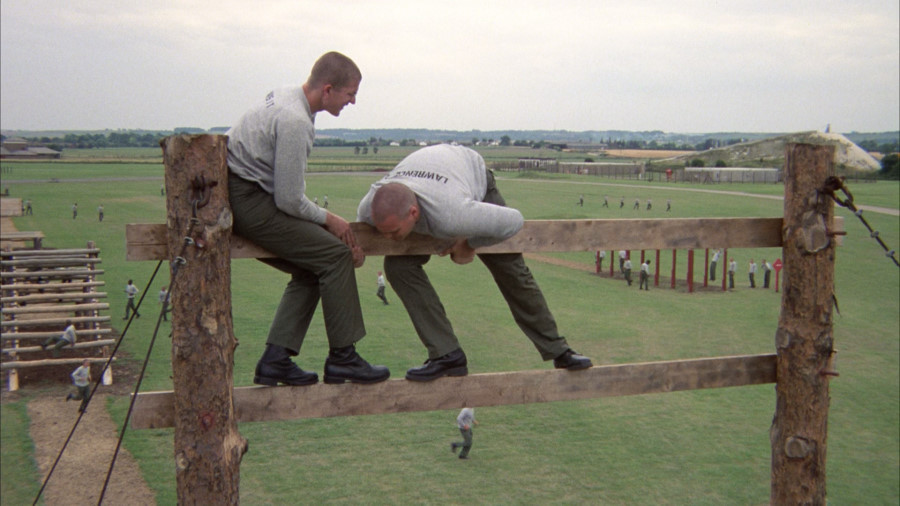
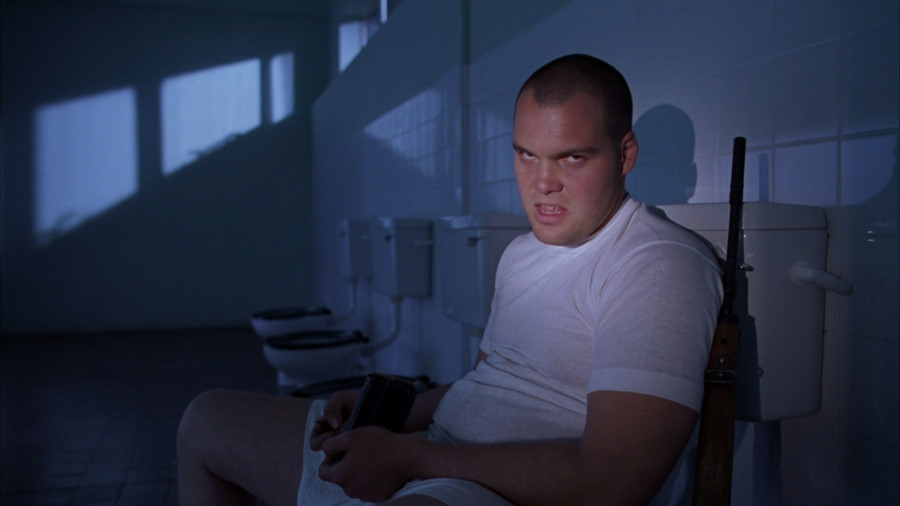


Whereas these beg for more vertical space: 7 - [url=ttp://www.dvdbeaver.com/film3/blu-ray_reviews ... -ray_7.jpg]8[/url]
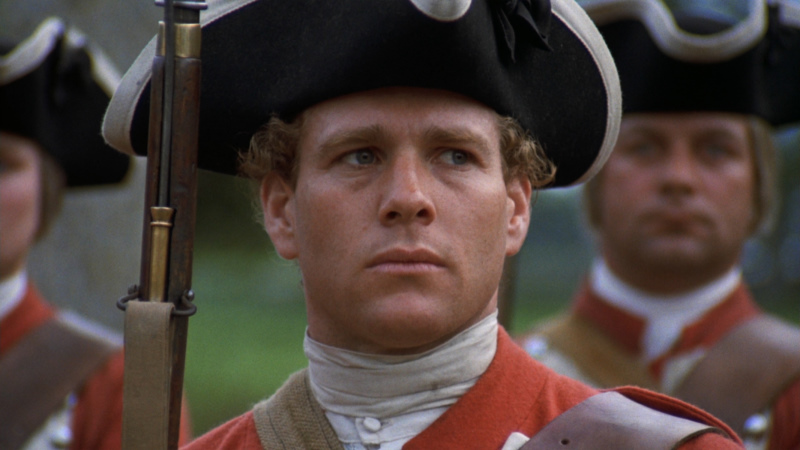
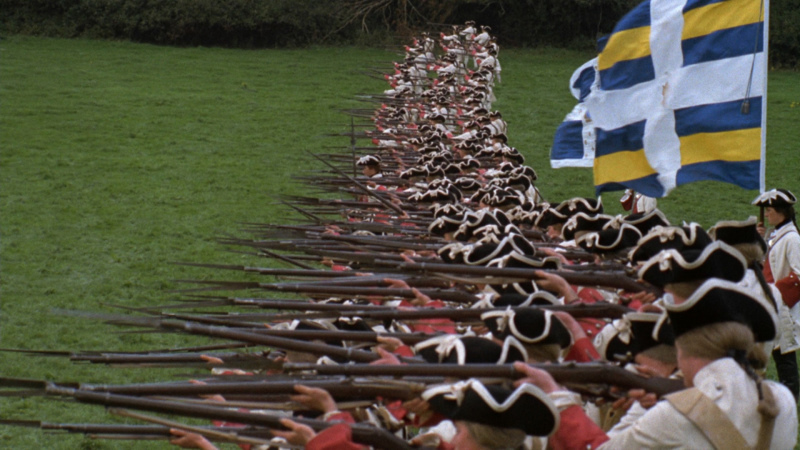
edit: argh, can't seem to get the DVDBeaver captures to link, either as images or urls...
-
MichaelB
- Joined: Fri Aug 11, 2006 10:20 pm
- Location: Worthing
- Contact:
Re: Stanley Kubrick Collection
I doubt that politics has anything to do with it, especially not where the BFI is concerned (you could hardly get more left-wing than The Miners' Campaign Tapes, and the recent Tales from the Shipyard made room for a Cinema Action campaign film). But fashion definitely does. With only a handful of exceptions, Criterion generally sticks pretty closely to favourite 'arthouse' countries - western Europe, Japan, Russia, the US, with eastern Europe, Africa, India, Latin America and south-east Asia almost entirely ignored. The BFI is a lot more adventurous when it comes to British cinema (eye-openingly so in recent years), but also has a similarly conservative programming policy when it comes to international arthouse titles - their catalogue is mainly Pasolini, Visconti, Tati, Ozu, Kurosawa and so on.Nothing wrote:Ditto Criterion. And yet you say this as if it were an inevitable fact rather than a bizarre prediliction. The Japanese are more exotic and less leftwing, I suppose...MichaelB wrote:the BFI has a very long track record in championing classic Japanese cinema, but no track record at all in championing Hungarian cinema. In fact, they handle precious few eastern European titles of any kind
Second Run, by contrast, has based its entire ethos on championing filmmakers and national cinemas who have slipped through the cracks - either formerly big names who've been neglected for decades (Jancsó, Menzel, Chytilová, Makk), or people who never made much of an impact in Britain at all despite the unimpeachable artistic merit of their work (Vláčil, Herz, Huszárik, Costa), as well as comparatively recent debut films that other distributors have ignored (The Unpolished, The Lighthouse). But the downside of this philosophy is that they're inevitably appealing to a niche of a niche in terms of the maximum plausible size of the market, so every penny has to be watched like the proverbial hawk.
-
Peacock

- Joined: Mon Dec 22, 2008 11:47 pm
- Location: Scotland
Re: Stanley Kubrick Collection
To jump back a bit, perhaps the reason the Kubrick spy (or indeed, the note from Kubrick himself reputedly, inside the film can in another case) asked for the screening of Barry Lyndon to be changed from 1:85:1 to 1:66:1 is because, as Michael said, 1:77:1 couldn't be projected in most places, so Kubrick would have preferred the image slightly more open at 66, than missing more info at 85? So I don't think these particular anecdotes disproves Vitali...
Although the whole idea of Kubrick intending the OAR to be 1:77:1 when most Western theaters couldn't play it seems a bit odd.
Although the whole idea of Kubrick intending the OAR to be 1:77:1 when most Western theaters couldn't play it seems a bit odd.
-
jedgeco

- Joined: Tue Nov 23, 2004 3:28 pm
Re: Stanley Kubrick Collection
I'll go you one further and suggest that, as a result of the push for letterboxed home video in the 80s & 90s, the home video enthusiast and cinephile communities have fetishized the idea of a "correct" aspect ratio and given it much more consideration than directors in the 50s, 60s, and 70s probably did. The idea that even a director as fastidious as Kubrick would have agonized over the difference between 1.77 and 1.66 seems questionable to me, especially given his "fill the screen" approach to home video.Peacock wrote:1:77:1 couldn't be projected in most places, so Kubrick would have preferred the image slightly more open at 66, than missing more info at 85? So I don't think these particular anecdotes disproves Vitali
-
MichaelB
- Joined: Fri Aug 11, 2006 10:20 pm
- Location: Worthing
- Contact:
Re: Stanley Kubrick Collection
Far from being a fetishist, Kubrick's always struck me as being unusually pragmatic with regard to these issues - and more than happy to revise his original thoughts (as the variable aspect ratios of the old Criterion Dr Strangelove attest). And the fact that he was quite happy for his last three films to be screened at anywhere between 4:3 and 1.85:1 suggests that he was all too realistic about the differing demands being made by different media.
Anyway, this one's clearly going to run and run - but I have no regrets at all about buying the box set.
Anyway, this one's clearly going to run and run - but I have no regrets at all about buying the box set.
-
justeleblanc
- Joined: Wed Nov 03, 2004 10:05 pm
- Location: Connecticut
Re: Stanley Kubrick Collection
Nothing, we might be talking about separate things when we speak of Shining and FMJ. By mono, do you mean pre-Dolby surround technology, do you mean mixing all the sounds only to the front-center track, or do you mean mixing all tracks with the same sounds?Nothing wrote:2001 is the only multi-channel Kubrick-approved soundmix that I know of. Everything I've read suggests that Kubrick mixed both The Shining and Full Metal Jacket in mono, his reasoning being that theatres couldn't be trusted to configure and maintain their multi-channel speaker setups correctly and therefore mono was the only way to guarantee the audience would hear the film as originally intended. In addition, I've seen these two films theatrically in mono + obviously the VHS, laserdisc and 1999 DVD release are mono. Now I'm not saying you're wrong necessarily, but what are your sources?
Regarding EWS, I heard this independently from two people intimately involved in the sound post on the film, so needless to say I trust their account. Apparently WB had quite a job persuading the family to agree to a 5.1 mix but eventually prevailed - after which point, some lame cover story was released about how Kubrick had intended to mix it in 5.1 all along, blah blah blah (very similar, imho, to the inconsistent gibberish that Vitali is spouting here.
Also, the switch from four-channel surround and digital surround can lead to much confusion among casual lingo. Four-channel sound mixing in the 70s involved three tracks in the front, and one track in the rear often called the mono surround track (since there was only one). 5.1 involves three tracks in the front and two stereo surround tracks in the back. I've heard people discuss Dolby's original four channel matrix as mono as an incorrect shorthand, which is why I ask.
Now as for Shining and FMJ. There are major differences in the sound designs between these films and Lyndon and Clockwork. During FMJ's suicide scene in the latrine, and during the sniper scene at the end, there's much more attention to sound detail, specifically in the echoing of the ambiance. Similarly Shining's outdoor wind sounds in certain scenes are equally significant, and is something I don't think you hear to the same extent in Lyndon or Clockwork. Obviously neither of his 80s films were mixed so dialog would be thrown around the different speakers, but the addition of more detailed ambient noise seems to be evidence that his sound mixers were working with better sound technologies and were utilizing the rear mono track in the better theaters. It would be common for sound mixers to not go overboard with four-channel sound mixing, for many theaters were unable to correctly support four channel surround, so it's possible some people saw FMJ and Shining with the sounds of the rear mono track mixed in at a lower volume in the front track.
-
aox
- Joined: Fri Jun 20, 2008 4:02 pm
- Location: nYc & Detroit
Re: Stanley Kubrick Collection

Dig him up...
-
justeleblanc
- Joined: Wed Nov 03, 2004 10:05 pm
- Location: Connecticut
Re: Stanley Kubrick Collection
Or build a hotel on top of him.aox wrote:
Dig him up...
-
Gregory
- Joined: Tue Nov 02, 2004 8:07 pm
Re: Stanley Kubrick Collection
Kenny's updated yesterday's piece with some really interesting new sources and discussion, and there are some fine observations in the comments, too. (I've gained back any respect I'd lost after the snippy "pictures of my TV" post -- and quite a bit more besides. Great stuff. The Brotzmann post and comments win huge points, too, but I digress.)
Vitali comes across as totally undermining his own credibility. If he's sick of answering questions about Kubrick OARs, he should try to simply resolve this in a clear, considered way, rather than stirring the pot and making pithy, bizarre, and untrue assertions that fuel lots more discussion and speculation.
Vitali comes across as totally undermining his own credibility. If he's sick of answering questions about Kubrick OARs, he should try to simply resolve this in a clear, considered way, rather than stirring the pot and making pithy, bizarre, and untrue assertions that fuel lots more discussion and speculation.
-
jedgeco
- Joined: Tue Nov 23, 2004 3:28 pm
Re: Stanley Kubrick Collection
I think that Robert Harris's reply over at Hollywood Elsewhere is a pretty good summary of where I come out (copied here since you can't link directly to it):
This is one of those situations where everyone (almost) is correct.
Mr. Kubrick passed away a dozen years ago, and at that time he had set standards for home video viewing of his works for both WB and Criterion.
To this day, I find his Criterion directives to have a bit of a "wink, wink, nudge, nudge" attitude about them, with their exposure of multiple aspect ratio in-camera mattes.
His films, by his authority, were set up to be viewed in the highest possible aspect ratio. And they were designed that way because that was the way he wanted them to be seen.
On home video.
On 4:3 screens.
Some up to a huge 35" diagonally.
He abhorred pan & scan, preferring to open mattes even to the point of revealing certain things that today might be digitally erased.
If anyone understood his directives, it was Mr. Vitali, and after SK's passing it is Mr. Vitali who within rational limits, and based upon ever-changing technology does his best to see that SK's work is handled in the best way possible.
I've not examined the OCN of Barry Lyndon, but it is said that the film was shot open matte at around 1.6:1, ie. via a camera aperture. This makes sense.
The film would have been protected at least to 1.66, but with the exception of controlled screenings, would not have been seen that way.
1.66:1 was an aspect ratio that ended here in the Colonies c. 1953, with films like Rear Window. By 1954, Paramount's VistaVision had set 1.85:1 as a perfunctory standard. Columbia and other studios followed suit. By 1975 few theaters were able to run at 1.66, as standards were 1.85 and 2.35. Not long after, the standard for some theaters unfortunately became 2:1. That made things easy. Crop both spherical films as well as scope productions to the same imagery.
One screen fits all.
Barry Lyndon looks terrific at 1.66. My personal feeling is that at 1.85, it is cramped, and would prefer not to see it at that ratio.
But the native HD ratio of 1.78:1 works just fine with the film.
1.66 would also, just slightly different. And to most, an unnoticeable difference.
Mr. Vitali knows of what he speaks. Beyond his acting career, he's a filmmaker. He is also still supporting SK, as he has in the past.
And with his knowledge, he understands that things change, and that decisions made by Mr. Kubrick in the late 1990s no longer apply in the home theater world of today.
I don't think I'd be going out on the limb by saying that I believe SK would be pleased with what WB has done with his film. It is more highly resolved and more stable than any print had ever been. The work performed by Warner's MPI is as perfect as technologically possible.
And as far as aspect ratios go, anything between 1.66:1 and 1.78:1 will do just fine.
Keep in mind that in stating this, I'm leaving the real world behind. That world of cinemas to project necessitates (in many cases) reverse trapezoidal projection aperture plates, in order to create the illusion of a rectangular image on screen.
All of this, in the real world, means that in 1975, most theaters would have run Barry Lyndon at 1.85, and probably 1.75 in Europe and the UK. In some theaters it may well have run at 1.66.
At the beginning of this comment, I noted that almost everyone is correct. The single incorrect notion is that the film would ever be properly projected at 1.59 or 1.6:1, as shot, but never intended to be seen.
Mr. Wells is passionate about film, and that passion is to be respected. Mr. Vitali knows precisely what Mr. Kubrick's desires and mindsets were, and is uniquely capable of translating them to the necessities of current home theater technology.
RAH
-
domino harvey

- Dot Com Dom
- Joined: Wed Jan 11, 2006 6:42 pm
Re: Stanley Kubrick Collection
How did 1.66 end in the same year widescreen period began (1953)?
-
justeleblanc
- Joined: Wed Nov 03, 2004 10:05 pm
- Location: Connecticut
Re: Stanley Kubrick Collection
My guess is he means certain studios (such as Paramount and Fox) stopped masking their films during projection when they began shooting with anamorphic lenses (score) or sideways film (vistavision).domino harvey wrote:How did 1.66 end in the same year widescreen period began (1953)?
-
GaryC

- Joined: Fri Mar 28, 2008 7:56 pm
- Location: Aldershot, Hampshire, UK
Re: Stanley Kubrick Collection
At the risk of being pedantic, !.78:1 (16:9) wasn't a cinema ratio - but 1.75:1 certainly was, though not as common as 1.66:1 and 1.85:1 it wasn't unheard of. At Southampton Uni, before we invested in 1.66:1 and 1.85:1, our lens turret had a choice of 1.37:1, 1.75:1 and Scope. And it was my understanding that almost every commercial cinema that wasn't a West End showcase venue, an arthouse or a repertory house at the time (mid-1980s) only had the latter two. Once you had projected enough films, you'd notice black bars from films hardmatted into 1.85:1 (e.g. All The President's Men) visible on screen when the film was projected in 1.75:1, every time.
Kubrick's note inside the Barry Lyndon reel can IIRC specified 1.66:1 but "not wider than 1.75:1". I know that some DVDs have made a distinction between the two, but the difference between 1.75:1 and 1.78:1 is minimal. So, if my memory is correct, then a 1.78:1 transfer does (more or less) follow Kubrick's wishes...
ETA: Just seen that Robert Harris (above) says much the same thing.
Kubrick's note inside the Barry Lyndon reel can IIRC specified 1.66:1 but "not wider than 1.75:1". I know that some DVDs have made a distinction between the two, but the difference between 1.75:1 and 1.78:1 is minimal. So, if my memory is correct, then a 1.78:1 transfer does (more or less) follow Kubrick's wishes...
ETA: Just seen that Robert Harris (above) says much the same thing.