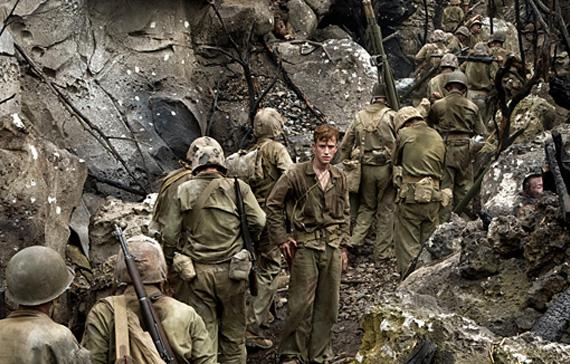
Speaking of CGI, I can't help but think that the creators gave more than a nod to he massively popular
Call of Duty video game series (perhaps to attract a younger audience?). In the obligatory
Making of The Pacific the creators talk about the "experiential" nature of the series and the "massive amount of research" to get at the truth of what it was like to actually engage in combat. (This, of course, smells like an attempt to steer clear of any political implications which would seem an impossible feat for a war film.)
I've always felt that the combat scenes were the least compelling aspects of war movies. To me it's everything around them, that informs them, that influences them that makes the experience interesting. Perhaps it's the lack of back-story that contributes the non-engagement in the individual plights of the marines in this film.
I'm soon to commence with part 3 of the series and I must say that I find the writing flat out hackneyed. Some of it seems to come right out the aforementioned video game. If there was a serious attempt at getting a good writer to adapt this material the English language, in the hands of the latest generation of Hollywood writers, has taken a real nosedive.
________________________
The language in part 3 improves, but not by much and to what avail? Greek American author, George Pelecanos, and Michelle Ashford are credited as writers of this
Melbourne episode (directed by Jeremy Podeswa ), which, as many have noted, seems like a sidetrack. I suppose that if the writing (and directing, for that matter) was exceptional and the actors were changed it would seem to be a different film altogether. The 1st Marine Division is on leave for the entire episode during which time you'd expect a bit more psychological insight into the motivations of the main characters. But the entire episode plays like a Hallmark card.

The Greek family that PFC Robert Leckie suddenly finds himself tied to is so touchingly obliging and simple (Zoe Carides' performance as Mama Karamanlis, ironically, the most compelling in the series thus far), offering nothing in the way of dramatic tension or psychological counterpoint to Leckie or any of the other enlisted men (who are mostly drunk or asleep or reluctantly accepting the Medal of Honor) that one wonders where the
story of the story is supposed to be. One might grasp for the
father/son that he never had theme but it isn't especially developed.
I admire Leckie's stubborn prowess, in general, but other than courting the Greek babe we don't get to see some of his other exploits. How did he manage to get her the silk stockings? How did he finagle a leg of lamb for the family when the fiesty, charming Mama Karamanlis couldn't? These are pretty important details when observing a character. OK, these guys are loners but the writers are keeping them away from the audience as well. I'm not sure this strategy works.
Hope we're back at war in part 4.