By "purely cinematic" I meant that Lost Highway naturally doesn't have the TV look that the first 3/4th or so of Mulholland sports due to its origin. Yes, definitely agree that Gifford's involvement is likely why LH is I think the most carefully structured and "neatest" of at least Lynch's more inscrutable and surreal films. Even though that other collaboration of theirs, Wild at Heart, may seem at first glance a bit messy, narratively it's a good deal more cleanly plotted than much of Lynch's work.
I must disagree with you on which film is essentially "all a mystery," though, as I feel that applies much more to Lost Highway than to Mulholland. While the dissociative identity explanation for LH makes good sense on paper, I find it doesn't quite work satisfactorily with the entire film, especially while simply watching it -- like there's several curious puzzle pieces here and there that just won't fit the theory. Whereas, on the other hand, MD's dream theory (i.e. that Diane Selwyn more or less dreams everything up to... well, when she wakes up) basically fits the film like hand in glove, and whenever I read other, more esoteric takes on the film I just can't quite suspend my disbelief and "see" them onscreen.
Lost Highway does seem to imply that Pete's section is just a fantasy or projection of the supposedly** crazed killer Fred's unstable mind; yet I don't think this is anywhere near "conclusive." For me, the film seems more of a pure experience in sight and sound, a sort of mental roller coaster or "simulation test" of what it would be like to be inside the brain of someone who is utterly "deranged" as the Bowie tune in the credits puts it. Because the film is so deeply subjective and untrustworthy in POV, I think the demarcations between fantasy and reality are much less clear than in Mulholland; and the relationship between certain characters (for example, the Mystery Man and Fred - is he helping him, hurting him, stealing his soul -- what exactly is the MM's motivation?) remain rather ambiguous to the end, whereas in MD most everything works pretty well as pure dream language reflected back at itself in the jarring final "reality" portion of the film.
Mulholland Drive is certainly more varied in tone than Lost Highway, and with a lot more humor and, especially, heart and sympathetic characters as well. In these respects it is the better and more likeable film, but I simply find the sumptuous hyper-noir aesthetic and sheer horrific, demented "ride" of Lost Highway to be preferable, even though (or maybe, in a way, partly because) it lacks that warmth and empathy. For better or for worse, depending on one's taste, LH feels like very possibly Lynch's most unrelentingly dark picture -- almost completely lacking the wrenching sentimentality and sense of hope that tends to characterize the endings of even quite grim films like Fire Walk With Me and Inland Empire (arguably Mulholland Drive as well).
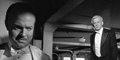
**I qualify Fred's status as crazed killer because I actually don't think the viewer has conclusive proof that Fred Madison really did kill Renee the night after Andy's party, all by himself. I think there's just as much a possibility that the Mystery Man did it, or the Mystery Man coerced Fred into killing her and then recorded him agonizing over her mutilated body, as we see in the final videotape. (If one is to follow this last reading, then the Mystery Man becomes a sort of BOB-like supernatural being feeding off the violence in people, making Faustian bargains with them and having the power to create doppelgangers and swap souls as we see with Fred's strange transformation into Pete -- a veritable "get out of jail free card" if there ever was one

. With all this in mind, then, Lynch's comment that Lost Highway takes place in the "same universe" as Twin Peaks starts to make more sense).