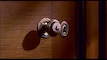
Hofmeister wrote:The 'gauze effect' is also in the film prints. It's always been there plain as day. I can't be the only one who remembers MARNIE projected.
Not everything we notice is an anomaly, this is what I'm trying to bring out. When HD shows up something that was less apparent in SD, this does not make it a digital artefact.
I've seen MARNIE projected in 35mm 12 times and counting over the last 30 years - and am embarrassed to say the I do not know for certain whether I've ever consciously noticed the gauze effect in the opening shot, or not, before. But something in the back of my head says, not only "Yes! Hofmeister!", but "Aha!" No other narrative film I know of, is as deep a meditation on illusionistic depth and the
trompe-l'oeil effect, and what they can be made to express. (And there are few, if any, films about which I have meditated more about in those 30 years, than MARNIE.)
MARNIE has almost always been heavily-qualified, if not derided, in assessments for its "cheap" effects, which is, pardon me for saying so, complete nonsense. (And frankly, any "scholar" asserting so - ](*,) - should be made to sit at the children's table.) They are sophisticated and state-of-art, at least, and experimental (read NOT cheap) in many instances. Hitchcock's and Burks' experimentation with new lenses with which to photograph Hedren, which began with THE BIRDS, reached notorious levels during the production of MARNIE. Also, the shots of Hedren on horseback are far better achieved and integrated than those of - to pick but one, highly illustrative, example among countless others - BECKETT, a film made the following year and greeted as a shining example of film craft by the established film and critical communities. (Though not, I think, perhaps the critical communities that responded favorably to MARNIE at the time.) No one seemed to mind then, that shots of Burton and O'Toole on horseback were rote, flat rear-projection. And that beautiful, complex backdrop of the Baltimore street, that so many seem to hate, is
not one but, at least, two backdrops (as seen from two different perspectives) as well as possibly a glass, or composite shot.
No, something else is very much at play in MARNIE's complex visuals but not cheapness. Whether one responds favorably to it or not remains another matter. The film's two dominant visual strategies, with regard to crafting a "backdrop" for the story, are: the plunging lines of forced single-point perspective, and; the grid. Both of which fix Marnie/Hedren in particular ways. Watch also, next time, how Hedren is restricted within the frame, from either entering or leaving it directly; that is, at the frame line rather than through a door or passageway already within the frame. There is an Ozu-like rigor being worked out, though to somewhat different effect. (Which is not to imply that Hitchock and Ozu are necessarily dissimilar. Very much, on the contrary.)
Of course, Marnie's one spectacular attempt to so, to escape, in effect, from the trap of her fate and the visual trap that is the film the, brings her, tragically, up against the grid of a stone wall.
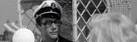
Such a gauze effect, too, makes sense as it could be seen to answer the gauze effect achieved in the complex overlay of picture and sound represented at the film's catharsis. Wherein, IIRC,
the blood saturating the sailor suit constitutes a veil almost, back through which Hedren's face emerges via a dissolve.
The weave of the fabric has always struck me as having been very much photographically accentuated in the dissolve.
It also makes sense, too, when you consider Mark's observation of a "flower" (like paintings, a typically potent signifier in Hitchcock), during the honeymoon cruise - the structural middle of the film, where so much of the film's keys and Hitchcock's now-famous preoccupation can be found - that:
"In Africa, in Kenya, there is quite beautiful flower. Coral-colored with tiny green-tipped blossoms, rather like a hyacinth. If you reach out to touch it you discover that the flower is not a flower at all, but a design made up of hundreds of tiny insects called fatid bugs. Now these insects live and die in the shape of a flower to escape the eyes of hungry birds."
This speech seems, not only, a possible diagnosis of Marnie herself, but it also articulates the idea that nature too can manifest a
trompe l'oeil wherein we perceive it as "beautiful" for being "a flower" and then "marvelous" (to pick just one such possible adjective) for being not a flower. This opens a rich interplay of ideas about visual strategies as survival and art; and pointing back to the film's earlier uses of nature and art as a poetic dimension. It therefore seems very much like an "Aha!" moment, to me, to think how Hitchcock and Burks might have found a way to sneak into the opening shot (one of the most potent and memorable in Hollywood history - and the purse only just begins to explain it!) another variation of this visual strategy.