I'm not entirely sure what they mean by "breaking the 180 degree line", but if they're literally referring to camera motion, I'm pretty sure there's no rule for how far one may turn their camera. Or else we'd all need to lambast Godard for the 360 spin in Week End.Finch wrote:Playlist review [of the 2013 Evil Dead remake] is damning.During the Q&A someone asked Alvarez why he felt it was okay to break the 180 degree line in the film, to which he responded that it hadn't really occurred to him and you can see this kind of sloppiness throughout the film. He didn't set out to break the rules, he just didn't really understand them in the first place. On a smaller debut he could've worked out some of these kinks out before transitioning onto a larger effort but here his inexperience is glaring. Horror is tension and release, anticipation and delivery, so despite throwing 100,000 gallons of blood on the screen, Alvarez doesn't seem to grasp these most basic fundamentals. Instead his film plays as a series of scenes where intense "stuff happens" and at times it's disgusting but never scary or fun.
The 180-degree Rule
-
CSM126

- Joined: Thu Nov 04, 2004 12:22 pm
- Location: The Room
- Contact:
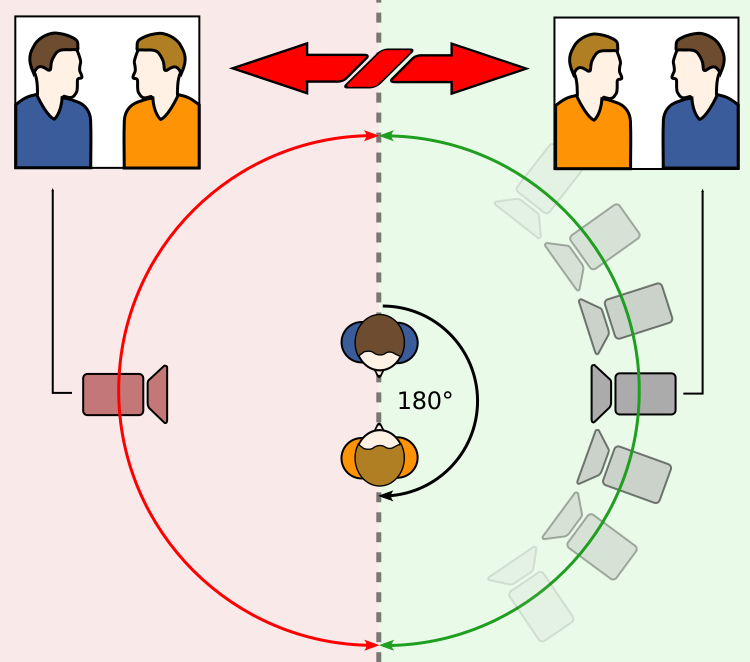
The 180-degree Rule
-
swo17

- Bloodthirsty Butcher
- Joined: Tue Apr 15, 2008 2:25 pm
- Location: SLC, UT
-
jindianajonz

- Jindiana Jonz Abrams
- Joined: Thu Oct 13, 2011 12:11 am
Re: Evil Dead (Fede Alvarez, 2013)
I'm no expert, but my basic understanding of the 180 degree rule is that when filming a scene, you should draw a straight (180 degree) line somewhere (typically between two characters) and make sure the camera never crosses the line. Think of it as staging the action on a stage in any way you want, but making sure the camera never leaves the audience seats.CSM126 wrote:I'm not entirely sure what they mean by "breaking the 180 degree line", but if they're literally referring to camera motion, I'm pretty sure there's no rule for how far one may turn their camera. Or else we'd all need to lambast Godard for the 360 spin in Week End.
The reason for this is that it helps people understand how things are moving. If you set a camera south of some train tracks and film a train going east to west, but then switch to a shot from a camera placed on the north side of the tracks, it will confuse people. A train that was moving from the right side of the screen to the left is now moving from the left side of the screen to the right. The audeince will naturally think that either the train has changed directions, or that another train has appeared that is heading in the opposite direction.
I will say that neither me nor my film-major friend noticed anything unusual with camera placement when we watched Evil Dead. The action all seemed cohesive enough.
-
tenia

- Ask Me About My Bassoon
- Joined: Wed Apr 29, 2009 3:13 pm
Re: Evil Dead (Fede Alvarez, 2013)
Wasn't Mann's The Insider famous for breaking the 180° rule ?
-
Roger Ryan
- Joined: Wed Apr 28, 2010 4:04 pm
- Location: A Midland town spread and darkened into a city
Re: Evil Dead (Fede Alvarez, 2013)
There are many ways you can effectively break the 180° rule (and good filmmakers do), but you need to understand why the rule exists first before you can do that!
-
Forrest Taft

- Joined: Fri Mar 16, 2007 12:34 am
- Location: Stavanger, Norway
Re: Evil Dead (Fede Alvarez, 2013)
The scene in The Shining with Jack and Grady in the bathroom is a good example of the 180° rule being broken to great effect, just as the scene gets a bit more eerie. There is something similarly effective in the train station scene in Peckinpah's The Getaway too, IIRC.
-
Dylan

- Joined: Wed Nov 03, 2004 1:28 am
Re: Evil Dead (Fede Alvarez, 2013)
Let's not forget that Bertolucci's The Conformist does this in just about every scene (to thrillingly great effect).
-
deadlovers
- Joined: Sun Mar 10, 2013 5:29 pm
Re: The 180-degree Rule
Pandora's Box has a great 180-degree break during the party scene as a character is crossing the room. No confusion, and very impressive mastery of the language. Haven't seen it bettered.
-
Michael Kerpan
- Spelling Bee Champeen
- Joined: Wed Nov 03, 2004 5:20 pm
- Location: New England
- Contact:
Re: The 180-degree Rule
Ozu (deliberately) broke this "rule" all the time (and his Japanese contemporaries followed suit occasionally).
-
lubitsch

- Joined: Fri Oct 07, 2005 8:20 pm
Re: The 180-degree Rule
But also in classical cinema e.g. Hollywood of the 30s where it supposedly was a sacred cow the rule is broken time and again. It's generally helpful to adhere to it though because it can give a scene a small jolt when you break it.
-
swo17
- Bloodthirsty Butcher
- Joined: Tue Apr 15, 2008 2:25 pm
- Location: SLC, UT
Re: The 180-degree Rule
It is, like many other rules, meant to be broken, but when you are breaking it you should know that you are doing so and why.
-
Feego

- Joined: Thu Aug 16, 2007 11:30 pm
- Location: Texas
Re: The 180-degree Rule
And then, of course, there's The Passion of Joan of Arc, which doesn't just break the rule, it steamrolls through it.
-
Mr Sausage

- Has Risen from the Grave
- Joined: Thu Nov 04, 2004 1:02 am
- Location: Canada
Re: The 180-degree Rule
Bingo. A good analogy: many writers break with traditional grammar for effect, but that's much different from doing it because you just don't have proper grammar. You're not in control of the rule breaking.swo17 wrote:It is, like many other rules, meant to be broken, but when you are breaking it you should know that you are doing so and why.
-
jindianajonz
- Jindiana Jonz Abrams
- Joined: Thu Oct 13, 2011 12:11 am
Re: Evil Dead (Fede Alvarez, 2013)
I'm sure nobody wants this to get philosophical, but this just leads back to the question of how connected art is to the artist- can an artist unintentionally stumble across brilliance? I wouldn't be so quick to say anybody "needs" to do this; I'd much rather approach it after the fact from the point of view "I saw it, and it didn't work."Roger Ryan wrote:There are many ways you can effectively break the 180° rule (and good filmmakers do), but you need to understand why the rule exists first before you can do that!
On a related note, how long has the 180 degree rule been around? Somebody pointed out Joan of Arc as a movie that constantly breaks it, and my first question is whether or not Dreyer was consiously aware that he was breaking the rule, or if he just made a film in a way that pleased him and it just so happened that this meant breaking the rule in the process. Had the rule been established in 1928, and did Dreyer ever say that his intention was to break it?
-
martin

- Joined: Thu Dec 13, 2007 12:16 pm
- Contact:
Re: The 180-degree Rule
Antonioni also breaks the 180 rule a lot. I think Gene Youngblood (on the Criterion commentary track) mentions one instance in L'Avventura. It's quite fascinating to read Wim Wenders' book about Beyond the Clouds, and learn how much concern Wenders had about continuity, and how "careless" Antonioni was in this matter.
I like to use a football (or soccer to you Americans, but it probably fits your football too) tv broadcast as an example of adhering to the 180 degree rule. It would be impossible to follow the match if the tv produceres had cameras on both sides of the stadium and would cross-cut rapidly to cameras on opposite sides while play is going on. We want to see one team attacking to the left (from our viewpoint) and the other team the other way. Not a mixture of both.
I like to use a football (or soccer to you Americans, but it probably fits your football too) tv broadcast as an example of adhering to the 180 degree rule. It would be impossible to follow the match if the tv produceres had cameras on both sides of the stadium and would cross-cut rapidly to cameras on opposite sides while play is going on. We want to see one team attacking to the left (from our viewpoint) and the other team the other way. Not a mixture of both.
Last edited by martin on Tue Mar 12, 2013 8:36 pm, edited 2 times in total.
-
swo17
- Bloodthirsty Butcher
- Joined: Tue Apr 15, 2008 2:25 pm
- Location: SLC, UT
Re: The 180-degree Rule
Yes, Youngblood's excellent commentary for L'avventura brings that up. That's actually where I first heard of the term.
-
Mr Sausage
- Has Risen from the Grave
- Joined: Thu Nov 04, 2004 1:02 am
- Location: Canada
Re: Evil Dead (Fede Alvarez, 2013)
Happy accidents are a real thing for sure. The problem with the 180 rule is that it's there to maintain continuity. It's not just a point of style mistaken for a grammatical rule, like when grammarians used to say you can't end a sentence with a preposition or something. So, while I'm sure there are a lot of directors who can get away with being lax with the 180 rule because they have such a command of their style and such a clear vision of what they're making that they avoid jarring continuity issues, such directors are going to be a minority. But if you have a first time filmmaker like the Evil Dead director who doesn't even understand it, then you're much more likely to get continuity issues and a general awkwardness that may not serve the film well.jindianajonz wrote:I'm sure nobody wants this to get philosophical, but this just leads back to the question of how connected art is to the artist- can an artist unintentionally stumble across brilliance? I wouldn't be so quick to say anybody "needs" to do this; I'd much rather approach it after the fact from the point of view "I saw it, and it didn't work."Roger Ryan wrote:There are many ways you can effectively break the 180° rule (and good filmmakers do), but you need to understand why the rule exists first before you can do that!
On a related note, how long has the 180 degree rule been around? Somebody pointed out Joan of Arc as a movie that constantly breaks it, and my first question is whether or not Dreyer was consiously aware that he was breaking the rule, or if he just made a film in a way that pleased him and it just so happened that this meant breaking the rule in the process. Had the rule been established in 1928, and did Dreyer ever say that his intention was to break it?
There are no absolutes in filmmaking. Some filmmakers can plain get away with being lax about certain points of film grammar, but they're usually special cases. You don't see average or middling directors able to pull this off. The names being thrown around here are all master directors. Guys like Dreyer and Antonioni, even if they weren't aware of the rule (or at least the effect of breaking it), at least had enough visual acumen and stylistic brilliance to get away with it, even turn it into a positive. There were other things making up for it, if indeed the laxity needed making up for.
-
Gregory

- Joined: Tue Nov 02, 2004 8:07 pm
Re: The 180-degree Rule
The examples of the moving train, the football match, and the Shining bathroom scene all involve opposite side-views that are 180 degrees apart ("on the line" one might say). But the practice of Ozu and others of filming 2 people who are speaking to one another by having each directly face the camera as it points in opposite directions on the line of a 180-degree axis seems to me far less disorienting than the opposing side views. So it seems to me there's more than one type of phenomenon here, depending on how the scene is set up.
As to when and where the rule emerged, Bordwell actually refers to it as "Hollywood's 180-degree system" in the Ozu book (emphasis added).
As to when and where the rule emerged, Bordwell actually refers to it as "Hollywood's 180-degree system" in the Ozu book (emphasis added).
-
Feego
- Joined: Thu Aug 16, 2007 11:30 pm
- Location: Texas
Re: The 180-degree Rule
In the case of Dreyer and The Passion of Joan of Arc, it's possible that he did not know about the 180-degree rule precisely as we know it today, but he certainly knew enough about film "grammar" to understand what he was doing. His earlier films like The Parson's Widow, Michael, and Master of the House certainly maintained a more conventional visual style than his 1928 film, which constantly denies the audience a point of spacial identification between the actors. We will see two characters speaking to each other, but the actors will face the same direction, or one may face off camera while the other faces the camera directly. The bottom line is that he understood he was breaking some rule in order to deliberately disorient the audience.
-
Forrest Taft
- Joined: Fri Mar 16, 2007 12:34 am
- Location: Stavanger, Norway
Re: The 180-degree Rule
I think that another reason as to why I find the cut in The Shining to be such an effective one, is that at first it appears to be an axial cut, which in itself can be quite jarring, as it is seldom used in contemporary cinema.Gregory wrote:The examples of the moving train, the football match, and the Shining bathroom scene all involve opposite side-views that are 180 degrees apart ("on the line" one might say). But the practice of Ozu and others of filming 2 people who are speaking to one another by having each directly face the camera as it points in opposite directions on the line of a 180-degree axis seems to me far less disorienting than the opposing side views. So it seems to me there's more than one type of phenomenon here, depending on how the scene is set up.
As to when and where the rule emerged, Bordwell actually refers to it as "Hollywood's 180-degree system" in the Ozu book (emphasis added).
I was under the impression that 180-degree system/rule came about as a result of the sound film, along with the rest of the characteristics of the classic Hollywood style? If so, I would be very surprised (and impressed!) if Dreyer was familiar with it when he was shooting Jeanne D'Arc.
-
zedz

- Joined: Sun Nov 07, 2004 11:24 pm
Re: The 180-degree Rule
Ozu is a great example of a filmmaker who basically developed his own, extremely consistent and expressive grammar. People aren't confused by his style, even though it breaks a lot of standard rules of Hollywood grammar (which Ozu was very familiar with - just look at his 30s films), because it has its own logic and consistency. He even invented whole new realms of cinematic grammar, such as his 'rules' for bridging / spatially connecting two distant locations with intermediary shots, something Hollywood basically reduces to "there should be an establishing shot". And he could play around wittily with those rules too, as with the baseball segue in An Autumn Afternoon.Gregory wrote:The examples of the moving train, the football match, and the Shining bathroom scene all involve opposite side-views that are 180 degrees apart ("on the line" one might say). But the practice of Ozu and others of filming 2 people who are speaking to one another by having each directly face the camera as it points in opposite directions on the line of a 180-degree axis seems to me far less disorienting than the opposing side views. So it seems to me there's more than one type of phenomenon here, depending on how the scene is set up.
As to when and where the rule emerged, Bordwell actually refers to it as "Hollywood's 180-degree system" in the Ozu book (emphasis added).
-
The Fanciful Norwegian

- Joined: Tue Nov 02, 2004 6:24 pm
- Location: Teegeeack
Re: The 180-degree Rule
Chris Berry's Postsocialist Cinema in Post-Mao China (which, despite its title, devotes a lot of attention to pre-1976 Chinese cinema) has this interesting discussion of how the 180-degree rule was applied/ignored in Chinese films of the '50s and '60s:
...the overall cutting logic within scenes of any length is often designed to take the spectator around the entire group involved in the action, so that the room, the characters and the settings are seen from all sides. This position also gives a sense of epistemological command, insofar as the spectator can receive the impression of being able to see everything there is to be seen. This pattern occurs in all the films in the sample [Bridge, The Unfailing Beam, Li Shuangshuang, Woman Basketball Player No. 5, Early Spring in February, Two Stage Sisters]. For example, in the scene at the beginning of Early Spring in February [1963] where Xiao Jianqiu is in the Tao family home, the camera begins with an establishing shot showing the table with the men arranged around it and the door through which Tao Lan is soon to enter along the left hand wall. After her entry, the characters get up and move around, and the cutting takes the camera round the room, so to speak, moving to the right of the table and round behind it, all the while giving the spectator good views of relevant facial expressions, be it a speaker or someone who is reacting, as it also gives an all-round view of the scene.
This method appears to exceed the 180-degree rule of the Hollywood classical cinema, which forbids cutting over an imaginary 180-degree line corresponding to the axis of action for fear of changes in screen direction that might confuse the viewer. However, most cuts that go over the 180-degree line in the Chinese classical cinema avoid confusion, partly because the large number of characters interacting and moving about in these scenes often make it hard to establish a 180-degree axis in the first place, and partly because prior establishing shots and full shots have provided the spectator with sufficient orientation.
Most shots that go over the 180-degree line in the Chinese classical cinema are not used in any particular meaningful or systematic manner, but are subordinated to the principle of maintaining frontality and motivated by character movement. The one exception is when a large angle of cut over the 180-degree line is used to mark a sudden dramatic shift. For example, in the scene of Li Xia's departure in The Unfailing Beam [1958], a frontal shot of him with one other soldier on either side of him cuts as they turn to a shot from a position directly opposite. This marks the significance of Li Xia's leaving Yan'an, symbolically suggesting a clear line between two spaces, one now behind him.
Similarly, in Early Spring in February, an example is connected to Tao Lan's flashback to a scene by a lake where she saw Xiao Jianqiu before. This occurs as he is playing a piano piece called, significantly in terms of the overall concerns of the film, "Hesitation." The cut over the 180-degree line marks her sudden memory and also the dramatic shift from him playing the piano to her remembering. At the beginning of the scene, Tao Lan enters and stands to the left of the piano as Xiao begins to play. The first four shots of the piano are from the right side of the piano. The fifth shot cuts over the axis to a position behind Tao on the left side of the piano. She walks across the room, and the sixth shot is a close-up of her face. The seventh shot shows us what she is looking at, namely Xiao Jianqiu playing the piano, and the eighth shot is another close-up of her face, which then dissolves into the flashback. After the flashback, the film dissolves back into a close-up of her face. She is then shown walking back over to the piano, the camera moving with her, and to the left of the piano. The camera finishes in a position similar to that of the fifth shot on the left of the piano, and so this shot is a sort of reverse of the procedure. The next shot cuts back across the axis of action to the right of the piano, the side it was on at the beginning of the scene.

-
Adam X
- Joined: Thu Apr 16, 2009 9:04 am
Re: Evil Dead (Fede Alvarez, 2013)
I think for the Playlist review to seemingly blame the director for breaking the '180-degree rule' is forgetting that the cinematographer/DP should be keeping this in mind while shooting far more so than the director. While obviously something for both parties to keep in mind when aiming for general spatial understanding of the image, it'd be the cinematographer who's more to blame if something like this unintentionally goes awry.Mr Sausage wrote:But if you have a first time filmmaker like the Evil Dead director who doesn't even understand it, then you're much more likely to get continuity issues and a general awkwardness that may not serve the film well.
Given the unfortunately context-free quote of the director's apparent lack of technical awareness, the cinematographer should be there to back things up - not having seen the Evil Dead remake (though I'm looking forward to it for some crazy reason), it's impossible to personally judge whether this may've been intentional or just sloppy filmmaking. Not all director's are technically-minded while shooting though, and (at least going by IMDb) Alvarez did edit his four shorts prior to the remake, so he's clearly not a completely performance-focussed filmmaker.
I think this is a really interesting discussion, for the moments when director's deliberately break this 'rule', as it can lead to some really wonderful effects. Makes me want to be more focussed on the tech side of things while watching films - regardless of how much on-set experience I get, I still tend to just absorb films on a first time viewing as a sensory whole, only on repeat viewings becoming more aware of the nuts and bolts. Which I guess is fortunate, as it's frustrating when behind the scenes knowledge ruins your pure enjoyment of something.
-
Forrest Taft
- Joined: Fri Mar 16, 2007 12:34 am
- Location: Stavanger, Norway
Re: The 180-degree Rule
For an illustration of what happens when the director is not paying any attention to the rule, look no further than to the hilarious "Reckless Youth", one of the Joe Dante-directed segments from Amazon Women on the Moon.