[img]http://criterion_production.s3.amazonaws.com/release_images/1202/392_box_348x490_w128.jpg[/img]
One of the most acclaimed Japanese directors of all time, Hiroshi Teshigahara distinguished himself in the sixties with a series of sinuous, atmospheric, and daring films. Teshigahara found his spiritual partner in novelist and screenwriter Kobo Abe, with whom he collaborated on these Kafkaesque portraits of identities in peril, films that captivated mainstream audiences while also touching the edges of the Japanese avant-garde. The existential ghost story Pitfall (Otoshiana), the shocking, erotic fable Woman in the Dunes (Sunna no onna), and the sci-fi–tinged nightmare The Face of Another (Tanin no kao) are among cinema's enduring enigmas and rarest pleasures.
Criterionforum.org user rating averages
Feature currently disabled
The Face of Another
[img]http://criterion_production.s3.amazonaws.com/product_images/254/395_box_348x490_w128.jpg[/img]
A staggering work of existential science fiction, The Face of Another dissects identity with the sure hand of a surgeon. Okuyama (Yojimbo's Tatsuya Nakadai), after being burned and disfigured in an industrial accident and estranged from his family and friends, agrees to his psychiatrist's radical new experiment: a face transplant, created from the mold of a stranger. As Okuyama is thus further alienated from the strange world around him, he finds himself giving in to his darker temptations. With unforgettable imagery, Teshigahara's film explores both the limits and freedom in acquiring a new persona, and questions the notion of individuality itself.
Criterionforum.org user rating averages
Feature currently disabled
Pitfall
[img]http://criterion_production.s3.amazonaws.com/product_images/251/393_box_348x490_w128.jpg[/img]
When a miner leaves his employers and treks out with his young son to become a migrant worker, he finds himself moving from one eerie landscape to another, intermittently followed (and photographed) by an enigmatic man in a clean, white suit, and eventually coming face to face with his inescapable destiny. Hiroshi Teshigahara's debut feature and first collaboration with novelist Kôbô Abe, Pitfall is many things: a mysterious, unsettling ghost story, a portrait of human alienation, and a compellingly surreal critique of soulless industry, shot in elegant black-and-white.
Criterionforum.org user rating averages
Feature currently disabled
Woman in the Dunes
[img]http://criterion_production.s3.amazonaws.com/product_images/248/394_box_348x490_w128.jpg[/img]
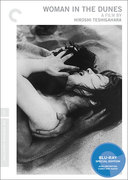
One of the 1960s' great international art-house sensations, Woman in the Dunes was for many the grand unveiling of the surreal, idiosyncratic world of Hiroshi Teshigahara. Eiji Okada plays an amateur entomologist who has left Tokyo to study an unclassified species of beetle found in a vast desert. When he misses his bus back to civilization, he is persuaded to spend the night with a young widow (Kyoko Kishida) in her hut at the bottom of a sand dune. What results is one of cinema's most unnerving and palpably erotic battles of the sexes, as well as a nightmarish depiction of the Sisyphean struggle of everyday life—an achievement that garnered Teshigahara an Academy Award nomination for best director.
STANDALONE SPECIAL FEATURES
• New high-definition digital restoration, with uncompressed monaural soundtrack on the Blu-ray
• Video essay on the film from 2007 by film scholar James Quandt
• Four short films from director Hiroshi Teshigahara's early career: Hokusai (1953), Ikebana (1956), Tokyo 1958 (1958), and Ako (1965)
• Teshigahara and Abe, a 2007 documentary examining the collaboration between Teshigahara and novelist Kobo Abe, featuring interviews with film scholars Donald Richie and Tadao Sato, film programmer Richard Peña, set designer Arata Isozaki, producer Noriko Nomura, and screenwriter John Nathan
• Trailer
• PLUS: An essay by film scholar Audie Bock and a 1980 interview with Teshigahara
Criterionforum.org user rating averages
Feature currently disabled
SET-EXCLUSIVE SPECIAL FEATURES
• New, restored high-definition digital transfers
• Video essays on all three films by critic and festival programmer James Quandt
• Four short films by Hiroshi Teshigahara: Hokusai (1953), Ikebana (1956), Tokyo 1958 (1958), and Ako/White Morning (1963)
• A new documentary about the working relationship between Teshigahara and Kobo Abe, including interviews with Japanese film scholars Donald Richie and Tadao Sato
• PLUS: A booklet featuring essays by James Quandt, Howard Hampton, Audie Bock, and Peter Grilli and Max Tessier's 1964 interview with Teshigahara