domino harvey wrote:Even today it's still a touchstone reference point amongst many people I know around my age.
I think you felt about the film somewhat the way I felt about Before Sunrise, which came out the year before I got out of high school. Faced with uncertain territory of college and adulthood, it seemed like a road map of the way things should or could be.
I only saw Ghost World about 4 or 5 years ago, when a Girlfriend insisted I see it, but I remember definitely siding with Enid over Rebecca--though I think the movie is far from decided on that course. The choosing of sides to me came easily, because Rebecca's wants and needs are so patently conventional that they are easy to dismiss. Enid may not really know what she wants, and she may be afraid to go out and figure out what it is she wants, but she is not easily satisfied with convention and compromise, and so to me she seemed more admirable for that refusal to settle. Watching the movie at an age somewhat advanced from the characters, I didn't really expect Enid to have anything figured out for herself, anyway. If you look at the film with the notion that these characters are struggling to formulate adult identities, then I think Enid is willing to flail more, to experiment with ways of being that move beyond Rebecca's more pat directions.
The comic and the film differ considerably here, because the deserted landscape in the comic is so clearly a devastated wasteland, while the surroundings of the film are basically lushly suburban. The colors in the film give the background so much richness, that I think it gives extra credence to Rebecca's pursuit of convention--convention in this world is very comfortable. The background of the comic, meanwhile, is close to desolate, and deprived of nearly all enriching color. As a result, Enid's dissatisfaction seems a clearer "read" of her environment, and Rebecca's embrace of it seems like defeat. In the film, the girls renting an apartment together seems a faintly Acadian scheme--the kind of sensible gesture that would make their young lives happier and more eventful, and the kind of move that would continue to evolve their collaborative view of the world. In the comic, staying in that space is slow suicide--and the comic underlines this when Enid looks in upon Rebecca, slumped over in listless trance at her job, and says to the air, "you've grown into a very beautiful young woman." Then she picks up and leaves the "ghost world," perhaps for good. That scene is shot through with the clear misery that conformity offers--a grind that pressures us to keep up only the illusion of happiness and fulfillment--and Enid is much more the hero for attempting to avoid that fate. By placing the movie in a less stylized, more graphically pleasing setting, that point is undercut very significantly; there's nothing in the movie's world that seems so bad that Enid needs to rebel against it.
Unlike the comic, the movie is also loaded with charm, and that seems to have worked very well in preserving the picture in people's memories. My dad even gets a smile on his face recalling scenes from Ghost World, which he saw a year or so ago on the Sundance Channel or AMC. The leads do a great deal to achieve this. It's hard to look at Thora Birch as quite the gawky, unfortunate character Enid is in the comics, and it's hard to see Scarlett Johansson as the plain figure Rebecca appears in the comics. Part of the problem in the comics is that these girls are starved for beauty in their lives--there is nothing that possesses any degree of "pure" beauty in the comic, no place or person that truly dazzles, and that extends to the girls themselves--who are awkward, not terribly clever, and not naturally attractive. That their experiences promise to be exciting but only lead to disappointments is rather painful in the comic, whereas the movie sells these setups as woeful comedy. The girls in the movie have a Chaplinesque, glittering charm (and maybe a little of Chaplin's self-regard, as well), mincing flatly over the deadpan comedy in a way that their comic-book counterparts could never approximate. So I think the notion that what these girls feel is simply angst, a phase of teenage immaturity, is more the creation of the movie than the book. The movie feels a little less serious, because the world presented in the film is in a sort of natural balance--the place is really beautiful, and the girls are harbingers of a new kind of Hollywood beauty that is nerdy and Rubenesque, direct and seemingly open and available. Whereas the setting of the comic is a genuine "ghost world," absent of every trace of vigor or vitality. The crises one faces in a dying world are very different that the crises played out in a cute apartment, and I think the change of the setting creates an accompanying change in mood, and a change in our sympathies, to match.


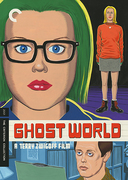
 ); also, the way Enid & Rebecca alternately condescended & pitied him was both pathetic & hilarious - LOL.