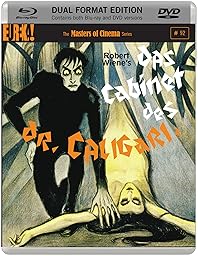
Props55 wrote:Schrecko, I haven't cared for any CALIGARI scores that have come down the pike since the days of LD. I keep the prehistoric Image/Sheppard DVD to this day for the Timothy Brock* score despite the upper frame sutures and the lame commentary. Ditto the 2nd Image iteration of NOSFERATU for the moody organ score, the tolerable (actually quite good!) "avant garde" score (
The Silent Orchestra?) and the Nosferatour.** While I respect (more than actually like) Zorn I too have grave reservations about his suitability for this project. With any luck though perhaps they will also include a more "traditional avant garde" score!!!
* What has happened to Brock? I still keep those early Kinos of LAST LAUGH and FAUST just to hear his heartrendingly beautiful scores. And I don't think STORM OVER ASIA would be the same experience without him.
** You once wrote a short piece about the virtues of watching an old copy of NOSFERATU (and, by extension, other silent horrors), how the ancient, murky prints and transfers accentuated the wierdness and ghostly supernatural spectacle. Although I love these incredible new restorations that reveal the sharp details and intricate textures hidden beneath the patina of age, I too enjoy occasionally reentering the dank tomb of "old-time" silent horror!
Well, his
Latest News site section is sadly underutilized these days. I believe he is still heading the Olympia, and been keeping himself quite busy. Perusing his site, this little tidbit caught my eye:
Brock conducted from the original manuscript, by Ildebrand Pizzetti and Manilo Mazza, the entire three-and-a-half-hour score to the 1913 epic Cabiria during the Cultural Olympics festival at the site of the 2006 Winter Olympics in Torino, Italy. In co-operation with the National Film Museum in Torino, he is now in the midst of restoring the original manuscript for publication in 2010.
One hopes that this signals something happening with the restoration of the Turin extant materials which bring this majestic epic far closer to it's original incarnation. The ancient Kino disc of mine is worn down to the fucking metal.
Without question, my favorite original Brock score is--and I've mentioned this about a thousand times already-- on the Image version of
Berlin, Symphony of a Great City. I've rarely seen a modern composer show such fantastic understanding of the nuance and symbolic vocabulary of an old silent film, as Brock in
Berlin. His score IS the film for me, it breathes the content through and through, the film and the score push each other forward, thrusting and resting and contemplating in total harmony . . . it's a fine interlocking lacework between score and image that I find incredibly rare. There is a remote, extremely obscure sadness running through the text of
Berln that the score subtly brings out--and that Brock clearly understood--so that by the climax of the film, as the cabaret figure kicks back into gear and drives the film towards its end, I inevitably have a lump in my throat, and can never put my finger on why. I only know that the score has an awful lot to do with bringing out this moving, subtle poetry resident in the film.
Hre's the latest calendar info from Brock's site. The man is clearly keeping himself very busy:
:: December 8, (afternoon) Lyon, France/Orchestre National de Lyon
Film: Modern Times – Music: Chaplin (restored by TB, 2000)
:: December 18, Antwerp, Belgium/Brussels Philharmonic Orchestra
Film: Blackmail – Music: Neil Brand (orch. TB)
:: December 21, Brussels, Belgium/Brussels Philharmonic Orchestra
Film: Blackmail – Music: Neil Brand (orch. TB)
:: December 30, Madrid, Spain/Orquesta Filarmónica de Málaga
Film: The Gold Rush - Music: Chaplin (restored by TB, 2007)
2014
:: January 3, Málaga, Spain/Orquesta Filarmónica de Málaga
Film: City Lights - Music: Chaplin (restored by TB, 2005)
:: January 4, Málaga, Spain/Orquesta Filarmónica de Málaga
Film: The Gold Rush - Music: Chaplin (restored by TB, 2007)
:: January 27, Basel, Switzerland/Basel Sinfonietta
Concert: Strauss: Tod und Verklärung, Mussorgsky: Songs and Dances of Death
:: January 31, Bristol, UK/Emerald Ensemble
Film: The Kid – Music: Chaplin (world premiere of chamber orchestra version by TB, 2013)
:: February 10, Riga, Latvia/Latvian National Symphony
Film: Carmen – Music: Hugo Reisenfeld/George Bizet
Film: Burlesque on Carmen – Music: Timothy Brock
:: February 15, Porto, Portugal/Orchestra Filharmonica di Porto
Film: New Babylon – Music: Shostakovich (restored by TB, 2001)
:: April 22, Madrid, Spain/Teatro de la Zarzuela
Film: The Circus – Music: Charles Chaplin (restored by TB, 2002)
EDIT: Nice little capsule of Brock's work on Berlin, and a short review:
Original Scores
Berlin, Symphony of a Great City (1929, score 1994)
Berlin, Symphony of a Great City
Original Title: Berlin: Die Sinfonie der Großstadt
Directed by: Walter Ruttman
Genre: avant-garde
Country: Germany
Running Time: 62 mins
Instrumentation List
Berlin, Symphony of a Great City (1994):
2 flutes (II dbl. picc.)
2 oboes (II dbl. E. horn)
2 clarinets
Alto saxophone
1 bassoon
-
2 horns
2 trumpets
1 trombone
1 tuba
-
timpani
percussion (2)
-
strings
Reviews:
Berlin, Symphony of a Great City
The title says it all: this is a visual symphony in five movements celebrating the Berlin of 1927: the people, the place, the everyday details of life on the streets. Director Walter Ruttman, an experimental filmmaker, approached cinema in similar ways to his Russian contemporary Dziga Vertoz, mixing documentary, abstract, and expressionist modes for a nonnarrative style that captured the life of his countrymen. But where Vertov mixed his observations with examples of the communist dream in action, Ruttman re-creates documentary as, in his own words, "a melody of pictures." Within the loose structure of a day in the life of the city (with a prologue that travels from the country into the city on a barreling train), the film takes us from dawn to dusk, observing the silent city as it awakens with a bustle of activity, then the action builds and calms until the city settles back into sleep. But the city is as much the architecture, the streets, and the machinery of industry as it is people, and Ruttman weaves all these elements together to create a portrait in montage, the poetic document of a great European city captured in action. Held together by rhythm, movement, and theme, Ruttman creates a documentary that is both involving and beautiful to behold. The original score by Timothy Brock is lyrical and dramatically involving, complementing the mood and movement marvelously. Also included is the avant-garde short Opus 1, an abstract study in animated shapes and movement.
Sean Axmaker