I love that small speech that Art Hindle makes to his daughter's teacher regarding Eggar's character: "Sometimes it just kills me to think that I might have screwed my kid up already. She's not even six...Sometimes when I'm being easy on myself I think 'It's not your fault, you got taken in. You got involved with a woman who married you for your sanity, hoping it would rub off'. Too bad it started to work the other way".
The thing I like most about Cronenberg's films is, though they have their gory and shocking moments, there is often a far more powerful feeling of glacial horror running through them - a shifting and melting of reality that makes all the films unforgettably troubling.
I find it difficult to put into words but from The Brood on Howard Shore's scores really add to this feeling, adding a layer of horror to the sequences in their drawn out notes and screaming shrieks of shock (yet also precisely timed in their howls), while the visuals calmly, impassively capture every detail of a shocking scene, as much as they would if a normal conversation were occurring.
One of the other interesting things about the early period of Cronenberg films and their focus on somewhat peripheral to the action figures of boyfriends/husbands, when really we might expect far more attention to be paid to Rose or Nola, is that it adds greatly to the sense of futility. Our 'heroes' don't really have an inkling as to what is going on until around the mid-point of these films and even then there is little they can do to fight against the horror, just try and focus on saving their girlfriends or children - with the tragedy being that they were often the first to be lost.
Shivers/They Came From Within/The Parasite Murders is a great example of this, as our clueless doctor based in the surgery in the deluxe block of flats starts noticing strange behaviour amongst his patients (shades of Invasion of the Body Snatchers), that seems to be linked to a sexual disease. Of course by the time he has uncovered the elderly doctor's experiments and had the implications explained to him by his friend (Joe Silver, who plays a very similar role, and meets a similarly nasty and ironic end in Rabid), it is far too late to do anything about it. (While I'm looking forward to seeing if
Vincenzo Natali's adaptation of J.G. Ballard's High Rise works out, really Cronenberg already captured a lot of the same kind of ideas in Shivers)
These 'heroes' are callow voyeurs (Jude Law in eXistenZ plays a similar character, who has more things happen to him than pushing forward the narrative himself), watching the new world come into being while the doctors and scientists like Dr Keloid in Rabid or the doctor in Shivers who have all the answers die, commit suicide or go mad early on in the film, abandoning the narrative and the characters within it to the consequences of their machinations.
Even when the 'father figure' survives to the final section, such as Reed's Dr Raglan or Dr Ruth in Scanners, they are singularly ineffectual or literally immobilised by their guilt, suitable only to be decoys to set up the final confrontations.

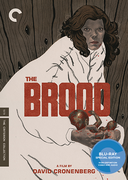




 ) during Cronenberg's divorce and brutal child-custody battle. It is interesting what you say about the cycle of "mad doctor" films, and it might have made the film even more interesting if it were told from Eggar's point of view rather than the husband's. But then, considering what Cronenberg was going through at the time, it's obvious why he would sympathize with the husband and depict the wife as literally distant and closed-off, unable to be reasoned with. This sympathy extends to Eggar's parents as well, with her mother being the abusive drunk and her father being the remorseful, anguished partner, the one who is loved by the child even as she recognizes his faults.