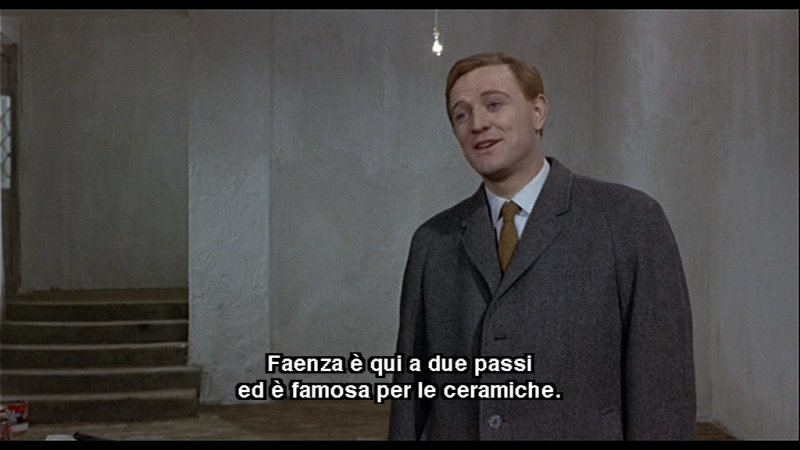
Red Desert (Antonioni, 1964)
-
kinjitsu

- Joined: Sat Feb 12, 2005 5:39 pm
- Location: Uffa!
Still have the Image disc but have considered buying this one yet still patiently waiting for that new and improved edition.Bryan wrote:Does anyone have the MEDUSA dvd release of this? I was wondering what the quality was like. Thanks.
Some specs:
Il Deserto Rosso
Durata: 120'
Produzione: Medusa
Distribuzione: Medusa
Codice Area: 2 - Europa
Tipo DVD: 9 - Singolo lato, doppio strato
Audio: Italiano: Dolby Digital 1.0
Sott. non udenti: Italiano per non udenti
Capitoli: 22
Formato video: 1.85:1 Anamorfico
Last edited by kinjitsu on Sun Jan 01, 2006 5:40 pm, edited 1 time in total.
-
Gordon
- Joined: Thu Nov 11, 2004 12:03 pm
-
kinjitsu
- Joined: Sat Feb 12, 2005 5:39 pm
- Location: Uffa!
Cached from Google:davidhare wrote:Connoisseur released Deserto Rosso on VHS, which I have. The print was rather understaurated to my mind, certainly bearing in mind the film was sholt in Technicolor.
Think I posted once before on this but a gorgeous, restored 35mm print was screened at the SFF for its Antonioni retro in 2003. This print is the one we need, presumably an Italian source.
SFF
RED DESERT
Full Detail:
‘Eros is sick', Antonioni would say of the erotic impulse that governs the romantic malaise of the characters in the trilogy of films that precede Red Desert. That metaphor of sickness is picked up in Red Desert and made both more literal in the character of Giuliana (Monica Vitta), a neurotic wife whose damaged psyche must, in the words of her doctors, ‘readjust to reality', and, more diffuse in as far as the idea of sickness extends to the general contamination of natural environments by the industrial world. The effects of the encounter between industry and nature are all too apparent as we watch Giuliana's move through a landscape of factories and their smog, of chemical refuse that results in polluted water canals and stagnant pools of greenish slime. If man is ill, he has in turn made nature ill. The one sequence of respite from this reality comes in the visual rendering of Giuliana's utopian fantasy of a young girl living in harmony with nature on an island paradise. Yet, the fantasy is ambiguous, for within the girl's world sails a mystery yacht that entices her with thoughts about what is beyond her horizon. Red Desert is Antonioni's first colour film, shot in the northern Italian industrial port of Ravenna and its environs. The proximity of land and water is a significant iconographic feature of the film that results in some surreal images, as in the shot of a cargo vessel that seems to be sailing on land. The film is a supreme experiment in colour cinematography, one of the richest in film history. Colour is used as if applied to a canvas—Antonioni went so far as to paint trees and grass to achieve the desired result—and yet the film is not striving for a conventional ‘painterly' effect. It is surprising that such dire subject matter is rendered with such sublime beauty. One of Antonioni's most perfect films. – Rolando Caputo
-
godardslave

- Joined: Tue Nov 02, 2004 8:44 pm
- Location: Confusing and open ended = high art.
and to provide a slight counterpoint:
culled from amazon vhs comments (I enjoy the comparision to Hegel especially):
culled from amazon vhs comments (I enjoy the comparision to Hegel especially):
Reviewer: Oslo Jargo (FINLAND) - See all my reviews
This film, although gorgeous to watch, is not something easy to behold. Most of the dialogue is mundane and tedious and the protagonists are annoying, spoiled and confounded bourgeoisie. Antonni drags us through their life and its like being dragged along some empty desert by a blind horse. What does he expect from us? Does he want us to side with the ill-fated Monnica Viti who eventually commits suicide in the end? Or does he want us to show that the desert is something very temporary? Either way, the film is a perfect blend of abstract philosophy devoted to these issues, its not entertaining, but neither is reading Hegel.
-
yoshimori
- Joined: Wed Nov 03, 2004 6:03 am
- Location: LA CA
If I understand you, that new print seems odd indeed. Antonioni notoriously desaturated colors for the bulk of Red Desert. Vitti wore an extremely desaturated green coat so that her 'red' hair might stand out just a little. Antonioni shot in the dust, under overcast skies, and in the early morning fog to flatten colors. And you might notice, for example, that each of the fruits in the fruit cart in the middle of the film has been spray-painted gray. All this sets up, by contrast, the short saturated scene of Vitti's story about the girl in the bay.davidhare wrote:Connoisseur released Deserto Rosso on VHS, which I have. The print was rather understaurated to my mind, certainly bearing in mind the film was sholt in Technicolor.
Think I posted once before on this but a gorgeous, restored 35mm print was screened at the SFF for its Antonioni retro in 2003. This print is the one we need, presumably an Italian source.


-
Lino

- Joined: Wed Nov 03, 2004 10:18 am
- Location: Sitting End
- Contact:
-
yoshimori
- Joined: Wed Nov 03, 2004 6:03 am
- Location: LA CA
Perhaps we're talking past each other. In any case, there are a couple of interviews with Antonioni re color in Red Desert (and Blow-Up) in his book, Architecture of Vision. Of particular interest might be his essay called "The White Forest" in which he writes about a scene for Red Desert for which he had an entire forest painted white. Here, for those who don't have the book, is a relevant excerpt:davidhare wrote:Nononono.
In fact, one thing was certain: that green had to be eliminated if I wanted the scenery to acquire something of an original beauty, made up of arid grays, imposing blacks, and even pale pink and yellow spots - distant pipers or signs. And so when the production manager announced to me, some time after, that the following Sunday we would be able to film the scene in front of the forest and asked me what I would need, I was suddenly certain, to the extent one can be certain in this order of things, that the forest should be painted white, a dirty white that, at best, would turn out gray in Technicolor, like the sky of those days, or like the fog, or like the cement.
These similarities in the gray sky, the fog, and the cement (which by the way is made here, close by, in enormous quantities) are similarities of which I am thinking only now, tonight, in an attempt to find at all costs a justification for the mass of work I have unleashed, and to silence the doubts and worries that are assailing me from every side... Second worry: if tomorrow the sun - with one of those jokes that this very mysterious object is used to pulling on us - comes out, all of this work will have been in vain...
The scene, unfortunately, was not shot because, Antonioni writes, the morning he planned to shoot it, the sun did indeed come out.
-
Lino
- Joined: Wed Nov 03, 2004 10:18 am
- Location: Sitting End
- Contact:
-
Gordon
- Joined: Thu Nov 11, 2004 12:03 pm
Fascinating. I did not know this about Accident - a film I have considerable admiration for. Have you seen the UK DVD - which is coupled with Bill Naughton and Roy Boulting's, The Family Way? It is a true 1.66:1 anamorphic transfers appears very good, but as I have never seen a 35mm projection, I way be bound in ignorance regarding the film's design. I got the set cheap, though, so I wouldn't be too bummed out.davidhare wrote:A comparable problem lies in the current Universal prints/DVDs of Losey's Eastmancolor Accident which has an "even" looking palette, whereas the original Eastman quality controlled prints of this and BlowUp in the sixties had a very "lush" application of primaries.
On most old films, the colour scheme is usually pretty natural and common sense sees most telecine folks through, but on films like The Red Desert, common sense goes out the window and key knowledge of the film's design is essential. The Italian DVD transfer looks amazing - I'd love to own it - with subs, though! There may actually be a breakthrough this year in regard to Antonioni, once The Passenger DVD makes it way into people's consciousness again and that we see Zabriskie Point from Warner and a new The Red Desert disc from whoever, hopefully Criterion, but as long as transfer is as good as the Italian disc, then I won't complain about who releases it. But it is a film that needs some contexualizing as it is perhaps the film in Cinema that is easily mistaken for a 'boring piece of shit'. It is a deeply uncomortable film and it is not a film that I could ever say that I truly like, let alone love, but it's themes and certainly its uniquely overwhelming presentation continue draw me in - hopefully not permanently, though!
-
Gordon
- Joined: Thu Nov 11, 2004 12:03 pm
I didn't know that there was an Oz disc of Accident. It is probably from the same Studio Canal master.
My point is that colour doesn't really play an essential part in films, other than being an arbitrary aesthetic choice. The colours in The Red Desert are anything but arbitrary. If you set the TV's colour to zero for the Italian Red Desert DVD and showed it to first-time viewer, they wouldn't understand the film - or maybe I should say that their Unconscious wouldn't have anything to work with. But if you showed the film the next day with the colour restored, it would probably feel like a totally different film. A lot of other colour films would feel different, but just for purely aesthetic reasons; with The Red Desert, the reason goes deeper.
Is anyone still awake?!
I agree completely. I wasn't trying to make the case for The Red Desert being a totally unique colour film, although the use of colour in the film plays a pivotal role in the story's psychological message - as is the case with all of Antonioni's colour films. When colour gets screwed up on The Evil Dead 2 it is a bummer, but it doesn't really detract from the film's emotional impact. If the red paint in The Red Desert looks brownish and totally lacking in garish vibrancy, then the film fails to work - for me at least. The screen captures from the Italian look almost 3D - the colour is eye-popping.davidhare wrote:Not meaning to nitpick, but the discussion of color in Deserto Rosso which I was interested to expand a little in terms of those last posts, should be indicating a much wider use of color as an expressive tool by many directors and DPs during the 50s, and 60s. Take the excellent DVD of Modesty Blaise - (If only Accident looked this good!) Hitch was certainly playing with color expressively at least with Burks as DP. As do Fuller, Mann, Cukor, and on and on and on.
Was it on this site that I once made a statement that I thought that most colour films don't use colour and that most colour films would be better off being shot in monochrome? It might have been on another forum. On the audio commentary for the 1963 film The Sadist, legendary cinematographer Vilmos Zsigmond also speaks about his life and career in a wider context and he said something that I found quite interesting; he says that on many of the films that he shot in the 70s, he lit some of the films as if he was lighting a black and white film (and also flashed in the exposed neg) on many films (Deliverance; The Long Goodbye; Scarecrow; The Deer Hunter) which seems to be well know amongst film buffs, but he goes as far as saying that those film would just as effective in black and white. So it has made me curious as to how the films would look if I set the colour on my TV to zero. I have yet to try this out, although I have tried this on a few colour films in the past - Halloween sticks in my mind as being surprisingly effective in bw - but as Zsigmond was deliberately lighting the film in the manner of a bw show, then the experiment actually has a purpose.In fact I think it was largely due to the demise of Technicolor with the closure of the facility in 1974 and the virtual monopoly domination of Eastman Kodak print stock that brought about a mundane evenness and sameness in color photography to so many American movies through the late 60s and 70s. But that's just a theory. I must sit down and thrash it out sometime. (My emphasis - GM)
My point is that colour doesn't really play an essential part in films, other than being an arbitrary aesthetic choice. The colours in The Red Desert are anything but arbitrary. If you set the TV's colour to zero for the Italian Red Desert DVD and showed it to first-time viewer, they wouldn't understand the film - or maybe I should say that their Unconscious wouldn't have anything to work with. But if you showed the film the next day with the colour restored, it would probably feel like a totally different film. A lot of other colour films would feel different, but just for purely aesthetic reasons; with The Red Desert, the reason goes deeper.
Is anyone still awake?!
-
Gordon
- Joined: Thu Nov 11, 2004 12:03 pm
You had a rant about the colour on the Criterion DVD transfer of Tales of Hoffmann, Dave?! A 3-strip Technicolor film shouldn't have bleached skin tones - you are right. Skin tones of honkies always looked reddish. DVD Reviewers often complain of reddish skin tones on transfer and this may be causing a bias with telecine operators, who are toning the reddness out of Technicolor-derived film elements during the transfer. Colour-correction is a standard practice now among the better DVD companies today. The recent Wizard of Oz has a few discrepencies in colour: DVD Beaver comparisons
Mario Bava films often used to - and still do - turn up on Laser/TV/DVD with ever-changing colour palettes, to the point where even people like Tim Lucas and Troy Howarth didn't know which one was the most accurate representation of Bava's intentions. I still don't know how Kill, Baby... Kill should look.
Can of worms, but I have always thought of Richard Brooks' adaptation of Capote's, In Cold Blood as the first mainstream Hollywood film to use (widescreen Panavision) black and white as an artistic device - nothing to do with budgetary constraints. Conrad Hall proved a triumphant choice and the film remains one of the most visually striking 'stark' films ever made. At this stage, colour was the standard operating procedure in Hollywood (less than 100 American films were shot in black and white were released in 1967 - more than 300 in colour) and In Cold Blood stands out as a unique American film in late 60s Cinema. Last Picture Show, Lenny, Paper Moon, Manhattan, Stardust Memories, The Elephant Man and Raging Bull followed, but it's interesting to note that directors and studios alike were willing to use black and white - to experiment, if you will, but not really at all with colour. The aesthetic in Hollywood in the 70s was dark, plain and simple. Even Star Wars lacks vibrant, purposeful primary-colour schemes. John Boorman's, Point Blank (with a great art dept. crew) also released in 1967, seems to be the last American film to utilise psychological colour schemes before this long run of deliberately drab (and wonderful - don't get me wrong here) adventures in cinematography. De Palma, inspired by Bava, Argento and of course Hitchcock, kept things going to some degree with various cinematographers. As did George Romero with cinematographer Michael Gornick (what ever happened to him - he should have been a A-list Hollywood DP) in Dawn of the Dead and also, the over-the-top comic-book homage, Creepshow, which has some amazing moments.
Blade Runner, it seems to me, was the breakthrough. It continues to dazzle and astound me and is proof positive that CGI isn't the be-all and end-all. Paul Schrader's, Mishima: A Life in Four Chapters is probably the most fascinating film of the 80s, especially in its use of colour and black and white, both with natural lighting and its imaginative representation of Mishima's extraordinary tableuxs. David Lynch's, Blue Velvet may well be the first American film since Douglas Sirk to present vibrant, symbolic primary colours within a middle-America small town and Wild at Heart literally explodes with colour.
Things have gotten better in the last few years (Mulan Rouge?), but maybe it is that vibrant colours don't register very well on TV and video that has affected the thinking and aesthetics of filmmakers, although that is now changing with HDTV and the advanced DVD formats due this year. One of the most visually astounding films of recent years was Vincent Ward's, What Dreams May Come which is a film that seems to be generally underappreciated. Morricone's score was rejected and Michael Kamen's seems a bit too predictable and the film does sag in places, but visually it is a total triumph.
As digital HD cameras become more widely used, 'films' will begin to look very different to what we are used to and colour will be registered and represented in a totally different way than all Eastman and Fuji stocks, never mind 3-strip Technicolor!
These posts may be used as a potent sedative before sleep, btw.
A 3-strip Technicolor film shouldn't have bleached skin tones - you are right. Skin tones of honkies always looked reddish. DVD Reviewers often complain of reddish skin tones on transfer and this may be causing a bias with telecine operators, who are toning the reddness out of Technicolor-derived film elements during the transfer. Colour-correction is a standard practice now among the better DVD companies today. The recent Wizard of Oz has a few discrepencies in colour: DVD Beaver comparisonsMario Bava films often used to - and still do - turn up on Laser/TV/DVD with ever-changing colour palettes, to the point where even people like Tim Lucas and Troy Howarth didn't know which one was the most accurate representation of Bava's intentions. I still don't know how Kill, Baby... Kill should look.
Can of worms, but I have always thought of Richard Brooks' adaptation of Capote's, In Cold Blood as the first mainstream Hollywood film to use (widescreen Panavision) black and white as an artistic device - nothing to do with budgetary constraints. Conrad Hall proved a triumphant choice and the film remains one of the most visually striking 'stark' films ever made. At this stage, colour was the standard operating procedure in Hollywood (less than 100 American films were shot in black and white were released in 1967 - more than 300 in colour) and In Cold Blood stands out as a unique American film in late 60s Cinema. Last Picture Show, Lenny, Paper Moon, Manhattan, Stardust Memories, The Elephant Man and Raging Bull followed, but it's interesting to note that directors and studios alike were willing to use black and white - to experiment, if you will, but not really at all with colour. The aesthetic in Hollywood in the 70s was dark, plain and simple. Even Star Wars lacks vibrant, purposeful primary-colour schemes. John Boorman's, Point Blank (with a great art dept. crew) also released in 1967, seems to be the last American film to utilise psychological colour schemes before this long run of deliberately drab (and wonderful - don't get me wrong here) adventures in cinematography. De Palma, inspired by Bava, Argento and of course Hitchcock, kept things going to some degree with various cinematographers. As did George Romero with cinematographer Michael Gornick (what ever happened to him - he should have been a A-list Hollywood DP) in Dawn of the Dead and also, the over-the-top comic-book homage, Creepshow, which has some amazing moments.
Blade Runner, it seems to me, was the breakthrough. It continues to dazzle and astound me and is proof positive that CGI isn't the be-all and end-all. Paul Schrader's, Mishima: A Life in Four Chapters is probably the most fascinating film of the 80s, especially in its use of colour and black and white, both with natural lighting and its imaginative representation of Mishima's extraordinary tableuxs. David Lynch's, Blue Velvet may well be the first American film since Douglas Sirk to present vibrant, symbolic primary colours within a middle-America small town and Wild at Heart literally explodes with colour.
Things have gotten better in the last few years (Mulan Rouge?), but maybe it is that vibrant colours don't register very well on TV and video that has affected the thinking and aesthetics of filmmakers, although that is now changing with HDTV and the advanced DVD formats due this year. One of the most visually astounding films of recent years was Vincent Ward's, What Dreams May Come which is a film that seems to be generally underappreciated. Morricone's score was rejected and Michael Kamen's seems a bit too predictable and the film does sag in places, but visually it is a total triumph.
As digital HD cameras become more widely used, 'films' will begin to look very different to what we are used to and colour will be registered and represented in a totally different way than all Eastman and Fuji stocks, never mind 3-strip Technicolor!
These posts may be used as a potent sedative before sleep, btw.
-
hellboytr

- Joined: Mon Mar 14, 2005 8:23 am
- Location: Istanbul - TURKEY
CASE OF THE TURKISH SAILOR IN IL DESERTO ROSSO
Red Desert is one of my favourite films. At last i could find the Russian Film Prestige DVD and i had the opportunity to watch it in its full glory
But there was an interesting point that attracted my attention... After a series of PMs with a Russian friend of mine(igorert@KG) and his generous help -as always- i thougt it may be good if i talk about it here, too.
The sailor that our female protagonist Vitti talks to towards the end of the film speaks a clear Turkish. This part was left untranslated in Image Entertainment's DVD, as far as i know.
After getting the Russian DVD, i saw that the italian subtitles stated the sailor as speaking "Russian(!)" but didn't translate what he said; besides, the russian dub and subtitles seemed to translate them. My friend kindly translated that specific sequence into english from the russian subtitles, and i saw that the subs was really absurd.
Here is the exact translation by me of that specific sequence:
 After learning the meaning of the Russian subs, i now think it would be much better if they weren't translated at all, like in the italian subs. The essence and importance of the sequence has a lot to do with the lack of communication between two people who don't understand each other, and it says lot about the theme of communication that runs throughout the movie as stated in the following snippet from a review i read in beaver:
Red Desert is one of my favourite films. At last i could find the Russian Film Prestige DVD and i had the opportunity to watch it in its full glory
But there was an interesting point that attracted my attention... After a series of PMs with a Russian friend of mine(igorert@KG) and his generous help -as always- i thougt it may be good if i talk about it here, too.
The sailor that our female protagonist Vitti talks to towards the end of the film speaks a clear Turkish. This part was left untranslated in Image Entertainment's DVD, as far as i know.
After getting the Russian DVD, i saw that the italian subtitles stated the sailor as speaking "Russian(!)" but didn't translate what he said; besides, the russian dub and subtitles seemed to translate them. My friend kindly translated that specific sequence into english from the russian subtitles, and i saw that the subs was really absurd.
Here is the exact translation by me of that specific sequence:
And all the lines that the sailor speaks according to the russian subs:- [Sailor] Good evening.
- [Vitti] Excuse me... Tell me...
- [Sailor]Are you looking for someone? Do you need something?
- [Vitti] I didn't want to. Does this ship takes passangers?
- [Sailor] Would you like a coffee?
- [Vitti] No, I really haven't decided yet.
- [Sailor] I don't understand.
- [Vitti] I can't decide. I'm not a single woman. (etc, Vitti tells how she feels seperated at times)
- [Sailor] Lady, if you don't feel well, let me help you. Why don't you go home? It's very cold out here. I don't understand. I don't understand.
I wonder who did the translation for this specific sequence- What can I do for you, senora?
- Can I help you?
- Do you want to travel on this ship?
- Wait.
- Don't leave, senora.
- I like you very much.
- I love you. I love you.
After learning the meaning of the Russian subs, i now think it would be much better if they weren't translated at all, like in the italian subs. The essence and importance of the sequence has a lot to do with the lack of communication between two people who don't understand each other, and it says lot about the theme of communication that runs throughout the movie as stated in the following snippet from a review i read in beaver:The presence of boats pervade the film, such as the mysterious boat harboring sickness, the industrial liner where Giuliana has a key discussion with Corrado, the mysterious boat that comes and goes in Giuliana's beach story, and lastly, the docked boat where Giuliana has a discussion with the Turkish sailor. This significant conversation where neither speaks each other's language yields for Giuliana perhaps the least vacuous conversation. This is where she comes closest to clarity for herself, voicing some realizations, as well as making a resolve to “stay.â€
-
ChrisW
- Joined: Mon Apr 10, 2006 2:54 am
- Location: Eastern Eye (Madman Entertainment)
- Contact:

-
ChrisW
- Joined: Mon Apr 10, 2006 2:54 am
- Location: Eastern Eye (Madman Entertainment)
- Contact:
-
Narshty
- Joined: Tue Nov 02, 2004 6:27 pm
- Location: London, UK
Warner's subtitles either transcribe or translate (in italics) every spoken word in Death in Venice, at least on the R1 edition. I'll go and have a look some point soon.davidhare wrote:This is a little like the untranslated Polish dialogue between Tadzio and mum Sylvana Mangano in Death in Venice.
I don''t speak a word of Polish but a friend swears Sylvana's egging Tadzio on to ingratiate himself with the "pathetic old queen."
-
Gordon
- Joined: Thu Nov 11, 2004 12:03 pm

- All new restored print (1.85:1 anamorphic)
- Dolby Digital Mono
- English subtitles
- Audio Commentary by Rolando Caputo, Associate Lecturer in Cinema Studies,
School of Communication, Arts & Critical Enquiry, LaTrobe University
- Michelangelo Antonioni: A Portrait
Distributor: AV Channel
Rating: TBC
Running Time: 115 mins
Release date: October 10th 2006
More "Director's Suite" editions coming soon:
The American Friend
Paris, Texas
Wings Of Desire
Conversation Piece
Crimson Gold
The Exterminating Angel
Viridiana
The Five Obstructions
Francis Veber's Comedies
Grizzly Man
I Live In Fear - Record Of A Living Being
La Chevre
La Commare Secca
Latcho Drom
Les Comperes
Les Fugitifs
Life Is A Miracle
Mr. Death - The Rise And Fall Of Fred A. Leuchter Jr
Umberto D