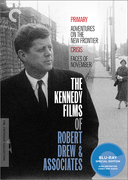
I was really struck by certain elements of
Adventures on the New Frontier, (despite generally agreeing with movielocke that it is "wholesome, bleh television") and wrote the following on
Letterboxd.
--
"The party is winding down. There is sobering work to be done by the intellectuals of the new administration. Professor Galbraith draws historian Arthur Schlesinger, Jr. into serious conversation about the problems their president will face on the new frontier after the ball is over."
What is "the new frontier?" The film makes no effort to contextualize the expression, knowing full well that the audience of 1961 was intimately familiar with Kennedy's slogans of 1960. But it's hard to watch this film without considering the intervening years, particularly 1963, particularly 1967, '68, '69. It may not be readily apparent based on what we see on camera why 1961 should feel like the advent of "the new frontier," besides the fact that the campaigning politician told us so and the spirit and title of the firm affirm it. Even the camera's secondary subjects aren't sure: elite, but generally intelligent men (women figure all-too-briefly in these environs and never during political cigar-talk) unaware of how severe the "opportunities and perils" of this "new frontier" might actually be.
There is nothing about this microcosm of maxipower (consisting of economists, whips, congressmen, advisors, and diplomats; the roster of hangers-on is surprisingly functional by 2017 "standards") that reads "the sixties." The most fascinating (and archaic) scenes surround the inauguration. After the film pads some time with re-runs of the earlier Kennedy film,
Primary, we head to the snowy inauguration morn: a bizarre hearse-mobile with a fully-glass rear-quarter ("bullet-proof?" this 21st-century citizen wonders) brings in JFK accompanied by outgoing President Eisenhower (mentioned, but neither seen nor heard). The film shows smatterings of Kennedy's speech but only recalls "Ask not what your country can do for you..." in narration - these words, like "new frontier," clearly already a part of American Legend in the few months following their utterance (the film saves the actual clip of Kennedy saying these words for its finale).
More pressing for the picture are smatterings of conversation surrounding the event including a post-speech conversation where John Steinbeck (who, though he outlived JFK, always seems to my generation as someone who would never overlap with "the sixties") bandies with John Kenneth Galbraith and their wives, dissecting and musing upon Kennedy's speech down to the minutest and most fastidious details of grammar and economy. To call their badinage dry would be the understatement of the decade. This is rhetorical analysis of an order that we mistily remember; so startling was their recall, one may feel shocked that they remember exact quotes from the speech after only hearing it once. As in
Primary, this is an old frontier in which political and legal oratory was valued and evaluated in an older fashion (i.e. by an legendary and oppressively intelligent wordsmith in the twilight of his life musing in the back of a luxury vehicle).
This leaning on "the old frontier," so to speak, is firmly apparent in the following sequence which paints a hazy view of the inaugural ball. We don't get a glimpse of Kennedy (the film even attempts humor, or at least some authorial presence, when it presents Galbraith's point-of-view at the party's main event: hundreds of yards from the blurry patch that is, allegedly, where Jack is), but we do see the new whipped whip and lovably hapless primary also-ran (despite eventually being Vice President of the US, but no one could see the future from 1961) Hubert Humphrey walking through the crowd, "Good to see you"-ing people left and right, as if carrying on the vestigial congeniality of his heart-to-heart walk-throughs in Wisconsinite middle-America (or, perhaps, he can't act any other way).
The telling truth of how blithely unaware this sector of the upper crust is of the new tumult approaching the nation comes at the party's close. We hear a swing band, having previously played 19th-century bangers "The Yellow Rose of Texas" and "Hail to the Chief," now playing, for the benefit of the tipsy dregs, a swing rendition of "I Could Have Danced All Night," sounding so unbelievably like a tune of the '20s that you would never guess that the song debuted just 5 years earlier. Here we have an era where the inherent quality of a "legend" (be it a speech, a song) is completely apparent out the gate and, being such, is encased in amber directly to prevent it from aging or, in this case, to cause it to age backwards into an earlier decade, canonizing it as a standard after its time. To this bubbly refrain, we see a woozy geezer and a young blonde woman wearing his top hat, he dancing awkwardly whilst holding her (at arms length) with the pull of his scarf around her waist, neither of them seeming remotely aware of the country, to say nothing of the camera. The nearly-emptied crowd betrays a sight of all sorts of top-hatted old men, surely the last generation to dress like this in earnest (or at least out of pomp and ritual): the generation that saw three-and-change terms of FDR, followed by practically two of Truman and two of Eisenhower (and a host of other old men that followed in the decades since the only president to start his term younger than JFK: Teddy Roosevelt). The generation that, perhaps overreacting, would see the sight of a fresh-faced president as a sign of a new day dawning for someone. For right or wrong? (I'm sure Nixon had an interesting opinion on this, assuming he hadn't yet re-evaluated the benefit of wearing makeup under television lights).
As these old men slowly make their way in circles on the emptying dance floor (I'm convinced this ball is still going on, and old guard purgatory in the depths of D.C.), we hear the narration quoted above as Galbraith calls over Schlesinger, a nebbish-out-of-his-social-element stereotype if ever there was one, for a private conference. Of course, the narration is probable circumspection: over-zealous filmmakers adding sizzling, if forced, context onto silent B-roll of a party scene. I'm not convinced anyone would ask that question (i.e., the one proposed in the narration) with the phrase "new frontier" in quotes unless they were being deliberately derisive.
But the proof of some new age, or the expectation thereof, is in the pudding. Look around their periphery: the ball was ending.
The ball is over. What are they to do besides drunkenly grab the nearest historian they can find and ask, "Is this like anything we've seen before? Is there any frame of reference on what to do?" Earlier, Steinbeck is asked how long he will support Kennedy. The author deadpans, "24 hours.... I automatically become opposition within 24 hours." Why change? Keep the cycle going, checks in balance and balances in check.
The rest of the film offers a less profound, less revealing glimpse than one would hope. Paltry, dry discussions in the White House and side-trips to Africa and West Virginia, exploring the results of Kennedy initiatives offer a evocative but shallow look behind the curtain, lacking the substance and context to be as indelibly insightful as the inauguration material.
More powerful, however, are the shots of the calm before the storm, namely for this family - so soon to face seemingly endless heartbreak - this accessible and likable family that was doomed to fulfill their American Legend on the tragic side of Greek theater. To see Bobby Kennedy, clever and vibrant in front of a campaign crowd, can only conjure thoughts of a kitchen floor in The Ambassador Hotel. To see Jackie, smiling while entertaining a crowd of Polish-speakers with a few words in their native language, can only bring to mind the thought of a wife clinging to the back of a limousine in Dallas. Maybe this really could have been a "new frontier" after all, at least in America, but after November 22, 1963, the integrity of this promise was to remain unexplored territory. Global destiny was hurtling toward different frontiers, very few of them earning the glib title of "adventures."
Life wasn't easy. It never was, it isn't now, and it probably never will be. A single president cannot change the face of humanity, society, or their country (despite campaign slogans) no more than they can change the complete make-up of the other branches of the US government that stand in their way. The future is stronger than they. New frontiers barrel towards us, decimating "personalities" with each acre; we cannot fathom how they will operate until we reach the wise vantage of hindsight. New frontiers are too large to see and understand in real time, unless we view them from the hundreds of thousands of miles in the sky.
Well, maybe that guy was on to something when he said, "We choose to go to the Moon."