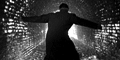
Caché (Michael Haneke, 2005)

Discuss specific films and franchises
Message
Author
User avatar
denti alligator
Joined: Thu Nov 04, 2004 1:36 am
Location: "born in heaven, raised in hell"

Caché (Michael Haneke, 2005)

#1 Post by denti alligator »

This is my vote for film of the year.
I'd love to get a discussion going--there's so much to talk about.

The film is powerful in so many different ways. To start with, it's one of the most effective political films I've seen in a while.

The puzzle of the film is executed beautifully. There's a flavor of Hitchcock in its intricacy and use of tension.

SPOILER:
Spoiler
The answer to the puzzle is one one level not at all important to the political statement of the film. It doesn't really matter who made the tapes. However, Haneke is clearly also interested in provoking reflection on the level of the "whodunnit." The only logical answer I can put forth is that it's Pierrot who has made the tapes, perhaps tipped off (maybe assisted by) Majid's son. The film, of course, doesn't provide any clear answers, only covering up (the main thematic gesture of the film, formally and on the diegtic level) possibilities.
This is one of the most intensely powerful films I have ever seen. A masterpiece by a master of cinema. I am in awe and can't wait to see it again.
User avatar
Elephant
Joined: Thu Dec 30, 2004 11:17 pm
Location: Brooklyn

#2 Post by Elephant »

denti alligator wrote:
Spoiler
The only logical answer I can put forth is that it's Pierrot who has made the tapes, perhaps tipped off (maybe assisted by) Majid's son. The film, of course, doesn't provide any clear answers, only covering up (the main thematic gesture of the film, formally and on the diegtic level) possibilities.
SPOILER:
Spoiler
Isn't that Majid's son who comes up to Pierrot at the very end during that last long shot of the school's front steps--they have a laugh together then separate? Seems they were behind it all along.
User avatar
denti alligator
Joined: Thu Nov 04, 2004 1:36 am
Location: "born in heaven, raised in hell"

#3 Post by denti alligator »

MORE SPOILERS:
Spoiler
I don't know that they have a laugh together, but they seem to know each other and to be on relatively friendly terms.

I believe Majid's son when he says he had nothing to do with the videos. My reading is that he befriended Pierrot and told him about what had happened between their fathers (I don't believe Georges's confession to his wife is fully true--clearly his crime against Majid was even greater). Pierrot then decides to "terrorize" his father about it, perhaps using access to Majid's place through his acquaintance with his son. All this, however, doesn't explain who the man's voice is who calls to speak to Georges earlier in the film.
User avatar
ben d banana
Joined: Wed Nov 03, 2004 12:53 am
Location: Oh Where, Oh Where?

#4 Post by ben d banana »

User avatar
Elephant
Joined: Thu Dec 30, 2004 11:17 pm
Location: Brooklyn

#5 Post by Elephant »

ben d banana wrote:A most insightful review.
Great review. This is such a deceptively simple film. Everyone with whom I've spoken who's seen the film has noticed some bit that no one else has noticed. I mean you're aware from the first ten minutes of the film that you're going to have to pay attention to every detail in every shot of the film, but it's really extraordinary how much Haneke packs in, and how you invent all these "dead clues" in your mind which lead nowhere. Plus he's created one of the most unsettling filmic atmospheres that I can remember--with almost no overt violence or threat this film is more riveting and tense than any of his others which I've seen. Great stuff.
User avatar
Barmy
Joined: Mon May 16, 2005 7:59 pm

#6 Post by Barmy »

Amazing film. I've been lukewarm on Haneke (HATED "Funny Games"; liked "Code Unknown"; indifferent regarding his other work). This is a must-see, particularly in a theater setting. I loved the audience's disparate reaction to the final shot. Many missed the "clue"; some saw it and thought it was lame; others saw it and thought it was brilliant. I've rarely heard such an uproar over the ending of an "art" film.
User avatar
toiletduck!
Joined: Tue Nov 02, 2004 9:43 pm
Location: The 'Go
Contact:

#7 Post by toiletduck! »

Well, damn it all to hell!

I saw it this past weekend, didn't catch the 'clue', and was all the happier for it. By the end of the film, I cared much less about whodunnit than about what 'it' dunn to Georges and his family life (and, in essence, what Georges done to himself and his family life). In not catching the 'clue', I simply told myself that this is what Haneke had intended -- a gradual, almost unnoticeable shift from a super-tight thriller to an even tighter political/character drama, but a shift that left the viewer in the dust if they didn't come along with it.

But now... shite, now I don't know what I think!

-Toilet Dcuk
User avatar
Andre Jurieu
Joined: Tue Nov 02, 2004 7:38 pm
Location: Back in Milan (Ind.)

#8 Post by Andre Jurieu »

toiletduck! wrote:Well, damn it all to hell!

I saw it this past weekend, didn't catch the 'clue', and was all the happier for it. By the end of the film, I cared much less about whodunnit than about what 'it' dunn to Georges and his family life (and, in essence, what Georges done to himself and his family life). In not catching the 'clue', I simply told myself that this is what Haneke had intended -- a gradual, almost unnoticeable shift from a super-tight thriller to an even tighter political/character drama, but a shift that left the viewer in the dust if they didn't come along with it.

But now... shite, now I don't know what I think!

-Toilet Dcuk
Well, even with the little clue left at the end, everything you've said is essentially valid. The final clue is really a red herring in some ways. Even if it gives us a hint as to who is creating the tapes, it's still a convoluted answer given the fact we don't know exactly who is creating the last shot. Even if there is an alliance we didn't know about beforehand, we still don't know exactly who is watching via the camera (other than us).
User avatar
toiletduck!
Joined: Tue Nov 02, 2004 9:43 pm
Location: The 'Go
Contact:

#9 Post by toiletduck! »

True, and I'm still sticking to my interpretation, but my belief that me and Haneke were in sync has now been shaken.

Eh, screw him, he only made the thing, what does he know?

-Toilet Dcuk
User avatar
redbill
Joined: Wed Apr 13, 2005 6:03 pm
Location: Waltham, MA

#10 Post by redbill »

Well, even with the little clue left at the end, everything you've said is essentially valid. The final clue is really a red herring in some ways. Even if it gives us a hint as to who is creating the tapes, it's still a convoluted answer given the fact we don't know exactly who is creating the last shot. Even if there is an alliance we didn't know about beforehand, we still don't know exactly who is watching via the camera (other than us).
Are are implying the last scene was actually being filmned or on tape, or am I misreading you?
User avatar
zedz
Joined: Sun Nov 07, 2004 11:24 pm

#11 Post by zedz »

redbill wrote:Are are implying the last scene was actually being filmned or on tape, or am I misreading you?
All through the film there are shots that are deliberately ambiguous in this respect, and that's surely a key part of Haneke's strategy (we don't know who's watching, when, or why).

I'm firmly of the opinion that Haneke isn't interested at all in the 'whodunnit' aspect of the story, and that the final shot is not supposed to 'resolve' any plot elements, but rather to extend the ambiguity and paranoia, and to underline the aesthetic concerns of the film (by the end of the film we're viewing images in quite a different way than we were at the beginning).

The final shot indicates a relationship, but we don't know what the nature of that relationship is, whether it's a new one or an old one, or what this implies about the other actions within the film. Haneke is playing on our conditioned expectations of a revelatory concluding twist, not pandering to it. Subverting conditioned responses in his viewers is what Haneke's all about - see any other of his films, but especially Funny Games - for evidence.
User avatar
Andre Jurieu
Joined: Tue Nov 02, 2004 7:38 pm
Location: Back in Milan (Ind.)

#12 Post by Andre Jurieu »

redbill wrote:Are are implying the last scene was actually being filmned or on tape, or am I misreading you?
No you're not misreading me - I am implying that the last scene is possibly being filmed as it happens, or is being watched on tape by somebody afterwards, or could even be a dream/nightmare, or a memory. As zedz points out above, the manner of the scene imitates a number of scenes throughout the film, except here we are not given a context of the image at all. It is simply what we make of it and it's up to us to determine its purpose or meaning. Control of the image is something Haneke is often concerned about (Funny Games and Benny's Video come to mind).

If it's a tape, no one is rewinding it this time in order to clue us in - they are simply letting it play through. If it's a dream, it isn't given the same preamble as the previous scene where Majid is taken from the farm (the scene before Majid's childhood departure is Georges attempting to get some sleep, so he in fact could be dreaming or remembering the events from his childhood perspective). If it's just a repressed memory, it makes less sense, since we don't know which character is remembering (I guess it could be Georges remembering a day he picked up his son from school). All this ambiguity appears to be intentional of Haneke's part, since it causes us to ponder who exactly is constructing the image and who exactly is watching. The only thing we know for sure is that we are watching.
User avatar
zedz
Joined: Sun Nov 07, 2004 11:24 pm

#13 Post by zedz »

Andre Jurieu wrote: If it's just a repressed memory, it makes less sense, since we don't know which character is remembering (I guess it could be Georges remembering a day he picked up his son from school).
Now this is an interesting possibility, and the following is pure speculation. A nearly identical shot occurred earlier in the film when Georges picked up Pierrot, and the was one of the first shots in the film where the framing and presentation evoked the idea of surveillance (although there was no subsequent indication that the scene was actually taped).

The idea that this shot might be Georges' memory (as we assume similar 'surveillance framed' flashbacks to his childhood to be) raised (at least) two possibilities:

1) Georges remembers the earlier scene and now realises the presence of Majid's son. Anybody who is going to see the film for a second time could verify this by scanning the frame of that earlier scene for any sign of Majid's son. Frankly, I think it's unlikely.

2) Georges is recalling the earlier scene and suturing in the horrific revelation that his paranoia is suggesting. An interesting possibility that combines the new 'ways of seeing' that he, like us, has been trained to employ with the film's themes of betrayal, conspiracy, familial breakdown and interrogation of (unreliable) memory.
rs98762001
Joined: Mon Jul 25, 2005 10:04 pm

#14 Post by rs98762001 »

This really shows you what a brilliant filmmaker Haneke is. I saw the last shot in a more benign, humanist light -- that both Georges' and Majid's sons have formed some kind of friendship together despite the dark past shared by their fathers. Maybe this is too naive an interpretation given Haneke's natural cynicism, but it seemed they were relating on quite an affectionate level.

Regardless, I agree that the question of 'whodunit' is probably what Haneke is least interested in. Showing the two sons together at the end is evidently a comment on how the events and actions of one generation will inevitably affect the next. But maybe he's saying the effect doesn't necessarily have to be negative...
User avatar
zedz
Joined: Sun Nov 07, 2004 11:24 pm

#15 Post by zedz »

Yes, I think there are dozens of ways of reading that last shot - and the film as a whole. Haneke's interested in creating that ambiguity (and the way in which it relates to our viewing habits and the underlying themes of the film), but not in resolving it. As in other of his films (Funny Games and, to a lesser extent, Time of the Wolf), he's employing a generic form - in this case the thriller - but he's not delivering a generic film.

Though in these films - and in the film within Code Unknown as well - he demonstrates a complete mastery of genre conventions. If the thriller elements in Hidden didn't work so well on the basic level of genre expectations (in terms of audience manipulation and involvement), I don't think the film could actually function in the way Haneke intends. Same goes for Funny Games.
User avatar
ben d banana
Joined: Wed Nov 03, 2004 12:53 am
Location: Oh Where, Oh Where?

#16 Post by ben d banana »

Oh toiletduck!, you've given me hope that I'm not a total idiot. Although, typing that sentence... Anyway, knowing there had to be something in that final shot, I scoured and scoured and nothing. Of course, in real life someone has to be standing within five feet for me to register their existence. I was quite satisfied with my viewing experience, especially after listening to all the confused yammering in the packed film festival house (best opening line of dialogue ever?), but when someone down the aisle announced what she saw (it was similar to Barmy's experience) I felt like a schmuck for missing it. My disappointment in myself kept this from being higher on my top films of the year list, but it surely is one of the finest, most well constructed, intelligent, and utterly unknowable films I've had the pleasure of viewing and I'm very much looking forward to its regular theatrical run.

To further this rather worthless post, when I recently saw the trailer I was shocked at how much of a "normal" movie it looked like, then the trailers for both of the new James Franco movies came on and I was brought back to reality.
User avatar
Andre Jurieu
Joined: Tue Nov 02, 2004 7:38 pm
Location: Back in Milan (Ind.)

#17 Post by Andre Jurieu »

rs98762001 wrote: I saw the last shot in a more benign, humanist light -- that both Georges' and Majid's sons have formed some kind of friendship together despite the dark past shared by their fathers. Maybe this is too naive an interpretation given Haneke's natural cynicism, but it seemed they were relating on quite an affectionate level...

... Showing the two sons together at the end is evidently a comment on how the events and actions of one generation will inevitably affect the next. But maybe he's saying the effect doesn't necessarily have to be negative...
That's the beauty of the shot. It allows for so much interpretation. I had a similar feeling about the shot once I realized the sons were behaving amicably to one another, rather than in the hostile that defined the relationship between the fathers. Of course, then I have to start figuring out the context of the shot. When does this event occur? Is it even a representation of reality? Who is watching? Is this a tape (this is all helped by the production design of the film, where books and tapes lie everywhere, so it feels like everyone is obsessed with recording and surveillance)? Whatever the case, it does appear to be hopeful in regards to the actions/behavior of the next generation, at least in some sense. However, it also presents a unnerving tension once you realize a relationship exists between the sons. Either way, it appears the kids are one step ahead of the parents.
User avatar
redbill
Joined: Wed Apr 13, 2005 6:03 pm
Location: Waltham, MA

#18 Post by redbill »

Obviously, many interpretations, but I took it as less hopeful. I imagined Majid's son as manipulating Pierrot and trying to use him to do to him and his family something similar to what Georges did to Majid and his family.
User avatar
Andre Jurieu
Joined: Tue Nov 02, 2004 7:38 pm
Location: Back in Milan (Ind.)

#19 Post by Andre Jurieu »

redbill wrote: I imagined Majid's son as manipulating Pierrot and trying to use him to do to him and his family something similar to what Georges did to Majid and his family.
That's also a valid reaction, though if we concentrate on the shot itself, it doesn't really appear that any manipulation has really occurred (though we don't hear their conversation and we have no idea of what the dynamics of their relationship are). I think it says something about how we require an answer out of a thriller, and I think it says something that we expect the worst from the final image when we realize the connection, since we simply jump to the conclusion that the kids are as awful as the parents. However, I do believe the point of Haneke playing with our visual perspectives and genre assumptions throughout the film is to make the viewer re-evaluate the assumptions we make while we perceive the world around us. If this is the case, I have to wonder is it easier for us to assume Majid's son is up to no good, because it allows us accept the generic reaction that someone is evil in this scenario.
User avatar
toiletduck!
Joined: Tue Nov 02, 2004 9:43 pm
Location: The 'Go
Contact:

#20 Post by toiletduck! »

Now that I think about it a little further, it's not such a stretch for me that the two of them are together in the scene. Even when I first saw it, despite not noticing Pierrot, the school shot brought him to the front of my mind. I jumped from focusing on how Georges' and Majid's obsessions had controlled their lives far more than it appeared from the surface to how these obsessions are affecting their children. I went there without even having noticed Pierrot and Majid's son on-screen, a further testament to the effectiveness of the scene.

While we're at it, another scene that I think works fantastically in a similar fashion is Pierrot's calling out of his mother's potential adultery. I was already in that uncomfortable state of mind after the "shoulder to cry on" cafe scene; and Pierrot's accusation was enough to get potential scenarios going through my head. And thanks to Haneke's non-treatment (unless I missed another key 'clue', who knows?), they're still bouncing around. Much more effective than giving me a firm yes or no.

-Toilet Dcuk
User avatar
redbill
Joined: Wed Apr 13, 2005 6:03 pm
Location: Waltham, MA

#21 Post by redbill »

Pierrot seemed VERY upset during that scene when he returns and talks to his mother. It leads me to be believe that he had proof (a tape?) of her relationship with her boss - since that where she was that night when Pierrot didn't come home.
User avatar
denti alligator
Joined: Thu Nov 04, 2004 1:36 am
Location: "born in heaven, raised in hell"

#22 Post by denti alligator »

redbill wrote:Pierrot seemed VERY upset during that scene when he returns and talks to his mother. It leads me to be believe that he had proof (a tape?) of her relationship with her boss - since that where she was that night when Pierrot didn't come home.
This is another scene (when Binoche is being comforted by her boss) that Haneke shoots with a static camera that might or might not be another video taping. The suggestion being that perhaps Pierrot has seen this.

A friend of mine complained that the only flaw in the film is the lack of distinction between film and video. I think this is crucial to how the film works. Isn't the film shot on digital video anyway?
User avatar
Andre Jurieu
Joined: Tue Nov 02, 2004 7:38 pm
Location: Back in Milan (Ind.)

#23 Post by Andre Jurieu »

toilet dcuk! wrote:While we're at it, another scene that I think works fantastically in a similar fashion is Pierrot's calling out of his mother's potential adultery. I was already in that uncomfortable state of mind after the "shoulder to cry on" cafe scene; and Pierrot's accusation was enough to get potential scenarios going through my head. And thanks to Haneke's non-treatment (unless I missed another key 'clue', who knows?), they're still bouncing around. Much more effective than giving me a firm yes or no.
redbill wrote:Pierrot seemed VERY upset during that scene when he returns and talks to his mother. It leads me to be believe that he had proof (a tape?) of her relationship with her boss - since that where she was that night when Pierrot didn't come home.
If I re-call that scene correctly (and admittedly my memory might not be accurate given the fact that I haven't viewed the film since September), it's Anne who jumps to the conclusion that Pierrot is upset about her relationship with her boss. Pierrot just steams quietly for the majority of the scene (I believe until the conclusion of the scene), while Anne starts guessing why he's upset, until she starts to focus on her own relationship with her boss. It's as if her guilt of the relationship is giving Pierrot something to be upset about. It seems that Anne feels Pierrot is scrutinizing her in a similar fashion as the surveillance tape and thus she has to starts apologizing for everything she feels guilty about and that she has hidden away from her family. It's interesting to see how she admits it and then offers an explanation (they're "just friends") to her son while Georges continually denies his own past indiscretions, and often just sweeps them aside as childish actions.
denti alligator wrote:This is another scene (when Binoche is being comforted by her boss) that Haneke shoots with a static camera that might or might not be another video taping. The suggestion being that perhaps Pierrot has seen this.

A nice little touch that Haneke places in that scene is the man that sits at the table behind Anne and her boss. While they are becoming more intimate, the man behind them glances over occasionally and lears at them a bit. I love the fact that even the extras are eavesdropping on this personal conversation that appears very secretive.
User avatar
toiletduck!
Joined: Tue Nov 02, 2004 9:43 pm
Location: The 'Go
Contact:

#24 Post by toiletduck! »

Andre Jurieu wrote:If I re-call that scene correctly (and admittedly my memory might not be accurate given the fact that I haven't viewed the film since September), it's Anne who jumps to the conclusion that Pierrot is upset about her relationship with her boss.
I seem to remember Pierrot mentioning her boss, not necessarily out-and-out accusing Anne, but tossing it out as a one of those stingers that teens toss oh so well. I don't really want to claim mine as fact, either, though. Can anyone confirm it either way?
Andre Jurieu wrote:A nice little touch that Haneke places in that scene is the man that sits at the table behind Anne and her boss. While they are becoming more intimate, the man behind them glances over occasionally and lears at them a bit. I love the fact that even the extras are eavesdropping on this personal conversation that appears very secretive.
Here, here! It was the briefest of looks, but I will never forget that man's face. A perfect little touch of realism.

-Toilet Dcuk
User avatar
redbill
Joined: Wed Apr 13, 2005 6:03 pm
Location: Waltham, MA

#25 Post by redbill »

I can't "confirm" but I remember it as Pierrot specifically bringing up her boss or at least alluding to him in an accusatory manner.
Post Reply