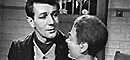
I've never quite managed to warm to this film (voted for The Seventh Seal this round), but it's certainly a fascinating experiment, and gets more interesting the more I watch it. One thing that strikes me is that we almost never see the two central characters looking at each other at the same time. The only exception, I think, is when they're on the park bench and she wakes up, and even then it's not entirely clear whether he is looking her in the eye. This contributes to the sense that these two lovers are always on the verge of making contact, always at cross-purposes to each other, spatially and temporally if not emotionally.
Because we only see still photographs of their encounters, the interactions between them are always elided. We’re told at the start that the man is obsessively attached to a memory from his childhood, and that opening sequence establishes the principle that memories are represented as still, inert images – like Proust’s madeleine, or Scotty’s Madeline in Vertigo (Marker plays on this connection in Immemory, I think, judging from a clip in the ‘Chris on Chris’ feature where we see images of Proust and Hitchcock side by side), these still images are frozen moments from the past which spark a series of associations, emotions and desires. In the same way, the photos we see of the burgeoning romance imply a relationship without quite representing one – and the relationship itself is always a kind of implicit relationship, one that would happen if the space-and-time-lines matched up. Just as the man comes from somewhere beyond the rings of the sequoia tree, so he and the woman are always slightly out of each other’s reach.
The moments when the two lovers really do seem to connect are the ones where we see the woman looking into the camera, at us. There are a couple of stills like this (for instance, when the man first goes back in time and sees the woman smiling at him from her car), but of course the clearest example is the moment when the still image comes to life and the woman smiles and blinks three times at the camera.
In Sans Soleil the narrator (or Sandor Krasna in a letter, I can’t remember) says something like ‘Is there anything more stupid than the rule which says you should never look into the camera?’, and highlights a particular moment when a woman looks into the camera for one 24th of a second, the length of a single frame; and what’s crucial is precisely that it is a brief, fleeting moment of real connection. It also seems to be something remembered and preserved in film, like the single frames we see in La Jetée. But the narrator of Sans Soleil also talks about the importance of consuming the present moment now, of savouring it; they talk about the dangers of forgetting this principle (citing the girl who pushed another girl out of a window for criticising the school team), or of holding a still image, or memory, for too long and causing it to burn in the projector (someone correct me if I have this wrong).
In La Jetée, it’s as if the apocalyptic war has reduced existence to a series of stills, memories of peacetime that people cling to, or painful moments in the present they would rather not inhabit and ‘live through’ – or perhaps the point is that these present-day experiences are immediately converted into memories, and returned to over and over again, precisely because they are traumatic. After all, the memory from which the whole story stems is fixed in the hero’s mind due to both its beauty and violence.
When the woman comes to life during what seems to be the consummation of the love affair, we get a single moment that is not frozen into a still memory – and is built up to by a series of stills that almost seem to ‘animate’ the sleeping woman – but is inhabited and lived through. And it’s significant that this moment does not show the two characters looking at each other, but makes the camera – and therefore us – occupy the place of the hero. I feel starved of something while watching the still photographs pass by. They don’t provide the kind of animation I’m used to responding to in a ‘moving picture’, and this is what makes the film’s dystopian vision of the future so chilling. (Worth noting that the vision of 4001, when it finally arrives, is also more ‘animated’ than the rest of the film, though in a different way.) It’s also what makes those few seconds of movement so powerful, making us share the hero’s sense of relief and fulfilment as this thirst is finally quenched. What else it suggests about the process of making and watching films, I’m not sure, but it certainly works on an emotional level.
It may also be significant that the lovers look at each other after the woman wakes up (just after he reflects on the fact that she will die in this part of the timeline), and that she comes to life after she wakes up again later in the film – and that going back into the past is described as waking up / coming back to life as an adult – and that the narrator’s moment of emotional awakening, when he saw the woman, was also the moment of his own death. But again, I’m not sure what it all means.
387 La Jetée and Sans Soleil
-
Roger Ryan
- Joined: Wed Apr 28, 2010 4:04 pm
- Location: A Midland town spread and darkened into a city
Re: La Jetée (Chris Marker, 1962)
Another astonishingly good analysis, "Sloper".Sloper wrote:...or Scotty’s Madeline in Vertigo...
I will only mundanely add that Terry Gilliam must have picked up on Marker's allusion to Vertigo since he featured a clip from that film in Twelve Monkeys (1995) which I'm sure most here realize was based on La Jetée. In Gilliam's film, the Vertigo connection is taken further by having Madeline Stowe's character disguised in a manner that recalls Scotty remaking Judy in the image of Madeline in the Hitchcock film. In this way, the disguise allows the Stowe character to become the same woman from the childhood memory, but to go unrecognized as such before being placed in the same context as the memory.
-
Black Hat

- Joined: Thu Nov 24, 2011 9:34 pm
- Location: NYC
Re: La Jetée (Chris Marker, 1962)
I've always felt this was what made the film as powerful as it is. In most films you're dropped in as an eavesdropper, immersed in the world of narrative and character. Marker's approach in La Jetée is one of a documentarian, a journalist's report like a show and tell project one gives at school. His career long fascination with time is perhaps at its apex here in that you're not sure when this story is being retold as if here he achieved his goal of telling a story without time.Sloper wrote:One thing that strikes me is that we almost never see the two central characters looking at each other at the same time. The only exception, I think, is when they're on the park bench and she wakes up, and even then it's not entirely clear whether he is looking her in the eye. This contributes to the sense that these two lovers are always on the verge of making contact, always at cross-purposes to each other, spatially and temporally if not emotionally.
The moments when the two lovers really do seem to connect are the ones where we see the woman looking into the camera, at us. There are a couple of stills like this (for instance, when the man first goes back in time and sees the woman smiling at him from her car), but of course the clearest example is the moment when the still image comes to life and the woman smiles and blinks three times at the camera.
This is an important connection to make regarding Marker's aesthetic choices in La Jetée as quite often his characters are looking directly at the camera, i.e. us. By connecting his character's to the audience as opposed to one another is an important distinction to be made as person to person connection which is what the character is seeking by searching for the girl is a key indicator of time.Sloper wrote:In Sans Soleil the narrator (or Sandor Krasna in a letter, I can’t remember) says something like ‘Is there anything more stupid than the rule which says you should never look into the camera?’, and highlights a particular moment when a woman looks into the camera for one 24th of a second, the length of a single frame; and what’s crucial is precisely that it is a brief, fleeting moment of real connection. It also seems to be something remembered and preserved in film, like the single frames we see in La Jetée. But the narrator of Sans Soleil also talks about the importance of consuming the present moment now, of savouring it; they talk about the dangers of forgetting this principle (citing the girl who pushed another girl out of a window for criticising the school team), or of holding a still image, or memory, for too long and causing it to burn in the projector (someone correct me if I have this wrong).
-
colinr0380
- Joined: Mon Nov 08, 2004 8:30 pm
- Location: Chapel-en-le-Frith, Derbyshire, UK
Re: La Jetée (Chris Marker, 1962)
One of the things that I most like about La Jetée (and something that was gratifyingly not lost from Twelve Monkeys) is that while it is time travel in a sci-fi literal sense, it is perhaps just as much about time travel in a nostalgic remembrance one too. Our post-World War Three main character is reminiscing about events that occurred in his childhood - vague memories of a moment he witnessed but did not comprehend the full power and significance of at the time. Fragments and passages of time that are finally being pieced together into a kind of narrative journey, and when our main character realises the time paradox significance of his presence, and perhaps his entire existence being a form of a kind of closed loop, that suddenly makes the love story much more powerful for being the one variable inside a life lived according to others and circumscribed by action. The love story literally is timeless, or momentarily outside of the flow of time, and in a way is what makes the still imagery so moving!
I think there's a really big sense of nostalgia for an 'innocent time' in someone's life too. In this story its literally a nostalgia for a child-like pre-awareness of the larger forces of the world such as war, responsibility, horror. Where bad things happen, but off in the (safe) distance. Our protagonist gets a moment of respite from the devastated future by ironically being forcibly medically experimented on to regress him back into the period he remembers before the war. In a way I think that makes the tragedy at the end resonate so powerfully, as our protagonist has felt and loved for perhaps the first time in his life and his choice (perhaps even sacrifice) at the end means so much more for that. I'm reading a lot into a quite brutal ending but I get the sense that now he knows the beauty and value of life and what it means to have that taken away. But also in the perhaps conscious choice to semi-consciously run and embrace the fate that he knows he cannot escape it also kind of subverts the purpose of his superiors in looking for people with a powerful image that they have them latch onto. That image is the one that gives his life a greater meaning, and also provides him with a form of escape in the presence of someone who cares about whether he lives or dies. Perhaps as in Vertigo the image of a true love is just as important as the real thing, even if that means death. Someone to act as a symbolic figure to guide him out of the time loop he is trapped in and beyond the past or the future - beyond the rings of the tree trunk. Are they just the last fantasties of a tortured, dying man? If they are, at least they're comforting ones suggesting his life touched another's, and was touched in return, at some point or other.
I think there's a really big sense of nostalgia for an 'innocent time' in someone's life too. In this story its literally a nostalgia for a child-like pre-awareness of the larger forces of the world such as war, responsibility, horror. Where bad things happen, but off in the (safe) distance. Our protagonist gets a moment of respite from the devastated future by ironically being forcibly medically experimented on to regress him back into the period he remembers before the war. In a way I think that makes the tragedy at the end resonate so powerfully, as our protagonist has felt and loved for perhaps the first time in his life and his choice (perhaps even sacrifice) at the end means so much more for that. I'm reading a lot into a quite brutal ending but I get the sense that now he knows the beauty and value of life and what it means to have that taken away. But also in the perhaps conscious choice to semi-consciously run and embrace the fate that he knows he cannot escape it also kind of subverts the purpose of his superiors in looking for people with a powerful image that they have them latch onto. That image is the one that gives his life a greater meaning, and also provides him with a form of escape in the presence of someone who cares about whether he lives or dies. Perhaps as in Vertigo the image of a true love is just as important as the real thing, even if that means death. Someone to act as a symbolic figure to guide him out of the time loop he is trapped in and beyond the past or the future - beyond the rings of the tree trunk. Are they just the last fantasties of a tortured, dying man? If they are, at least they're comforting ones suggesting his life touched another's, and was touched in return, at some point or other.
-
andyli
- Joined: Thu Sep 24, 2009 8:46 pm
Re: 387 La Jetée and Sans Soleil
Retro-HD has posted a glowing review of Potemkin's Sans Soleil blu-ray, which is sourced from a 2K restoration newer than what Criterion used. Anyone knows why this release has no page on Amazon.fr or blu-ray.com?
-
hearthesilence
- Joined: Fri Mar 04, 2005 8:22 am
- Location: NYC
Re: 387 La Jetée and Sans Soleil
But it looks like they threw a yellowish tint over everything. It's the same story all over again - a better transfer with a fine, textured grain, but the color consistently looks off.
Marker obviously can't do this, but I wish some of the filmmakers in question would just go up to them face-to-face and rip them a new one. If the lab starts with the same bullshit of "there's nothing wrong with the color, that's what we've determined to be the accurate look of the film stock from that era," it just needs to be thrown back at them "I made this film and not once did I ever say to anyone 'we should make this look like piss yellow.'"
-
tenia

- Ask Me About My Bassoon
- Joined: Wed Apr 29, 2009 3:13 pm
Re: 387 La Jetée and Sans Soleil
In motion and within the overall movie, I found that the Eclair usual color signature was less intrusive and rare than on several more problematic (and more recent) restorations. This was done in 2013, a time where Eclair's color signature wasn't as recurringly intense as it is now, you still have a wider palette of colors and some rather neutral whites, everything isn't tealed.
However, it's there indeed.
The Amazon product page states a February release date, which could be because it's supposedly a FNAC exclusive for now. You can however buy it at Potemkine online store, but I don't know their international policy.
Potemkine also re-released La jetée but I don't know if it's a new restoration.
However, it's there indeed.
The Amazon product page states a February release date, which could be because it's supposedly a FNAC exclusive for now. You can however buy it at Potemkine online store, but I don't know their international policy.
Potemkine also re-released La jetée but I don't know if it's a new restoration.
-
andyli
- Joined: Thu Sep 24, 2009 8:46 pm
Re: 387 La Jetée and Sans Soleil
Thanks Tenia I'm gonna wait for Amazon then. This is a must own for me.