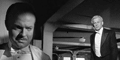
Hey, I love this movie too and I'm not
that old! This is my favourite Hal Ashby film, and favourite Peter Sellers performance (it has also been a bit embarassingly inspirational to my own approach to life, for better or worse. Though I think I'm rather silly to hope that such an approach based on pure sedendipity would work in real life!). I always find those opening scenes of the death of the 'old man' employer (soon to be mirrored by Melvyn Douglas's capitalist character) and loss of a way of life, being forced out into the urban jungle of late 70s New York almost physically painful to watch, and its perhaps only made easier to experience by the good fortune that Chancey experiences soon afterwards!
I think its almost anti-Trump though in that while both characters are wildly detached from any form of reality going on around them, Chancey Gardner is less a belligerent capitalist bluntly barging through any objections than a beatific, distracted innocent (almost an alien being, complete with funky 2001: A Space Odyssey music riff!) drifting through the world, and its more chance than calculation that everything syncs up for him. Its perhaps an indictment of something that only seems more prevalent these days: people hearing only what they want to hear. But its not a brutal indictment, more one that suggests the way that naive homilies can contain a grain of truth within them (but can be twisted to fit anyone's agenda), that simplicity can cut through all the bluster (though it all anticipates the rise of soundbites over more in-depth conversations or interviews), and perhaps that 'profound statements' are only that in the eye (or ear) of the beholder. In a world so based on people hiding their true intentions behind honeyed words, maybe pure simplicity cannot be taken at face value any more. And maybe that doesn't matter if it provides some comfort, or defuses a crisis! (I guess that we're kind of living through the inverse of that situation currently!)
Chancey Gardner is sort of the blank centre of the film that inspires all the other characters to explore themselves through him, and do things they never thought they could, or had given up all hope of ever achieving. That's also part of the reason why I think, despite superficial similarities, Being There stands in stark contrast to Forrest Gump too, where Forrest's journey is the most important thing and the people he meets along the way just supporting characters in his life, no more or less important than the stock-footaged Presidents or celebrities he meets; or used, as in the horribly manipulative journey of Forrest's love interest, to illustrate the dangers of straying from the path, which only leads to destruction. Whereas Chancey is barely a character at all, more a conduit, and rather it is the people around him who we see get inspired by his presence.
I agree on the outtake situation, which rather undercuts one of the best 'magical realist' endings in all cinema, though I've never found it a total deal breaker. Aside from that I think the best scene is the
one at the prestigious function which sort of encapsulates all the themes of the film in the way that it balances beautifully between that sense of niavety and knowing irony without overbalancing too much into one area or the other.