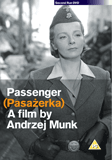
Passenger (Pasazerka) has been called 'one of the most audacious fictions ever made about the Holocaust'. Director Munk died in a car crash, aged just 39, in the middle of filming. His friend, Witold Lesiewicz, and his colleagues decided to complete the film to what they believed were Munk's intentions and assembled it using the existing footage, Munk's still photographs and a voice-over narration.
Finally released in 1964, the film won main awards at Cannes and Venice and has been described by those who have seen it as an unfinished masterpiece. Unseen for far too long, this is the first-ever DVD release of this unique film anywhere in the world.
Special Features
- The Last Pictures - a rare 45-minute documentary about Munk and Passenger, made in 2000 by Andrzej Brzozowski who was Munk's Assistant Director on the film. Never broadcast outside of Poland, it is a fitting tribute to Munk and features contributions from directors Andrzej Wajda and Roman Polanski.
- New digital transfer with restored image and sound.
- New and improved English subtitle translation.
- Optimal quality dual-layer disc.
- Booklet featuring essays on the film and Munk, by film critic/writer Stuart Klawans and academic Ewa Mazierska.
Described as 'one of the most audacious fictions ever made about the Holocaust' Passenger is a classic of Polish cinema. Director Munk died in a car crash, aged just 39, in the middle of filming. His friend and colleague Witold Lesiewicz decided to complete the film to what he believed were Munk's intentions and assembled it using the existing footage, Munk's still photographs and a voice-over narration. On release the film won awards at Cannes and Venice and has been described by those who have seen it as an unfinished masterpiece.
The Harvard Film Archive give a far better summation of Andrzej Munk's career than I can:
"Andrzej Munk's tragic death at age thirty-nine might have formed the plot for one of his own darkly sardonic works: a Polish Jew and an active resistance worker during the war, he was returning home from shooting his film Passenger at the Auschwitz concentration camp in 1961 when an oncoming truck struck his car. He left behind only four feature films, but his influence was prodigious. As one of the key figures of the postwar “Polish Schoolâ€