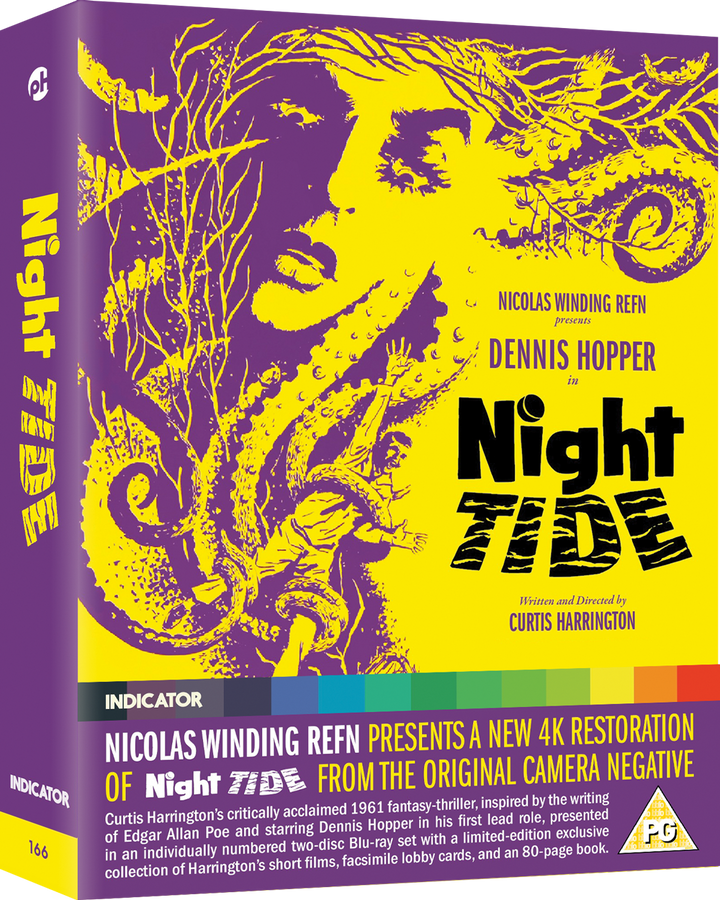
I made my way through Curtis Harrington’s shorts on the second disc prior to the feature to contexualize his progression and potential auteurism, a strategy I recommend as they helped me appreciate
Night Tide more than I likely would have without the base.
Starting things off, his adaptation of
The Fall of the House of Usher is notably very amateurish and choppy (but let's give the kid a break, he was only 14-year-old when making it); however the editing techniques at times indicate an understanding of film language, and there are moments of uncomfortable suspense that linger unexpectedly after a series of abrupt edits, which suggests effective results stemming from a willingness to explore ways to manipulate the image. It's clearly inspired by the earlier film and one gets the sense that he saw it enough times to dream it, with an experimental feel that recalls more modern surrealist filmmakers like Jarman in form, though more likely because of a lack of resources and skills rather than intentionally obscure.
Fragment of Seeking was a fun little construction of eerie tension in watching: voyeurism towards voyeurs. I was swept up in this from the first few minutes where perspective is panned back in jagged cuts rather than camera movement, and the interest of a mysterious person in another mysterious person was an exciting exercise in enveloping the audience through provocative castration of mastery. The main characters’ glasses shining light off of them functioned like an alien in some moments and further barred him from audience alignment (the bright light amplifies to obstruct his face when he first removes them too!) The use of lighting in general is clearly what is being played with here as well as orchestrating the rhythms of pacing to build tension. The short was a strong success for me with a looming score breeding anxiety and some impressive imagery. For an early, amateurish film, it functioned incredibly well and earned its genre delivery. By far my favorite of the included shorts.
Picnic was less successful but I get what he was going for by drawing out the tension with extra fat to establish a range for pacing. The long shots of the image he’s seeking work for a minute but it gets old quick and isn’t very compelling as a whole, though I do appreciate Harrington’s style in following and approaching people, creating an unsettling stalker-ish vibe in attempting to forge connections. This follows the previous film as a step deeper in blending narrow zombified perspective with the pursuit of connection, which of course is ill-fitting, and another score that unpacks the anxiety inherent in this futile yet compulsive need. The ideas aren’t entirely fleshed out but there are some clever visual achievements towards the end that remind me of the types of films Lynch was inspired by, just not as good. As the film goes further off the rails it does get better though.
On the Edge is a very short picture that serves as an opposing effort to the prior film that was too ambitious for the skills available. This is like an anti-fable with a message that is a puzzle, expertly paced and existing in a strange dreamlike milieu like a tempered Lynch film. It was slight but well-realised by biting off just as much as it can chew, and probably ranks as my second favorite of the bunch.
The Assignation: More cryptic stalker voyeurism, this time in color on a riviera in garb.
The Wormwood Star: An eclectic palpitating score sets up this oddball that’s more assaultive than the other pictures, partly due to the use of sound and finally language, which is installed for the first time to chant cultish jargon over images of abnormal figures in drawn art. The focus on drawings is a nice change of pace and in step with Harrington’s interest in mysterious imagery without feeling the need to do more than pan across these pages. It’s an uneven shift that ventures away from the polar bookends and loses itself for the bulk, but I can’t say I minded too much. If only Harrington used his willingness to abrasively cut with sharp editing tools here instead of meandering around, which would have made this more wildly experimental, but it’s still different and cool pictures are nice to look at for a few minutes.
The Four Elements had me laughing about a minute in when the by now typically enigmatic style on narrating about the mysticism of nature was revealed to be
a documentary on man’s banal mechanics of natural resources.
Otherwise it was a slog, but mostly because I just didn’t care or recognize the point except as a self-reflexive joke.
Usher is a modern outlier, shot in 2002 but still in the tone of the earlier, and stronger, shorts. The production value and acting matches that of an amateur work though, just updated and longer. This quasi-
Usher adaptation is played with a sense of self-awareness in contextual tinkering but not elsewhere. This is straighter without much experimental filtering or eccentric threads woven in, and unfortunately I found it completely uninspired and dull. Too bad it’s also the longest, running nearly 37 minutes, and only gets cheesier as it goes along, sadly not on purpose. The silver lining is that some of the beats hit unintentional comedy very similar to
The Room, so that was a treat, especially the Ouija board scene that made me laugh harder than I’d like to admit at the horrendous perfs, and the silent panning of apathetic figures at a deadpan party that may have actually been purposed as such. Either way, I won’t be watching this one again anytime soon, unless some people are in the mood for the pleasures of campy exposition once this quarantine is over.
As for the main feature, I have to give credit where credit is due: NWR and co. have put a lot of effort into this mostly dazzling restoration.
Night Tide starts out with the typical male hypnotized by enigmatic alluring female, and soon finds himself inexplicably drawn to her. It’s interesting watching this following his shorts because the thread that binds at least half of those to this isn’t subtle at all. No wonder Refn loves this, as the directors both find something authentic about their paralyzed captivation with sex, and really the denominator of beauty, as well as anxiety around its inescapable pull that has a menacing side to it. There are similar slow pans too here especially across stunning natural settings and close ups on the beautiful mermaid, whether she's conscious or not. This obsession with beauty feels shallowly superficial compared to Refn’s capability to ask more probing questions with his Tarkovsky-inspired philosophical side to balance out the grindhouse artifice, but there is something more organic about Harrington's exhibition of the beautiful. There is an existential element to this film as well though, filtered through rigidly fixed emotions of love and fear, emanated in passion and attention to the stakes of life. It’s not as deep as it sounds, but it sure is pretty to look at.
While the film sets itself up to be a horror romance, it transforms into something even more hybrid, with noir vibes - especially the notion of fatalism - imposing on both sexes: his through sexual gravity and hers through a forceful linkage in her identity to other, potentially cursed, forces of oppression that contain her natural free spirit that Hopper doesn’t possess. The film also plays with lighting just as his early shorts do, taking place mostly in daylight and even the indoor spaces are bright or have a lighting effect - to comical degrees at times if operating under the impression that Harrington is obsessed with lighting, like the strobe lights in Mora’s apt! The final act veers strictly into that noirish territory
revealing all to be a criminal ruse of jealousy and manipulation perpetrated by the "mermaid's" patriarch- including literally constructing her own false identity to own her... sick stuff. This flipping of the gender roles around against the femme fatale trope gives some food to chew on about sexual politics and those oppressive forces hinted at earlier without explaining the same-sex ominous threat in the female siren from the beginning!
Overall I liked this fine, and the genre-bending lands in a space that carries dark implications, is ripe with its awareness of gender expectations in cinema and life, and still retains cryptic mystery. Unfortunately it's all still very thin, but as an atmospheric exhibit that plays like a B-horror/noir/romance with some analytical alterations, Harrington's film still exudes originality. There are some beautiful and memorable scenes and scenery and the man is clearly passionate about an interest in the allure of beauty, which everyone can relate to, I hope.