Gregory's assessment of
Young Man With A Horn is on point. We get the usual ebullience (and sometimes flat-out violence) from Kirk Douglass and a effectively chilly performance from Lauren Becall. And Doris Day? I think the closest she ever came to portraying a jazz singer was in
Love Me or Leave Me, with James Cagney. But even there she's more torch singer than jazz interpreter. So, yeah, overall the music in
YMWAH is a side attraction.
I bring up these other films featuring jazz musicians primarily to shed light on Tavernier's approach in
Midnight.
One that just came to mind (I wonder if you've seen this, Gregory) is Allen Reisner's
St. Louis Blues (1958) featuring Nat Cole, Eartha Kitt, Pearl Bailey and a host of musicians. Now, here, as in
Midnight we get a real jazz musician in the lead, supposedly playing legendary blues writer and coronet player, W.C. Handy. In the film the deeply religious Handy takes up with a blues band and the moral dilemma of upholding his minister father's values vs. the seeming lack of morality inherent in a blues musician's lifestyle becomes the focal point. (Thank God for the 60s, heh.) Now, one can argue about the point at which a blues band becomes a
jazz band far less effectively (I think) than one can elucidate the difference between the blues and straight-ahead jazz but blues is unquestionably the basis and foundation of jazz.
Similar to Gordon in
Midnight, Nat Cole developed as a jazz musician and in 1958 his was a marquee name. So in terms of dollars the casting made sense. But Cole lends a remarkable sensitivity to the role and his chemistry with the sometimes pushy but always encouraging saloon singing Eartha Kit as Gogo Germaine is especially effective. Their relationship epitomizes what I referred to in the first post about finding kindred spirits at the heart of
Midnight. Presumably, if Handy hadn't found Germaine, he'd be writing church music in Memphis til he was as old and socially antiquated as his overbearing father. That's inplied in the script. But, remarkably, it's also on the screen. Cole (and the film) comes alive when Kitt is singing alongside him. That, I think, epitomizes the spirit of jazz - a collborative improvisation, even if the number is just a 12 bar blues. What one does with the blues number makes all the difference. And, of course, it's
here where the rather stiff bio-pic shines.

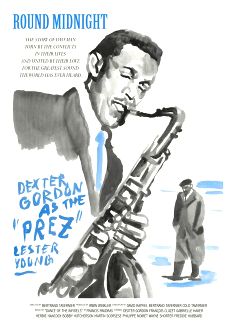
Reisner, though, wasn't able to extend this spirit to the rest of the film. Can't blame him. For one, the script doesn't allow it. It even puts a stranglehold on the fiesty Pearl Bailey and the powerful Mahalia Jackson who, though a died-in-the-wool gospel singer, was admittedly highly influenced by her native New Orleans jazz musicians. You can hear it in her phrasing and variations (she certainly never sang a spititual twice the same way). Perhaps if Reisner was less concerned with presenting a sanitized version of the Handy story and let the actors simply riff off the script a bit he'd have been able to at least approach something like the seemingly free-form like narrative of
Round Midnight. My contention is that things happen within this approach to narrative that absolutely cannot happen within the strictures of the traditional bio-pic approach. That
something that happens is vital, certainly in jazz, but I would argue a
jazz film as well.
I think Eastwood's
Bird, for another example, suffers because of this (another tough slog) but I need to watch it again to be sure.
(Admirers of
Round Midnight (or jazz, in general) will probably get a kick out of
this clip featuring Lester Young interviewed by some French music critic. Spooky. I wonder if Gordon listened to this when he was developing the character of Dale Turner. The issue of Turner being asked to play like somebody else, which comes up immediately in the film, is a focal point of the Prez interview. Now that I think on it - Gordon probably got the story straight from Lester himself.)
The Martin Scorsese connection with
RM was just elucidated for me in the special edition extra feature of
New York, New York. Irwin Winkler was commenting on how he met with Scorsese and Tavernier, who asked both of them if they were satisfied with the ending of
New York, particularly, with the fate of Jimmy Doyle, played by Robert Deniro. Scorsese said that he wasn't and that Doyle probably would have moved to Paris (where, presumably, he could play for a more appreciative audience) and lived out he rest of his days there. Well, apparently Tavernier told Winkler that he was interested in making that film which inevitably became
Round Midnight. I'm not sure if Dexter Gordon was aware of this. Despite being solidly
American personalities, Jimmy Doyle is about a universe away from Dale Turner. I think that by the time the movie was in actual production the Jimmy Doyle story had been scrapped altogether.