454 Family Life

Discuss releases by Indicator and the films on them

Moderator: MichaelB

Post Reply
Message
Author
User avatar
MichaelB
Joined: Fri Aug 11, 2006 10:20 pm
Location: Worthing
Contact:

454 Family Life

#1 Post by MichaelB »

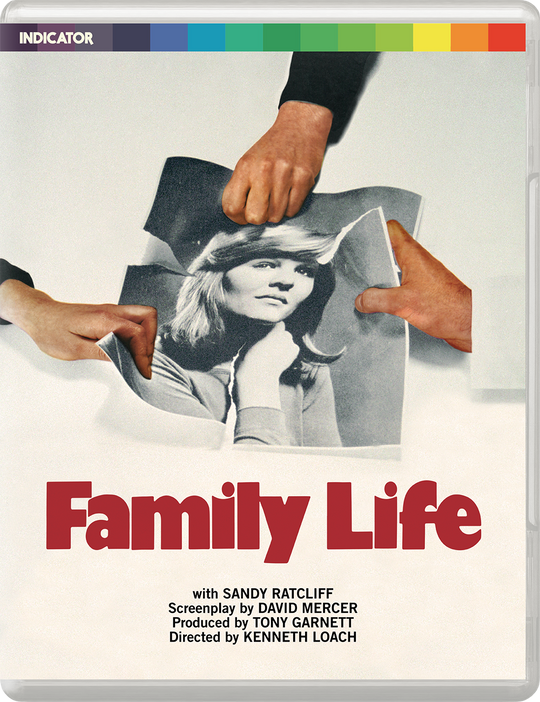
Image
FAMILY LIFE
(Ken Loach, 1971)
Release date: 19 November 2024
Limited Edition Blu-ray (World premiere)


Pre-order links here

Sandy Ratcliff (Hussy), Bill Dean (Gumshoe), and Malcolm Tierney (McVicar) lead the cast of Family Life, a powerful drama from acclaimed director Ken Loach (Fatherland, Carla’s Song).

When rebellious Janice (Ratcliff) becomes pregnant, her controlling parents insist she has an abortion in order to avoid a scandal, causing Janice to suffer a schizophrenic episode which is exacerbated by the medical treatment she receives.

Produced by Tony Garnett (Prostitute) and adapted by David Mercer (90° in the Shade) from their acclaimed R D Laing-influenced BBC TV drama ‘In Two Minds’, Family Life is a heartbreaking and searing indictment of familial hostility and institutional indifference.

INDICATOR LIMITED EDITION BLU-RAY SPECIAL FEATURES

• High Definition remaster
• Original mono audio
• Interview with Jack Klaff (2024): the stage and screen actor remembers Sandy Ratcliff, the star of Family Life
• The BEHP Interview with Tony Garnett (2007): archival video interview, made as part of the British Entertainment History Project, featuring the producer, director and long-time Ken Loach collaborator in conversation with Darrol Blake and John Sealey
• Looking East (2024): British and central-eastern European film specialist Michael Brooke's video essay on the rare overlaps between those cultures, including links between Ken Loach, Miloš Forman and Krzysztof Kieślowski
• Original theatrical trailer
• Image gallery: promotional and publicity materials
• New and improved English subtitles for the deaf and hard of hearing
• Limited edition exclusive book with a new essay by Rachel Pronger, archival cast and crew interviews, an in-depth look at Ken Loach and David Mercer’s original television play and Family Life, comparing the differences and developments in the context of R D Laing and the anti-psychiatry movement, and film credits
• World premiere on Blu-ray
• Limited edition of 3,000 units for the US
• All extras subject to change

#PUSLE454B
REGION A
UPC: 843501042571
User avatar
therewillbeblus
Joined: Tue Dec 22, 2015 7:40 pm

Re: 454 Family Life

#2 Post by therewillbeblus »

A very good movie, and I don't typically like Loach
therewillbeblus wrote: Mon Mar 13, 2023 11:48 pm
swo17 wrote: Thu Mar 09, 2023 3:03 am Family Life (Ken Loach)
I'm curious what twbb might think of this from a therapeutic standpoint. Some cogs in the system describe the film's lead character as schizophrenic, her condition not having been impacted by her environment (which they describe as a favorable one in which she's had every opportunity) but this seems to me to be plainly ironic. In fact she's been suffocated by people who constantly talk about having her best interest in mind without considering her feelings, and she's come to a point of learned helplessness. In other Loach films the culprit might be some cold, unfeeling state welfare division, but here the most guilty party would seem to be the family unit itself and its insistence on children repeating the lives of their parents without necessarily any good reason behind it. Any deviation from the set path, or perceived intention to deviate, or even innocent dalliance that has a chance of leading in that direction is chastised as a failing that must be corrected before it becomes serious. And this all happens under the guise of parental love, which is beyond criticism because "all a parent can do is their best." Anyway, compelling stuff with no easy solutions, and Loach doesn't sugarcoat any of it
Thanks for your indirect recommendation. I really liked this and share your reading. It's interesting to view it in the context of the cloudy 70s aggressively disorienting self-actualization, because we don't often get depictions of adults in family systems holding onto rigid values to oppress youth in this decade, compared to, say, the 50s. Or, at least, I feel like more films were being made about that dissonance affecting the elders with an equal kind of destabilization, or framing the adults as harmless characters 'out of touch' and thus resigned to the tertiary space of delusionally clasping to past ideology in the margins of the narrative, if focus was pitched on them at all. But no, this film is a ruthless account of these systems still functioning in working order, and gravitating any false hope in psychedelic expansion back into the sober reality of the inescapable tangible forces in one's milieu - not the self-constructed one of likeminded peers, but the one that governs over them, bubble or no bubble. The mirage is that the counterculture movements have any impact in destabilizing the power of old systems.

The film is not interested in validating the parents' perspectives as tragic in losing a hold on their daughter, because their absolute ignorance leaves zero space for a willingness to change or see something different than their own narcissistic projections. The mother says she knows her daughter better than her daughter knows herself throughout, which is classic objective-power dynamics (used predominately in therapy until the last couple decades, which is why her therapist's affirming interventions feel so progressive - though client-alliance isn't a new concept; it's how any work gets done at all and always has been the key ingredient to change), but the closest we come to appreciating her position is when she complains to the institution that she was desperate to get some "control" over her daughter. It's as much of an admission that she's lost and impotent in how to parent or understand this generation as anything in this movie.

It's also interesting that the diagnosis is schizophrenia, since the nature/nurture debate has often extended to that extreme of a psychotic diagnosis in academic settings. I remember several professors using the question of whether we most often see homelessness causing schizophrenia, or schizophrenia causing homelessness, without a known answer, in abnormal psych and assessment and diagnosis classes. This film's case study is clearly a misdiagnosis, but it's a more realistic version of Gaslight - where Janice breaks down in the hospital, briefly convinced that the "machines" are controlling things, only after having her agency removed and then being repeatedly confused and disempowered in a vicious cycle perpetuated by multiple providers in positions of power over her. A nurse coming in and saying a bunch of things she doesn't understand and then saying "I'm glad we had this little chat. You're smart, you'll figure out what I meant" is the straw to break the back, but it also causes Janice to hang on to a few key words in her monologue as she experiences an episode of emotional dysregulation, informing the reality she projects onto the care worker intervening during the crisis. Though she was already severely agitated prior, and what we know about agitation/escalation, is that kids particularly (but really most people) only hear about 8% of what's being said to them in these moments, and base their reactions mostly upon other instincts. Anyways, Sandy Ratcliff was outstanding.

Also, while it's not unique to compare a raw, intimate social-problem British film from this era to Mike Leigh's work with naturally-conceived dialogue, etc., I swear the score used identical music cues to his early work. Or am I going crazy too?
User avatar
Aunt Peg
Joined: Fri Dec 21, 2012 9:30 am
Location: Sydney

Re: 454 Family Life

#3 Post by Aunt Peg »

Pleased to see more Ken Loach on Blu Ray.
User avatar
zedz
Joined: Sun Nov 07, 2004 11:24 pm

Re: 454 Family Life

#4 Post by zedz »

I think this is his best film by some margin. Absolutely harrowing: a bad time is guaranteed for all!
User avatar
MichaelB
Joined: Fri Aug 11, 2006 10:20 pm
Location: Worthing
Contact:

Re: 454 Family Life

#5 Post by MichaelB »

I subtitled it, so I got to watch it in slow motion!

(It was an absolute bastard to subtitle, too - there were times when no fewer than three people were talking simultaneously, but with none of them visible onscreen because Loach was focusing on the silent person's reaction. In situations like that, I have to tease out the most important speaker, highlight them and précis the others, as there's no time to read a full transcript of everything.)

But yes, it is a very, very impressive piece of work - and in my piece on the disc I'm going to be comparing the performances of Grace Cave here and Milada Ježková in Miloš Forman's Loves of a Blonde (given the disc's US-only status, I opted for the US title) - both nonprofessionals cast via a chance encounter between them and their respective directors. They both play monstrous "concerned" mothers, and both were so uncannily good that it would be hard to imagine professional actresses being half as effective.

(This was Cave's only acting role, although Ježková made such a splash that she became a prolific character actress, including appearances in Loach's two other favourite Czechoslovak films, Closely Watched Trains and The Firemen's Ball.)
User avatar
Sloper
Joined: Wed May 30, 2007 2:06 am

Re: 454 Family Life

#6 Post by Sloper »

This is my favourite Ken Loach too (though I haven't seen all of them), and yes Sandy Ratcliff and Grace Cave are particularly wonderful. Loach said that Cave identified with the mother quite strongly, and didn't see her as being unreasonable or a 'monster', which is probably why she's so good. The film runs the risk of demonising the parents but it's all the more chilling for not doing that - you can see that they genuinely believe they're doing the right thing, and that in a different story they would be the heroes, like the parents in This Happy Breed magnanimously forgiving their prodigal daughter.

A family friend who grew up around the same time and place as Janice once told me that the mood of his community could be summed up by the phrase, 'She's not as good as she might be' - a sort of vague, insinuating judgement that implies 'she' is rotten and evil but without spelling out why, because to do so would be indecent. Grace Cave captures that tone perfectly, often just through little touches like the way she says 'as big as you are' (I think this is in the dinner scene with Janice's sister).

Re: the synopsis on the blu-ray jacket, I've never had the impression that the abortion causes Janice's 'schizophrenic episode'. I can imagine an alternative version of the story where the parents are more understanding and better at communicating with Janice, and they either support her in keeping the child or help her get an abortion, depending on what she decides. It's telling that although the parents make her do this, they also condemn her for it - if I remember correctly, the mother even refuses to hear the word abortion in her home, because it's 'disgusting'. Having said all this, I don't really have a constructive suggestion for how else to describe the plot of the film: part of its power lies in the way it simply throws us into the middle of Janice's crisis and invites us to think about what has caused it. The title, 'Family Life', is a kind of answer, but one that only raises more questions.
User avatar
zedz
Joined: Sun Nov 07, 2004 11:24 pm

Re: 454 Family Life

#7 Post by zedz »

Sloper wrote: Thu Aug 22, 2024 1:58 pm This is my favourite Ken Loach too (though I haven't seen all of them), and yes Sandy Ratcliff and Grace Cave are particularly wonderful. Loach said that Cave identified with the mother quite strongly, and didn't see her as being unreasonable or a 'monster', which is probably why she's so good. The film runs the risk of demonising the parents but it's all the more chilling for not doing that - you can see that they genuinely believe they're doing the right thing, and that in a different story they would be the heroes, like the parents in This Happy Breed magnanimously forgiving their prodigal daughter.
Yes, I think one of the great strengths of this film (and a glaring weakness of many later Loach films) is that the 'villains' are in their own way tragic victims themselves. By upbringing and social context, the parents are totally unprepared to deal with the needs of their daughter, so they default to societal norms or comply with the advice of the medical establishment.
User avatar
MichaelB
Joined: Fri Aug 11, 2006 10:20 pm
Location: Worthing
Contact:

Re: 454 Family Life

#8 Post by MichaelB »

Yes, I think that nails it - both Family Life and the problems that I have with rather too much later Loach, especially the films scripted by Paul Laverty, who can never resist the opportunity to clamber onto a soapbox to lecture the audience as if they were ever so slightly dimwitted (something that the great Italian neorealist and Czechoslovak New Wave films that Loach so admired pretty much never did). As you say, Family Life doesn't do this at any point; it's a near-perfect illustration of Jean Renoir's famous dictum "everyone has their reasons".

In fact, a good test to see if a film - or any kind of dramatic narrative - really works on that count is to see if you can plausibly watch/read it from the point of view of each individual major character without getting exasperated. The mother is particularly effective here, I think, because there's no question that she wants the best for her daughter, but her definition of "the best" is radically at odds with what Jan believes, and indeed with what society is increasingly believing.
User avatar
zedz
Joined: Sun Nov 07, 2004 11:24 pm

Re: 454 Family Life

#9 Post by zedz »

MichaelB wrote: Fri Aug 23, 2024 1:54 am Yes, I think that nails it - both Family Life and the problems that I have with rather too much later Loach, especially the films scripted by Paul Laverty, who can never resist the opportunity to clamber onto a soapbox to lecture the audience as if they were ever so slightly dimwitted (something that the great Italian neorealist and Czechoslovak New Wave films that Loach so admired pretty much never did).
Case in point is Sorry, We Missed You, which actually devotes a scene to giving the boss an opportunity to explain his point of view, but he just comes off as a moustache-twirling villain / negative mouthpiece for the screenwriter.
User avatar
MichaelB
Joined: Fri Aug 11, 2006 10:20 pm
Location: Worthing
Contact:

Re: 454 Family Life

#10 Post by MichaelB »

Absolutely - and I remember that vividly because the opening scenes suggested that the film would be offering a more nuanced take. And it's easy to see how a more nuanced take might be feasible, since the boss is clearly also a victim of a system that sets impossible targets that he has to pass on to his hapless underlings - and there's also the contrast between the utopian vision that he sets out at the start (in which he may well truly believe) and what eventually happens.

The big problem with the Loach/Laverty films, at least from the viewpoint of someone with easy access to what was happening in British television at the same time, is that they're paralleled by the output of Jimmy McGovern, a writer who's consistently unafraid to portray ostensibly monstrous people in a quasi-sympathetic light, if only in order to give us a real insight into what makes them tick in a way that trusts the viewer to draw his/her own conclusions. The most extreme example is in that skin-crawling scene in the confessional in Priest in which the abusive father delivers a philosophical justification for incest, but pretty much any random McGovern project will feature something similar, which to me is what makes him a far more complex and interesting artist.

Alan Clarke had many of the same qualities, of course - as did Johnny Speight, whose immortal Alf Garnett was supposed to be a monstrous caricature of a working-class conservative, but because Speight didn't mount a soapbox to wag his finger at his audience and because he was too instinctively good a writer (and ditto Warren Mitchell as an actor) just to make Garnett a pure caricature, he naturally ran the risk of people failing to get the joke and believing that Garnett was some kind of role model. But complex art inevitably attracts complex responses - and what's most impressive about Family Life is that it's much closer to their work than it is to rather too much of Loach's.
User avatar
What A Disgrace
Joined: Mon Nov 08, 2004 2:34 am
Contact:

Re: 454 Family Life

#11 Post by What A Disgrace »

I received my copy today, and its spine number is...an ellipsis!
Post Reply