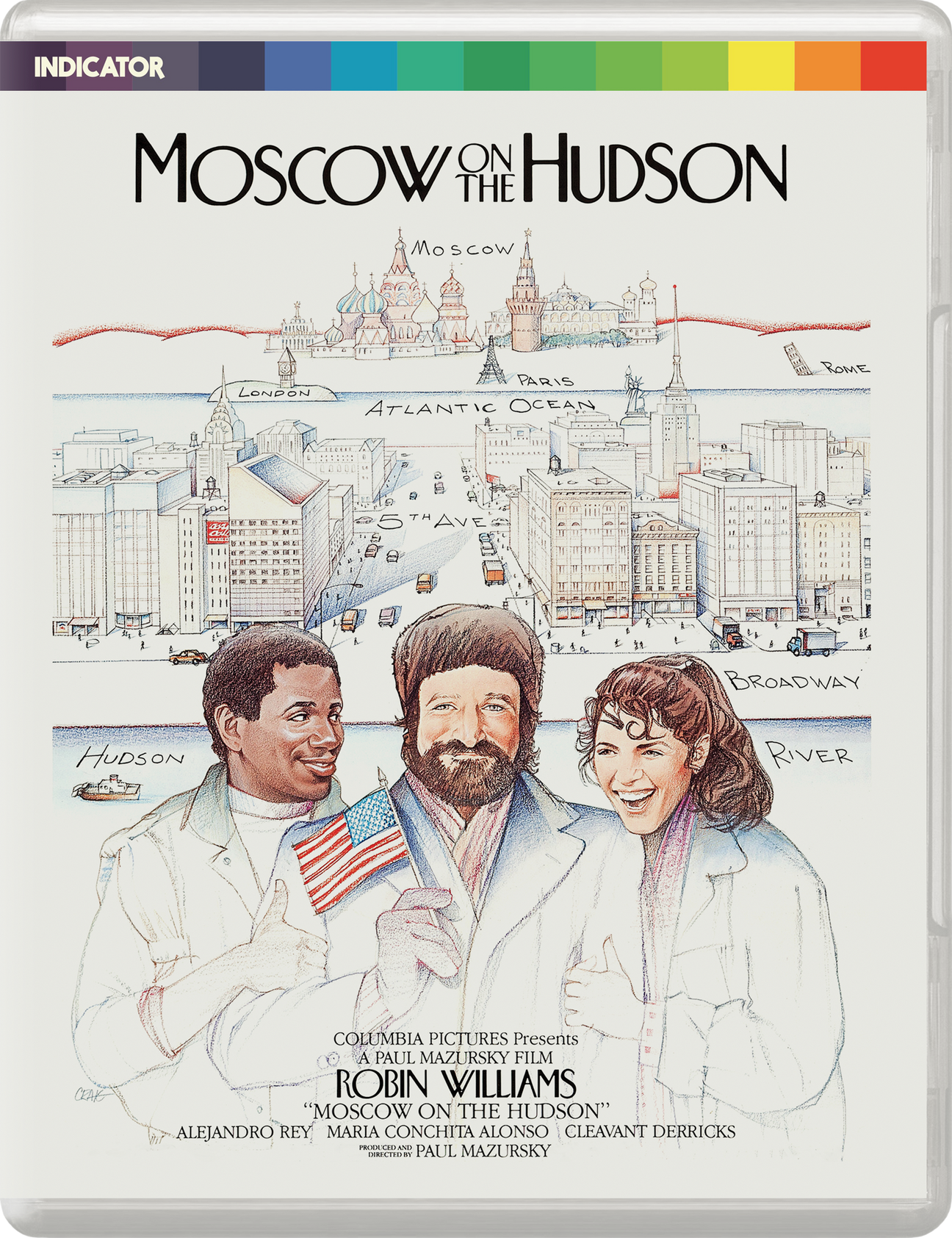
Vladimir, a musician with the Moscow circus, defects to the US and must navigate a new life in New York. An early dramatic role for star Robin Williams, the actor undertook a crash course in Russian and learned to play the saxophone in order to play the part.
INDICATOR LIMITED EDITION BLU-RAY SPECIAL FEATURES
• 4K restoration
• Audio commentary with director Paul Mazursky (2001)
• The Guardian Interview with Paul Mazursky (1984): the filmmaker in conversation at London’s National Film Theatre
• Image gallery: on-set and promotional photography
• Original theatrical trailer
• New and improved English subtitles for the deaf and hard-of-hearing
• Limited edition exclusive booklet with a new essay by Monica Castillo, a contemporary account of the making of the film, Paul Mazursky’s research visit to Moscow, an overview of contemporary critical responses, and film credits
• UK premiere on Blu-ray
• Limited edition of 3,000 copies
• Extras subject to change
#PHILTD195
BBFC cert: 15
REGION B
EAN: 5060697920604
I always loved this film, and a revisit cemented its excellence as indicative of Mazursky's greatest strengths. The early section of the film is funny but paints a fully dimensional dramatic picture of the costs and benefits of the action Williams will take. The moment of defection is simultaneously emotionally-deflating and uplifting, as Mazursky slows everything down to practically stop time as Williams makes his most important existential choice. Meditating on the intensity of this moment gives validating weight to the drama, and surrounding the suspenseful scene with comedic bits alleviates the mood from transcending into social horror, as Williams runs the risk of stranding himself in isolation. Thankfully this relief is the sublime thematic projection of one of the vibes of this piece: That acts of compassion breed reciprocal positivity. People are quick to help Williams, and Mazursky shines at fleshing out an optimistic version of humanity amidst the realistic challenges, including socially, that must be navigated.
New York city is the perfect setting as a cultural melting pot, yet Mazursky doesn't shy away from the segregation perpetuated by American history in the present. Racial dynamics are the first addressed (there is also a gay interaction that struck me as rather progressive for the time this was released), but this is really a film about ethnicity (or more aptly- culture) and the possibilities of rewards in immersion when coupled with respect and curiosity. Williams' existential quest leads to self-development through open-mindedness, willingness, and -most importantly- enthusiasm for engaging with others. Williams asks people about themselves, and tends to live for this engagement, actively listening and refusing to insert himself into the conversation. This kind of approach is rarely so honestly depicted, and the good-natured tone is rooted in fantasy as brought into reality, professing that this is a way life possible for any person who wishes to treat life with an attitude of kindness.
Mazursky still keeps his skeptical, realist side, which stresses the inherent problems in coexisting, shattering the formulation that the karmic reciprocity from earlier is a firm rule. Cultural differences are used as a tool to explore the differences in perspective all people have struggling to grow together towards their distinct dreams at different stages of readiness. In expanding on these differences, Mazursky boils them down to a universality in segregation of people from each other based on individuality and separate ideological priorities due to unique history. Williams' speech about the comfort in misery under conditions he is familiar with is a powerful truth, a priceless reality of complacency that defines why most of us fail to act towards our dreams - though what's key about the scene is how Williams breaks into laughter with (a terrific) Cleavant Derricks, sharing a moment of pleasure in the scary terrain of discomfort.
The impermanence of relationships is not glossed over but emerges as a central purpose to Mazursky's vision, where relying on others is seen as crucial for brief bouts of meaning and support, but ultimately the self is who must be established and cared for as the one constant throughout life. Mazursky is careful not to discredit Williams' earlier selfless gestures and 'others'-focused behavior, but instead demonstrates how self-care and unconditional empathy are able to be tended to at once without affecting the other. This isn't a 'me and mine' view or an 'caretaker' one, but an act of balance that understands the significance of social relationships to allow us to get through hardships as well as necessary to have meaningful moments. When Williams contemplates loss, it's important to have a person - even a stranger- there with him.
The film is incredibly funny- from exploring the oddities in social mannerisms to producing gags about acclimating to new privileges- but like any good social comedy, the drama is realised as the blueprints for the humor to exist. What begins as a film about differences becomes actualized as a story of inclusive human experience of feeling excluded. In the pivotal scene, independence is defined as not a promise happiness but the opportunity for it. Williams playing his sax at the end, alone and comfortable in his own shoes - or enough as he can be - is a perfect finality to a narrative about the bittersweet reality of life, affirming a life of social participation and self-acceptance as second-to-none, imperfections, loneliness, and all.
Just saw Mazursky’s Willie and Phil, which is an amazingly great film that I’m still letting wash over me, and it features a cute little nod forward to this near end.
Working my way through my incredibly daunting kevyip. I don't think I enjoyed this as much as TWBB did but I found a lot of charm in this. The film probably could have gone a few more obvious ways. It could have easily been pro-US/anti-Soviet (an obvious path it wasn't likely to take). I also thought it may just take the simple approach to show how similar Vladamir's life in the US would be compared to the USSR, downside and all. But to my surprise, the film strayed from social commentary after the first 30 minutes and really just focused on a more personal aspect of the protagonist's life. And this allows for the fantastic supporting cast, especially Vladamir's love interest. Honestly the run time in this film just breezed by. Williams gives a fantastic performance, which isn't quite laugh out loud funny but actually played really respectfully and charmingly. Not as over the top as he can so often be.
If there's any part of it that rubbed me the wrong way, the scene at Bloomingdale's setting up the defection is so obvious the film almost lost me. With a character saying, "Alright we have 30 minutes left in America. Time to go to Bloomingdale's then to the airport" was just a preposterously annoying set-up, especially given the tight leash the group of people is on in the prior few New York City scenes. I also feel like given the nuance with he treats American culture, landing on a point of view that the struggles that are a part of America are worth the freedom, the Soviet Union isn't treated the same way (the lack of poverty in the USSR is sort of voiced over, but the family shares a nice apartment and doesn't appear to struggle to afford it!)