No because we are not watching prints and new scans from the negative look way better. It's normal and how things have been done for ages so when directors try to make it look like film prints it just does not look as good because 4k should be making things way better than a film print.Altair wrote: Tue Dec 09, 2025 8:32 pmIsn't this what ideally all home video releases should look like? A digital recreation of the theatrical release? I'm actually heartened that 4k discs seem to be getting closer to that appearance.CSM126 wrote: Tue Dec 09, 2025 12:04 amYou’re right. They like the home video presentation to look as much like a theatrical print as possible (minus the due blips and damage marks of course).rrenault wrote: Mon Dec 08, 2025 11:17 pm What's with celluloid purists like Nolan and PTA insisting home video releases of their films be IP rather than OCN-sourced? My suspicion is they want their films to have that "movie" feel and not look like 'raw negatives'. I'm not sure though.
Interpositives and Intermediates vs. Negatives
-
TVC 15
- Joined: Sat Apr 26, 2025 10:50 pm
Re: UHD New Releases, Reissues and Upgrades
-
MichaelB

- Joined: Fri Aug 11, 2006 10:20 pm
- Location: Worthing
- Contact:
Re: Interpositives and Intermediates vs. Negatives
Please define precisely what you mean by "as good" and "way better".
-
CSM126

- Joined: Thu Nov 04, 2004 12:22 pm
- Location: The Room
- Contact:
Re: Interpositives and Intermediates vs. Negatives
While I’d be a hypocrite to decry negative scans (having enjoyed so many excellent transfers derived there from), I do think that any director who wants to replicate the experience of a print is entitled to do so. After all, people who work with celluloid know what to expect in:re generation loss and account for it. It’s part of the look they plan for. So I get it when people like PTA or Nolan avoid negative scans in favor of the IP. They can reasonably say that the negative doesn’t reflect what they had in mind for the public to see.
-
TVC 15
- Joined: Sat Apr 26, 2025 10:50 pm
Re: Interpositives and Intermediates vs. Negatives
More detail, sharper, better contrast, sharper grain, more control over colour because the colour on Boogie Nights and Nolan 4Ks look off. What is the point of 4K if you are not making the film look the best it can?MichaelB wrote: Tue Dec 16, 2025 12:19 pm Please define precisely what you mean by "as good" and "way better".
-
MichaelB
- Joined: Fri Aug 11, 2006 10:20 pm
- Location: Worthing
- Contact:
Re: Interpositives and Intermediates vs. Negatives
But why is "more detail, sharper, better contrast, sharper grain" intrinsically more desirable, when it wouldn't have been visible in theatrical prints, and the director and DOP would have been fully aware of this?
It seems to me that the great virtue of 4K UHD is that it gives you an unprecedented opportunity to make home video actually look like film—but "look like film" may well not revolve around achieving maximum detail and sharpness. Indeed, that may actively not be what the filmmaker was after, Geoffrey Unsworth's cinematography being a famous case in point.
It seems to me that the great virtue of 4K UHD is that it gives you an unprecedented opportunity to make home video actually look like film—but "look like film" may well not revolve around achieving maximum detail and sharpness. Indeed, that may actively not be what the filmmaker was after, Geoffrey Unsworth's cinematography being a famous case in point.
-
TVC 15
- Joined: Sat Apr 26, 2025 10:50 pm
Re: Interpositives and Intermediates vs. Negatives
That is fine if people like that but can that not be done for Blu-ray so why 4K? I saw a quote from a person who worked on something saying the Blu-ray was the purer way to see the movie and that 4K was enhanced with high dynamic range and looked better than that movie ever did for us who like what 4K can do.MichaelB wrote: Tue Dec 16, 2025 12:48 pm But why is "more detail, sharper, better contrast, sharper grain" intrinsically more desirable, when it wouldn't have been visible in theatrical prints, and the director and DOP would have been fully aware of this?
It seems to me that the great virtue of 4K UHD is that it gives you an unprecedented opportunity to make home video actually look like film—but "look like film" may well not revolve around achieving maximum detail and sharpness. Indeed, that may actively not be what the filmmaker was after, Geoffrey Unsworth's cinematography being a famous case in point.
-
MichaelB
- Joined: Fri Aug 11, 2006 10:20 pm
- Location: Worthing
- Contact:
Re: Interpositives and Intermediates vs. Negatives
Again, you're using a definition of "better" that many may not agree with, including the original filmmaker. (Ditto "purer".)TVC 15 wrote: Tue Dec 16, 2025 1:02 pmThat is fine if people like that but can that not be done for Blu-ray so why 4K? I saw a quote from a person who worked on something saying the Blu-ray was the purer way to see the movie and that 4K was enhanced with high dynamic range and looked better than that movie ever did for us who like what 4K can do.
-
TVC 15
- Joined: Sat Apr 26, 2025 10:50 pm
Re: Interpositives and Intermediates vs. Negatives
I am speaking for myself when I say better so hope nobody thinks I am speaking for others. These are just my opinions but if Blu-ray can look like a film print even more pure than 4K then what is the point putting it on 4K unless you take advantage of better resolution and high dynamic range?MichaelB wrote: Tue Dec 16, 2025 1:07 pmAgain, you're using a definition of "better" that many may not agree with, including the original filmmaker. (Ditto "purer".)TVC 15 wrote: Tue Dec 16, 2025 1:02 pmThat is fine if people like that but can that not be done for Blu-ray so why 4K? I saw a quote from a person who worked on something saying the Blu-ray was the purer way to see the movie and that 4K was enhanced with high dynamic range and looked better than that movie ever did for us who like what 4K can do.
-
rrenault
- Joined: Wed Nov 17, 2010 7:49 pm
Re: UHD New Releases, Reissues and Upgrades
But I think the debate is over whether “way better than a film print” is how directors intend their films to be experienced by audiences.TVC 15 wrote: Tue Dec 16, 2025 12:17 pmNo because we are not watching prints and new scans from the negative look way better. It's normal and how things have been done for ages so when directors try to make it look like film prints it just does not look as good because 4k should be making things way better than a film print.Altair wrote: Tue Dec 09, 2025 8:32 pmIsn't this what ideally all home video releases should look like? A digital recreation of the theatrical release? I'm actually heartened that 4k discs seem to be getting closer to that appearance.CSM126 wrote: Tue Dec 09, 2025 12:04 am
You’re right. They like the home video presentation to look as much like a theatrical print as possible (minus the due blips and damage marks of course).
That said, one thing worth considering is an OCN-sourced 4K Blu-ray is still going to be 2-3 generations removed from the OCN just as a theatrical release print is(you have the scan, then the restoration/master, then the compressed version that fits into the disc) so maybe this discussion isn’t worth having.

If a 4K Blu-ray were projected onto the screen at the Grand Rex in Paris it might not necessarily look better than a film print. I could be wrong about this though.
-
TVC 15
- Joined: Sat Apr 26, 2025 10:50 pm
Re: UHD New Releases, Reissues and Upgrades
Paul Thomas Anderson and Nolan are exceptions and most directors have no problem with approving negative scans that look way better than prints to me. People are upset about Boogie Nights because we are used to 4K looking sharper and more detailed than film prints.rrenault wrote: Tue Dec 16, 2025 1:13 pmBut I think the debate is over whether “way better than a film print” is how directors intend their films to be experienced by audiences.TVC 15 wrote: Tue Dec 16, 2025 12:17 pmNo because we are not watching prints and new scans from the negative look way better. It's normal and how things have been done for ages so when directors try to make it look like film prints it just does not look as good because 4k should be making things way better than a film print.Altair wrote: Tue Dec 09, 2025 8:32 pm
Isn't this what ideally all home video releases should look like? A digital recreation of the theatrical release? I'm actually heartened that 4k discs seem to be getting closer to that appearance.
That said, one thing worth considering is an OCN-sourced 4K Blu-ray is still going to be 2-3 generations removed from the OCN just as a theatrical release print is(you have the scan, then the restoration/master, then the compressed version that fits into the disc) so maybe this discussion isn’t worth having.
-
MichaelB
- Joined: Fri Aug 11, 2006 10:20 pm
- Location: Worthing
- Contact:
Re: Interpositives and Intermediates vs. Negatives
Well, yes, which is why terms like "better" and "purer" are so subjective as to be intrinsically meaningless.
Take a project that I worked on directly—the BFI's Institute Benjamenta Blu-ray. The negative of that (natively black-and-white, shot on obsolete East German 35mm Orwo stock) could easily have rendered an incredible tonal range, from the most brilliant whites to the deepest blacks—but I know first-hand from talking to the Quay Brothers and their cinematographer Nic Knowland that that was absolutely not what they wanted; to quote them directly, they were aiming for "a symphony in greyscale", where pure whites and blacks were so rare that you really noticed them when they appeared (which was of course fully intentional).
Which has reminded me of another, Arrow's The Strange Case of Dr Jekyll and Miss Osbourne. This time, we sadly didn't have access to the already-deceased director, but we did have his cinematographer Noël Véry on hand to confirm that the softness in the image was 100% intentional, and that they went to considerable lengths on set to ensure that it would look like that. In that particular case, unlike Benjamenta, it wouldn't have been possible to achieve a pin-sharp image with a wide dynamic range because that information was (intentionally) simply not present in the negative—but, inevitably, the resulting Blu-ray had a couple of reviews criticising the transfer for, um... entirely accurately reproducing the intended look of the film.
Which is why I instinctively bridle at terms like "better", "purer", and so on, and much prefer more precise adjectives like "sharper" and "grainier", because at least I'll know where someone's coming from.
Take a project that I worked on directly—the BFI's Institute Benjamenta Blu-ray. The negative of that (natively black-and-white, shot on obsolete East German 35mm Orwo stock) could easily have rendered an incredible tonal range, from the most brilliant whites to the deepest blacks—but I know first-hand from talking to the Quay Brothers and their cinematographer Nic Knowland that that was absolutely not what they wanted; to quote them directly, they were aiming for "a symphony in greyscale", where pure whites and blacks were so rare that you really noticed them when they appeared (which was of course fully intentional).
Which has reminded me of another, Arrow's The Strange Case of Dr Jekyll and Miss Osbourne. This time, we sadly didn't have access to the already-deceased director, but we did have his cinematographer Noël Véry on hand to confirm that the softness in the image was 100% intentional, and that they went to considerable lengths on set to ensure that it would look like that. In that particular case, unlike Benjamenta, it wouldn't have been possible to achieve a pin-sharp image with a wide dynamic range because that information was (intentionally) simply not present in the negative—but, inevitably, the resulting Blu-ray had a couple of reviews criticising the transfer for, um... entirely accurately reproducing the intended look of the film.
Which is why I instinctively bridle at terms like "better", "purer", and so on, and much prefer more precise adjectives like "sharper" and "grainier", because at least I'll know where someone's coming from.
-
rrenault
- Joined: Wed Nov 17, 2010 7:49 pm
Re: Interpositives and Intermediates vs. Negatives
True, but there’s also a difference between a release day print that screened at one of the premier cinemas in central NYC, Paris, LA, etc and just a random film print that was projected at a dollar cinema.
So it’s possible the release day prints one would see at Grand Rex or Max Linder(for me, the world’s best non-PLF venue in A/V terms) in Paris, at Odeon Leicester Square in London, or at the no longer existing Ziegfeld in NYC were just as sharp and vivid as an OCN-sourced UHD.
So it’s possible the release day prints one would see at Grand Rex or Max Linder(for me, the world’s best non-PLF venue in A/V terms) in Paris, at Odeon Leicester Square in London, or at the no longer existing Ziegfeld in NYC were just as sharp and vivid as an OCN-sourced UHD.
Last edited by rrenault on Tue Dec 16, 2025 1:32 pm, edited 1 time in total.
-
TVC 15
- Joined: Sat Apr 26, 2025 10:50 pm
Re: Interpositives and Intermediates vs. Negatives
I like movies to look sharper and granier and with better contrast and highlights which I get with most 4Ks and love. I am just wondering why 4K is needed for Boogie Nights if they want something to look like a film print without the sharper and granier look and HDR that 4K can do? Could a Blu-ray remaster not do just as good a job and not create false expectations?
-
andyli

- Joined: Thu Sep 24, 2009 8:46 pm
Re: Interpositives and Intermediates vs. Negatives
This is a very much complicated question than it seems, as there's in fact ongoing controversy and debate in the modern digitization process.
The point is, scanning from the OCN does yield unprecedented sharpness, but is such sharpness as originally intended by the filmmaker? The perceived resolution of a film image becomes downgraded as it goes further removed from the original negative. Eventually the audience see from the big screen a much fuzzier image than what's captured on the negatives. Filmmakers back then fully understand this inevitable loss of information in the post-production process--some would even rely on it to hide shortcomings in the cinematography/production. For example, filmmakers of martial art films used a lot of wires for effects because they expected that the audience wouldn't be able to see them anyway in theaters. If we scan from the OCN and choose NOT to digitally erase the wires, something not intended for the audience would become clearly visible. The same argument could be made about the dynamic range (contrast). The OCN is said to be able to hold high dynamic range, but it'd mostly be lost as we print our way through to the theatrical copies.
Today's digital restoration practice seems to favor the OCN most of the times, believing that extracting as much information as possible is beneficial to both the consumers and the film in question. Once the image is harvested with a scanner, it is fed into a digital pipeline that does not hurt the resolution while the color is tinkered with so that it resembles a theatrical print (or an answer print). By doing so, the restorers have completely by-passed the traditional process and created a Frankensteinian concoction of maximum sharpness, highest dynamic range possible, and optimal color grading. But the problem is, in the analog age, no physical material like that has ever existed.
If we are to get more theoretical, we can probably say that celluloid film as a work of art has no 'original copy' in its true sense. The OCN is but a raw material. And once it reaches the finish line of post-production, we end up with hundreds of copies each slightly different from the next one. So, what material do we choose to restore, and what are we restoring the material to?
The bottom line is that nobody is saying the practice of scanning the OCN is wrong. I'm merely pointing out that there are drawbacks. And I believe Michael is doing exactly that, too. Working with the interpositive, which loses some resolution but gains a lot other things, is not a bad option either.
The point is, scanning from the OCN does yield unprecedented sharpness, but is such sharpness as originally intended by the filmmaker? The perceived resolution of a film image becomes downgraded as it goes further removed from the original negative. Eventually the audience see from the big screen a much fuzzier image than what's captured on the negatives. Filmmakers back then fully understand this inevitable loss of information in the post-production process--some would even rely on it to hide shortcomings in the cinematography/production. For example, filmmakers of martial art films used a lot of wires for effects because they expected that the audience wouldn't be able to see them anyway in theaters. If we scan from the OCN and choose NOT to digitally erase the wires, something not intended for the audience would become clearly visible. The same argument could be made about the dynamic range (contrast). The OCN is said to be able to hold high dynamic range, but it'd mostly be lost as we print our way through to the theatrical copies.
Today's digital restoration practice seems to favor the OCN most of the times, believing that extracting as much information as possible is beneficial to both the consumers and the film in question. Once the image is harvested with a scanner, it is fed into a digital pipeline that does not hurt the resolution while the color is tinkered with so that it resembles a theatrical print (or an answer print). By doing so, the restorers have completely by-passed the traditional process and created a Frankensteinian concoction of maximum sharpness, highest dynamic range possible, and optimal color grading. But the problem is, in the analog age, no physical material like that has ever existed.
If we are to get more theoretical, we can probably say that celluloid film as a work of art has no 'original copy' in its true sense. The OCN is but a raw material. And once it reaches the finish line of post-production, we end up with hundreds of copies each slightly different from the next one. So, what material do we choose to restore, and what are we restoring the material to?
The bottom line is that nobody is saying the practice of scanning the OCN is wrong. I'm merely pointing out that there are drawbacks. And I believe Michael is doing exactly that, too. Working with the interpositive, which loses some resolution but gains a lot other things, is not a bad option either.
-
MichaelB
- Joined: Fri Aug 11, 2006 10:20 pm
- Location: Worthing
- Contact:
Re: Interpositives and Intermediates vs. Negatives
Because 4K HDR isn't intrinsically about making things sharper and grainier, with "better" (that word again!) contrast and highlights.TVC 15 wrote: Tue Dec 16, 2025 1:30 pm I like movies to look sharper and granier and with better contrast and highlights which I get with most 4Ks and love. I am just wondering why 4K is needed for Boogie Nights if they want something to look like a film print without the sharper and granier look and HDR that 4K can do? Could a Blu-ray remaster not do just as good a job and not create false expectations?
What it offers is much greater flexibility in terms of bringing out elements in the original film materials that you want to bring out—but you need to have a good aesthetic reason for doing so.
Take Indicator's ongoing Jean Rollin series (on which I was and still am the technical producer)—without the director and cinematographer to hand this time, we had to think long and hard about what Rollin actually wanted and try not to second-guess him without evidence-backed argument. Going from the largely ecstatic reviews, I hope we've broadly got it right—but what we're not doing is simply whacking up the grain and contrast if we think that this works against the intended look. A film as tonally subtle as The Iron Rose would have looked hideous if we'd taken that approach.
Because a frequently-encountered problem when scanning original camera negatives directly is that of too much detail. Sometimes this is obvious, for instance when you're clearly not supposed to see wires holding up special effects, or excessive detail in someone's make-up that was obviously never intended to be visible, and sometimes it's subtler, but you have to constantly be aware of it.
-
TVC 15
- Joined: Sat Apr 26, 2025 10:50 pm
Re: Interpositives and Intermediates vs. Negatives
I guess what I am saying is that I like as much sharpness and grain as possible with more details in highlights which is normal now because prints were all blown out. I don't care if it didn't look like that on a film print because it just looks better to me. Directors aren't approving Blu-rays and 4Ks that look like film prints it is only a few like Anderson and Nolan and Nolan used DNR which does not compute with Nolan being in love with the look of prints. It is the norm for everything from the negative to have more sharpness and grain and highlight detail so it will be weird seeing something looking like a film print when it happens that is all really. I won't be upgrading if there is not much of a difference and it is not taking advantage of 4K the way others do most of the time.
-
MichaelB
- Joined: Fri Aug 11, 2006 10:20 pm
- Location: Worthing
- Contact:
Re: Interpositives and Intermediates vs. Negatives
Yes, but my point is that this shouldn't become the norm if it's not what the director and cinematographer intended.TVC 15 wrote: Tue Dec 16, 2025 2:04 pm I guess what I am saying is that I like as much sharpness and grain as possible with more details in highlights which is normal now because prints were all blown out. I don't care if it didn't look like that on a film print because it just looks better to me. Directors aren't approving Blu-rays and 4Ks that look like film prints it is only a few like Anderson and Nolan and Nolan used DNR which does not compute with Nolan being in love with the look of prints. It is the norm for everything from the negative to have more sharpness and grain and highlight detail so it will be weird seeing something looking like a film print when it happens that is all really. I won't be upgrading if there is not much of a difference and it is not taking advantage of 4K the way others do most of the time.
What you keep monotonously insisting is "better" may well work directly against the intended look, and the projects that I work on overwhelmingly prioritise the latter, assuming that we can reach evidence-backed consensus as to what that is.
And I wish people would stop fetishising sharpness as the be-all and end-all of a decent image. Especially since rather too much of the time it's a wholly artificial sharpness generated by the player and/or the monitor, usually because the factory settings haven't been altered—and those are usually set much too sharp in order to ensure that the image looks "eye-popping" when you set it up for the first time. But I don't want "eye-popping", I want subtlety and fidelity.
-
TVC 15
- Joined: Sat Apr 26, 2025 10:50 pm
Re: Interpositives and Intermediates vs. Negatives
I get that but we have been scanning from negatives and digitally colour timing for so long now that I don't see why it is a problem now. If everybody wanted a film print look then would they not all go back to an interpositive instead of a negative? 4K usually looks way better than any film print with detail, grain and contrast in my opinion and I have been to premieres. Why would we want something to look like a print with generational loss?
-
Guido
- Joined: Sun Jun 01, 2008 3:31 am
Re: Interpositives and Intermediates vs. Negatives
But that's exactly the point you seem to be missing. There is no such thing as a unanimous quality standard that's being upheld by a collective "we", despite how much you'd like there to be one — it all comes down to the intentions and choices of the creators, which are unique to every project.TVC 15 wrote: Tue Dec 16, 2025 3:16 pm Why would we want something to look like a print with generational loss?
-
MichaelB
- Joined: Fri Aug 11, 2006 10:20 pm
- Location: Worthing
- Contact:
Re: Interpositives and Intermediates vs. Negatives
Andyli and I have already given you several examples of why aiming for maximum detail above all else can be misguided in a restoration situation. In fact, your final question has already been directly answered by both of us independently, and the fact that you've blanked all of our examples in favour of just restating the same meaningless superlatives ("way better") speaks volumes in itself.TVC 15 wrote: Tue Dec 16, 2025 3:16 pm I get that but we have been scanning from negatives and digitally colour timing for so long now that I don't see why it is a problem now. If everybody wanted a film print look then would they not all go back to an interpositive instead of a negative? 4K usually looks way better than any film print with detail, grain and contrast in my opinion and I have been to premieres. Why would we want something to look like a print with generational loss?
Absolutely. Of course, if the creators are no longer around to advise us, this is where it gets tricky—but in such situations my overwhelming priority is to aim for what the film looked like at its premiere, unless there are solid, evidence-backed reasons for believing that the premiere was compromised in some way.Guido wrote: Tue Dec 16, 2025 3:53 pmBut that's exactly the point you seem to be missing. There is no such thing as a unanimous quality standard that's being upheld by a collective "we", despite how much you'd like there to be one — it all comes down to the intentions and choices of the creators, which are unique to every project.
(For instance, cinematographer Peter Hannan confirmed that this was true of Withnail & I, and says that the 2014 Arrow restoration was the first version in any medium that looked like what he originally intended—although of course there we had an original creator on board, with all the authority that that conveys.)
-
Zot!
- Joined: Wed Jan 20, 2010 4:09 am
Re: Interpositives and Intermediates vs. Negatives
TVC, I agree with you on one thing, which I hinted at above. Which is that those disagreeing with you (including me) are kind of going against the grain (pun not intended). The biggest reason for the OCN scans is because modern audiences demand it in both digital theaters and 4K media, so they can sell products and tickets and future proof their film assets. The industry is driven by what sells, and everybody wants things to look glossy and super detailed, because that is what we've come to expect today.
That doesn't mean that we should ignore that for 100 years of cinema OCN scans were simply not an option. So why be revisionist? Film can be an art, and as the others have mentioned resolution is not everything...sometimes not anything. This didn't even start at the negative. They used lighting, filters, lenses, pantyhose and vaseline to add intentional diffusion to what could have been razor sharp. An OCN scan is never going to show her blemishes...should we AI them in?:
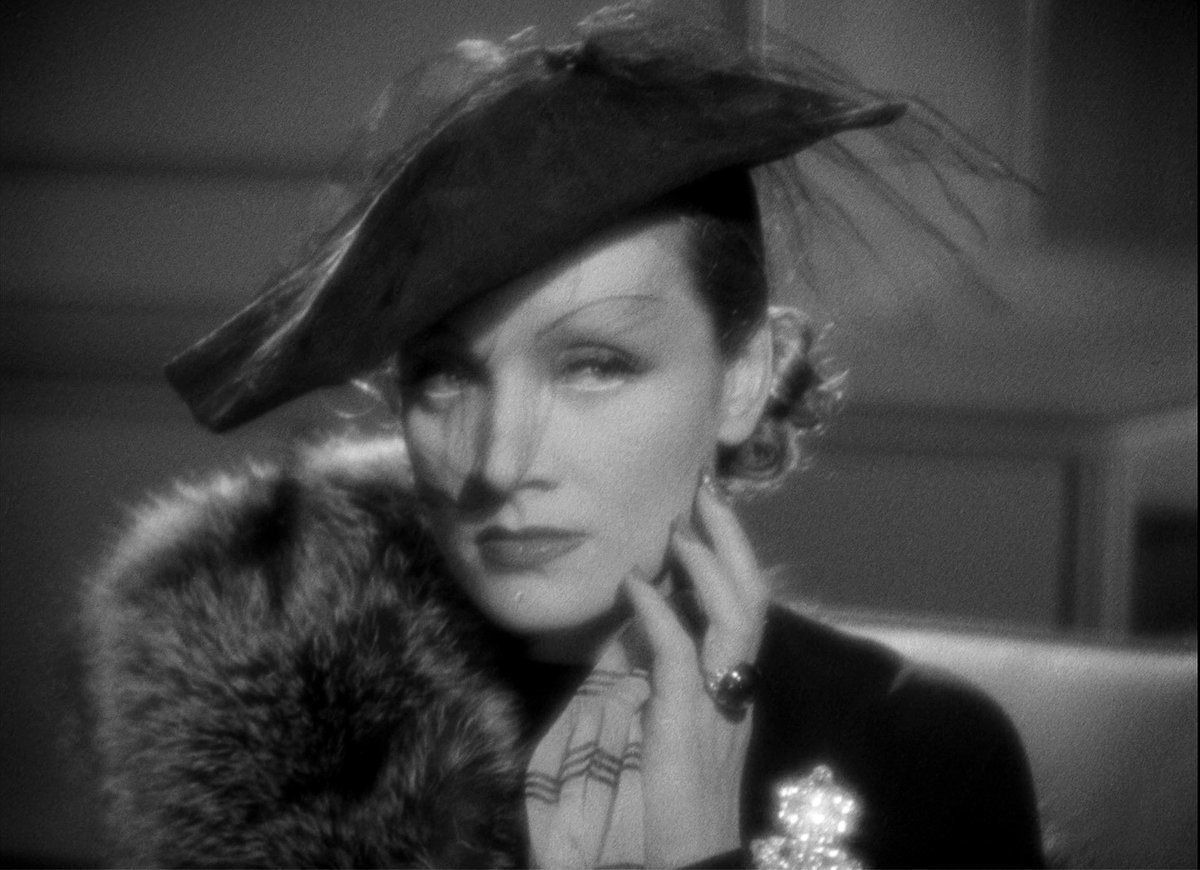
That doesn't mean that we should ignore that for 100 years of cinema OCN scans were simply not an option. So why be revisionist? Film can be an art, and as the others have mentioned resolution is not everything...sometimes not anything. This didn't even start at the negative. They used lighting, filters, lenses, pantyhose and vaseline to add intentional diffusion to what could have been razor sharp. An OCN scan is never going to show her blemishes...should we AI them in?:
-
MichaelB
- Joined: Fri Aug 11, 2006 10:20 pm
- Location: Worthing
- Contact:
Re: Interpositives and Intermediates vs. Negatives
This is, of course, another illustration of why a quixotic desire for maximum sharpness should always be weighed against what the film is trying to achieve. We've all seen 1930s films in which a pin-sharp shot of the male lead is intercut with a soft-focus shot of his female counterpart, but I'm willing to bet that it's not something that many of us really noticed until 4K scans significantly exaggerated the difference—but that exaggeration is now jarring in a way that almost certainly wouldn't have been the case in the intended 35mm projection situation.
-
rrenault
- Joined: Wed Nov 17, 2010 7:49 pm
Re: Interpositives and Intermediates vs. Negatives
There are definitely 4K presentations out there, including some “reference” ones on this site, that are a bit too sharp and eye popping compared to what I’d imagine any theatrical exhibition print would ever look like. The Warriors is a good example.
On the other hand, having seen 2001: A Space Odyssey in 70mm in a cinema, I wouldn’t say the UHD is “too sharp or eye popping” to be true.
The Die Hard UHD also looks convincingly like a theatrical exhibition print.
On the other hand, having seen 2001: A Space Odyssey in 70mm in a cinema, I wouldn’t say the UHD is “too sharp or eye popping” to be true.
The Die Hard UHD also looks convincingly like a theatrical exhibition print.
-
tenia

- Ask Me About My Bassoon
- Joined: Wed Apr 29, 2009 3:13 pm
Re: UHD New Releases, Reissues and Upgrades
I get what you're aiming at, but that's not the case. For all purposes and taking stuff done nowadays and not 15yo 4k scans : 35mm OCNs are currently considered scanned at their max, ie the scan pretty capture everything there is to capture. The digital resto is not supposed to change that, because it'll retain the captured content and sharpness (except of course if intrusive filtering is applied). And then, a UHD is supposed to be quite transparent to its source, even if it'll obviously lose a sliver of information due to compression.rrenault wrote: That said, one thing worth considering is an OCN-sourced 4K Blu-ray is still going to be 2-3 generations removed from the OCN just as a theatrical release print is(you have the scan, then the restoration/master, then the compressed version that fits into the disc) so maybe this discussion isn’t worth having.

All this taken into account, there most likely is a bigger loss of info between an OCN and its IP than between the scan of an OCN and the resulting UHD. That's... why we can quite easily perceive when a UHD is sourced from a scan of an OCN or a scan of an IP, and why we can even guess when a BD is sourced from a 2k resto or a 4k one. Otherwise, we wouldn't bd able to, because all the digital work would hide all those gaps and homogeneise them, which it doesn't.
I'd also argue that "projecting a UHD theatrically" would be equivalent, compression aside mostly, to projecting the restored 4k DCP, and having seen quite a wide rangr of those, I can tell that those done from OCN 4k scans are different looking than those done from IP 4k scans, and that yes, OCN-sourced 4k DCPs are at least grainier than 35mm archive prints being projected. Sharper ? I'm not so sure. But then, we'd also need to take into account that digital 4k projection isn't the same than 35mm projection equipment !
Absolutely. There are different views, the most used one being sourcing from OCN, but some people, labs, directors, DoPs differ from this. That's pretty much it, and honestly, all things considered, as long as it's not digitally manipulated to death, it's a good work. Here, it's soft, yeah, so sure enough, it's not as sharp as some hoped the UHD to be. Is it bad per se ? It doesn't look like it. But considering the market in general and your usual UHD upgrade, it looks more limited.Guido wrote:But that's exactly the point you seem to be missing. There is no such thing as a unanimous quality standard that's being upheld by a collective "we", despite how much you'd like there to be one — it all comes down to the intentions and choices of the creators, which are unique to every project.TVC 15 wrote: Tue Dec 16, 2025 3:16 pm Why would we want something to look like a print with generational loss?
-
jsteffe

- Joined: Sat Mar 31, 2007 1:00 pm
- Location: Atlanta, GA
Re: Interpositives and Intermediates vs. Negatives
I also saw 2001: A SPACE ODYSSEY recently on 70mm and came to the conclusion that it works better that way than in the digital restoration off the OCN. The issue is that the negative is indeed too detailed, and the seams in the special effects are too obvious as a result. When you see a good 70mm exhibition print, the special effects--especially the rear projection--look amazing, basically seamless.rrenault wrote: Tue Dec 16, 2025 4:42 pm On the other hand, having seen 2001: A Space Odyssey in 70mm in a cinema, I wouldn’t say the UHD is “too sharp or eye popping” to be true.
I've also seen instances where makeup on actors looks too obvious on digital restorations from the OCN, and it arguably wouldn't be in an exhibition print. To give just one example, I suspect that is the underlying reason behind the mixed response some people had to the DAWN OF THE DEAD 4K restoration, because the foam latex was too visible in some of the gore effects. I agree, but I feel that it wasn't so much because the image was brighter and more colorful than we were used to seeing, but because there was simply too much detail in the image. (By the way, I love the look that Michael Gornick brought to the film in the digital restoration--it makes perfect artistic sense.)