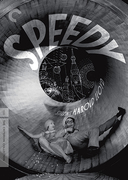
I really enjoyed Speedy, and although I have a couple of slight reservations I think I'm with domino on the quality of this film! I especially liked the heightened, almost cartoonish, sound effects added into scenes to highlight some of the comic moments such as the snipped braces on a couple of characters during the final brawl scene making an amusing twanging sound as they fly off! And especially of course the pincer from the crab making a ratchet tightening noise every time it reaches out from our unaware hero's pocket to grab hold of something, or someone!
My reservations around Speedy are really around the way that it feels like a collection of (mostly wonderful!) set pieces rather than a particularly compelling narrative, despite all of the stuff about having to save the father's horse-drawn bus business from unscrupulous businessmen and gangsters! But really more than its story it works best as a tribute to a variety of New York locations and what can be done with them. The majority of the film is pitched at an extremely frantic level, though that feels like it works to capture the hectic, anxious pace of the city, full of people racing to keep up with the pace of modern life!
I think I might have liked a little bit more of a, dare I say Chaplin-style, emphasis on the story over the set pieces, whereas here it feels as if the, always amusing, individual jokes feel like the main focus and then a story is built up afterwards around those jokes. But I think that is probably highlights a difference between the working methods of Chaplin and Lloyd - not better or worse, just differently emphasising their storylines! (It also sometimes felt like some of the jokes in Speedy anticipate Jacques Tati in the sense of making absurd but appropriate leaps of logic in some of the gags: say the moment where the sun coming through a spotty umbrella casts a shadow which causes Harold and his girlfriend Jane to think that he has gotten spots of dirt on his new suit!)
I think I see where Michael Kerpan is coming from with his comment on the female lead here, although I would disagree that it the problem is that the female lead isn't appealing - it is more the way that the film is using her that is the problem. I thought that Jane was a wonderfully charming character, unafraid to have some quite un-ladylike, down to earth fun and quick with a smile. She has a wonderful introduction swiftly booting a couple of tailgating kids hanging on the back of her father's bus (anticipating Harold hitching the taxi to a distressed upper crust lady's car during the final scene!) and hopping on it herself! And Jane is a wonderful presence (even a partner-in-crime!) during the subway train crush sequence and afternoon spent with Harold enjoying the fairground attractions at Coney Island. But the problem comes with the way that Jane sort of drops entirely out of the film after the Coney Island scene as the film focuses more on Harold's taxi driving troubles and the situation of tracking down and returning the father's own bus back to him in a race against time. After being such a strong, individual and wonderful presence in those early scenes, Jane sort of gets sidelined for the rest of the film until getting utilised by the film as the classical 'reward' for the hero at the end, as she runs into the arms of the triumphant Harold in delight! (Though I don't think the film means anything by ignoring Jane for the final half - it just moves its focus elsewhere. In a sense the 'love interest/partner-in-crime' who takes over the second half of the film from Jane is Babe Ruth! Perhaps the only person other than Jane who could catch Harold's eye! But even here while the film suggests early on that baseball might be a hugely important element of the film, even this gets used only for a couple of scenes and then is dropped. Though its all making up part of a larger tapestry, creating a quintessential New York atmosphere I guess!)
Tangentially, something that kept coming to mind during this early section of the film was the 70s BBC show Some Mothers Do 'ave 'em, especially in the way that Frank in that show can never hold down a job, much as Harold in Speedy keeps trying and failing to keep jobs! Though both Speedy and Some Mothers Do 'ave 'em do not make the main character's lack of stable employment a means to condemn our hero, and despite a bit of worry there's never too much anxiety to be found in their predicament as there is always another job around the corner to apply for and inevitably get, before losing it due to hijinks and belligerent employers! (In a more dramatic register that Charles Bukowski novel, and later film,
Factotum is perhaps dealing with how this situation might play out in 'real life'!). Though Jane in Speedy is also in the vein of someone like the Gamin in Modern Times and taking a more active role in the action (at least at first) than the more worried Betty Spencer in "Some Mothers"!
One of the very best scenes in Speedy is that beautifully poetic scene in the back of the furniture truck that our couple hitch a ride on back into the city from Coney Island, where they have a scene of moving some of the furniture around in such a way that the back of the truck looks like a cosy front room! Its touching both for the shared moment the couple have and the connection that they are making with each other through their shared dreams, but it also has a slight undercurrent of sadness there too for the suggestion that a brief fantasy of suburban bliss might be all that our couple are ever going to have. Even such a seemingly minor dream seems quite distant. Yet Speedy does feel in a lighter register for all of its 'gritty, on location realism'. There are worries there about future job prospects and livelihoods, but they turn out to only be worries that get solved by ingenuity and a certain amount of street smarts and contacts (such as the furniture truck driver being a friend and being happy to provide a lift back when Harold and Jane seem stranded in Coney Island). I wonder if this upbeat tone in the face of certain darker issues comes about because Speedy was released only a year before the Great Depression struck, so there might still have been a sense of optimism there about life and job prospects that might have seemed hopelessly deluded only a year or two later. (The main social comment in the film is the funny moment of Harold throwing a prospective cab fare's suitcases about which turn out to be full of prohibited alcohol, with the poor jilted fare having to anxiously avoid a passing policeman, gather up his leaking cases and quickly walk off, leaking an incriminating trail of liquor behind him as he goes!). Something like the extremely similarly toned dream sequence in Chaplin's Modern Times from the mid-30s, with the Depression and an upcoming World War separating it from Speedy, plays much broader, almost delusional (the self-milking cow delivering itself to the kitchen door each morning!) in comparison to the character's extremely destitute circumstances in reality.
Even the main plot device of Speedy is revolving around an apparently already extinct form of transport even in 1928 - the horse-drawn taxicab, with the commentary stating that the last of this form of transport had already stopped over a decade before. So there's already a safer sense of risk to the anxiety that this film is dealing with. It is a nostalgic look at a previous way of life that might have been preserved in a more slow moving part of the city more than highlighting any situation more currently relevant or business being threatened in contemporary 1928 terms (I guess the modern equivalent would be doing a movie about the history of Apple that stops in 1998!

Yes, its interesting as a nostalgic or historical piece but isn't it also, perhaps consciously, avoiding dealing with more difficult to grasp 'of the moment' concerns? Though that mid-50s Peter Sellers film The Smallest Show On Earth also came to mind for another form of 'safe nostalgia' for something already gone by suggesting there is a small, untouched by time, old cinema still around in some tucked away corner of the world)
In some ways that plays into the characterisation of Harold himself. A lot of the situations seem to involve Harold ignoring something occurring right under his nose due to his wandering attention. He's slow to wake up to the new realities of the world over and over again, and that is what keeps getting used throughout the film as the set up to all of the misunderstanding comic moments that cause Harold so many problems! (Amusingly after our discussion of
the high rating given to the new Criterion disc in the UK there is a shot of Harold flipping the bird at himself at the end of the mirror sequence! Perhaps the BBFC had never noted it before until the commentators pointed it up!) Even in the final search for the father's stolen taxi cab Harold is missing the clues until the dog pushes him in the right direction! The dog itself is constantly used in a role almost as a blunt but amusingly often ignored as an irritation 'guide dog' during the film!
Anyway despite some of my qualms I found the film extremely funny throughout! (I also love the on location-feel to the film, with crowds of presumably real onlookers gathering around to look at the action going on!) I think the scene I laughed hardest at (aside from those brilliant brief shots where characters have enormous close up reactions of utter shock, incensed outrage and/or abject terror!) is the scene where Harold is trying to work out whether he has actually got a taxi fare or not, which is dependent on who wins a brawl! And I especially love that he gives up and drives off only for us to still see the brawl going on in the background further up the street in the next shot! While I have my reservations about the storyline of Speedy being more than just a framework to embellish upon, the sense of atmosphere conjured up by the film and the use of space to emphasise the comedy (not just in the stunts but also the placement of characters for maximum impact) is where this film is at its absolute best!
Its also a great film about being savvy and cheekily pushing your luck to the breaking point...and beyond? I don't think I would have the guts to do some of the irreverent things that Harold does in this film, even if I might secretly dream of doing so every so often! Maybe that's the essence of a successful wish fulfilment film!