In honor of the DVD release, I've been treating myself to a "Louise Brooks: Auteur" *cough* review, watching as many of her films as I can get a hold of (sans Prix de Beaute, which I'm waiting on buying when I have a little extra cash). I'm also holding out on watching Diary of a Lost Girl again until MoC releases it next year (or whenever). I want it to be like new when I get to it again (blown away on the first viewing, however.) I'll write about them in order from least to most liked.
Spoilers in all of these, probably.
First up was St. Clair's The Show-off (1926), which isn't very aptly titled if you're interested in the film for Brooks, as it's mostly a Ford Sterling and Lois Wilson film. Brooks is trying to play the "flapper next door" in this, and it doesn't really work. Gregory Kelly can't really keep up with her as a love interest, and the chemistry dies a quick death between them. It is interesting that she's really the only character that exerts herself against "the Show Off", playing on whatever wisegal spirit she can muster (her character named "Clara", presumably acquiring the knowing It Girl's persona more than something homegrown). The highly of the film, to me, is Sterling's car ride, which is so ridiculous you can't help but guffaw. It's also the most interestingly directed sequence in the film, as it keeps you on your toes and makes you laugh simultaneously.
Brooks has a bigger part in Hawks' A Girl in Every Port, where she plays a Coney Island acrobat conniving to get two sailor friends one in the sack, the other the wallet. Hawks ably directs the large framed and sauntering Victor McLaglen (I barely recognized him from Gunga Din) and the sleazeball with a heart of gold Robert Armstrong (easily recognized from King Kong). Brooks is a femme fatale back when they were just called "whores", I suppose, and doesn't steal any time from the two male leads, who fight and drink their way through all their problems (not a bad lot, eh?) Anytime I saw Brooks at the circus where she performed, I kept thinking of the geek in Goulding's Nightmare Alley, so I should probably revisit it with a clearer mind.
It's the Old Army Game starring WC Fields was the most interesting because I had just read the Fields specific chapter in Lulu in Hollywood before viewing. This was really funny, and the copy that I had a chance to see had an audible audience recorded with the electro organ soundtrack (with all the laughing, sneezing, and comings/goings you could want seeing it in a theater yourself.) How anyone could watch Fields stuff a blanket in a midget's mouth and not chuckle is beyond me, but there wasn't a peep out of the crowd during that bit (made me wonder if it was out of synch, or maybe I was.) Directed by Brooks' future plaything/husband Edward Sutherland, but it was mostly a stagey vaudevillian piece that showcased, rightly, Fields' comic genius. Odd watching a young Fields, and an even younger Brooks (the two years between this and A Girl in Every Port made a big difference.)
The end of this was pretty odd, when they're at a stranger's house picnicking and just start trashing the place. Pretty surreal, in a way.
The last, and best, of these early films is Wellman's Beggars of Life, as it shows some very natural range that Brooks can have, and it's wonderfully directed as well, with lots of stylish touches (montages, camera movement, stunts, especially). The dialogue seems the most attended to of the bunch as well, which seems more character specific rather than tacked on for pure exposition/humor. Unfortunately, while I was watching it I couldn't get the idea of Brooks being proposed to by a fat hobo because she was perceived as such a slut by the crew (more gossip from Lulu in Hollywood.) Beery and Arlen are more than just walking through the parts, and bring some real character to the screen. As broad as the comedy gets, they play it pretty straight without overdoing it. The blue/depressing tinting really added to the effect (tinting the intertitles made some of them difficult to read, however), and out of the four I would be much more likely to watch this one again. This film is very important, I think, in seeing that Brooks can work outside of the "It Girl" box, and show range in a powerful natural way even without Pabst's coercion.
edit: I didn't bold that "I" correctly the first time around.
358 Pandora's Box
-
Tribe

- The Bastard Spawn of Hank Williams
- Joined: Tue Nov 02, 2004 11:59 pm
- Location: Toledo, Ohio
- Contact:
Original 1929 NY Times review:
A Disconnected Melodrama.
PANDORA'S BOX, with Louise Brooks, Fritz Kortner, Franz Lederer, Alice Roberte, Carl Goetz and others, directed by G. W. Pabst; "Should Married Men Go Home," a comedy, with Laurel and Hardy. At the Fifty-fifth Street Playhouse.
At the Fifty-fifth Street Playhouse is a German silent film called "Pandora's Box," with Fritz Kortner and Louise Brooks in the leading rôles. The story is declared to be a combined adaptation of Frank Wederkind's plays. "Erdgeist" and "The Box of Pandora." In an introductory title the management sets forth that it has been prevented by the censors from showing the film in its entirety, and it also apologizes for what it termed "an added saccharine ending."
Although there are several adroitly directed passages in this production, the narrative is seldom interesting. One is not in the least concerned as to what happens to any of the characters whose nonchalance during certain junctures is not a little absurd. It is a disconnected melodramatic effusion in which there is an attempt to depict a thoughtless, attractive woman and her unsavory experiences.
Lulu, the woman, played by Miss Brooks, is convicted of killing Dr. Schoen, whom she was to wed. As a matter of fact, he forces the pistol into her hand and in the ensuing struggle the weapon explodes with the fatal result. Lulu, apparently is not especially perturbed over this happening. In court she directs flirtatious glances at the Prosecuting Attorney and at the presiding judge. In those scenes dealing with her escape there is a suggestion of the melodrama in old serials, except that there is no climbing to housetops or swinging from trees. Lulu and others eventually reach a gambling place in the slums of Paris, where she is blackmailed by those who want money for one reason or another.
Miss Brooks is attractive and she moves her head and eyes at the proper moment, but whether she is endeavoring to express joy, woe, anger or satisfaction it is often difficult to decide.
Mr. Kortner, one of Germany's ablest screen players, adopts slow tactics in this offering. He is precise about sticking a monocle in his eye and also in getting into trouble at the psychological instant.
The scenes in the wings of a theatre are, however, filmed far better than the story deserves and the types for the minor rôles are well chosen.
-
dadaistnun

- Joined: Thu Nov 04, 2004 12:31 pm
 but I really want to see this one.
-
denti alligator
- Joined: Thu Nov 04, 2004 1:36 am
- Location: "born in heaven, raised in hell"
Criterion responds to my inquiry:
Thanks for writing in, and for catching the typo on the Pandora page.
Like so many other issues relating to silent film presentation, Pandora's Box needs to be interlaced due to the film's proper speed. As you probably know, unlike sound films which standardized on a frame rate of 24 frames a second (fps), silent films were shot at different speeds. The proper frame rate of Pandora's Box is 20 fps.
The thing to keep in mind is that all standard definition NTSC video is interlaced; every digibeta we provide to authoring for every disc is interlaced. It is in the DVD encoding process that interlaced video can be "put back together" into progressive frames. However, this process depends upon a reliable "2:3 pulldown" structure, which is the method by which a 24 fps movie is fit to the 30 fps speed (actually 60 interlaced fields) of the American video format, NTSC. (This pulldown cadence is often referred to as 3:2 pulldown.)
But, again, if a film is transferred at a speed other than 24fps, the standard "structure" that the encoder expects is not present, and attempting to convert to progressive frames at that stage results in an unwatchable confusion of mismatched frames. This is why Pandora's Box (like other non-standard-speed silent films, say Häxan or Nanook of the North) is presented interlaced.
I hope that helps. Thanks again!
Best,
Issa Clubb
Producer
-
denti alligator
- Joined: Thu Nov 04, 2004 1:36 am
- Location: "born in heaven, raised in hell"
-
zedz

- Joined: Sun Nov 07, 2004 11:24 pm
Well, Sunrise is a sound film, so presumably the answer is yes in that case!denti alligator wrote:The question is if this
is true, what are we all bitching about? But is it true? How are the MoC silents like Faust and Sunrise progressive? Are they at 24 fps?Like so many other issues relating to silent film presentation, Pandora's Box needs to be interlaced due to the film's proper speed
-
FilmFanSea

- Joined: Wed Nov 03, 2004 5:37 pm
- Location: Portland, OR
??? The 1927 Sunrise is a sound film? Whatcha smokin', zedz?zedz wrote:Well, Sunrise is a sound film, so presumably the answer is yes in that case!
edit: I recognize that a synchronized music score was added after filming was completed, but was the 24fps standard being used for synchonized scores by 1927?
-
Tribe
- The Bastard Spawn of Hank Williams
- Joined: Tue Nov 02, 2004 11:59 pm
- Location: Toledo, Ohio
- Contact:
The NY Times review of the Criterion DVD:
[quote]G. W. Pabst's 1929 German silent film, “Pandora's Box,â€
[quote]G. W. Pabst's 1929 German silent film, “Pandora's Box,â€
-
zedz
- Joined: Sun Nov 07, 2004 11:24 pm
If it's a synchronised score, then the score is printed on the film and needs to be projected at a standardised speed, right? Which is 24 fps. They couldn't have added the score to the film unless the film was shot at sound speed (and, by 1927, most Hollywood films were, I believe). What is at issue here is the speed of the film, not whether or not it was originally shot silent. Lonesome was shot silent too, but it must have been at 24fps to accommodate its soundtrack and interpolated talkie scenes.FilmFanSea wrote:??? The 1927 Sunrise is a sound film? Whatcha smokin', zedz?zedz wrote:Well, Sunrise is a sound film, so presumably the answer is yes in that case!
edit: I recognize that a synchronized music score was added after filming was completed, but was the 24fps standard being used for synchonized scores by 1927?
-
HerrSchreck

- Joined: Sun Sep 04, 2005 3:46 pm
I'm not entirely sure that 20fps can't be spread across the pulldown as it's a simple method of division-- spreading the film frame by frame out across the appropriate number of video feilds... perhaps the existing protocol wasn't deemed to be worth modifying in this case. Dave Hare states that the Gaumont PANDORA is progressive. FLOATING WEEDS and KING OF KINGS to the best of my memory are progressive. Aren't MOC's silents being encoded progressive lately too ie FAUST, METROPOLIS, etc? All many Kinos like THE MAN WHO LAUGHS, METROLPOLIS, etc, are encoded frame by frame, just every 4th has a ghosted, i e double, image.
Anyhow, as I said, I wasn't speculating on the reasons... my original point once again stands: the film is interlaced.
And yes, there are progressive silents.......
EDIT:
Anyhow, as I said, I wasn't speculating on the reasons... my original point once again stands: the film is interlaced.
And yes, there are progressive silents.......
EDIT:
That's not neccessarily true zedz... you can record onto a tape spinning at any speed, like ep-lp-sp on vid, the key is to make sure you play back at the same speed you recorded it at. SUNRISE was a genuine silent film, and was shown extensively without soound, so the sound had to be recorded onto the optical track-- part of the original film-- as it was turning at silent films speed.zedz wrote:If it's a synchronised score, then the score is printed on the film and needs to be projected at a standardised speed, right? Which is 24 fps. They couldn't have added the score to the film unless the film was shot at sound speed (and, by 1927, most Hollywood films were, I believe). What is at issue here is the speed of the film, not whether or not it was originally shot silent. Lonesome was shot silent too, but it must have been at 24fps to accommodate its soundtrack and interpolated talkie scenes.
-
HerrSchreck
- Joined: Sun Sep 04, 2005 3:46 pm
HOW TO ENCODE A SILENT FILM PROGRESSIVELY (even when leaping standards like a pole vaulter) by Nick Wrigley (From the FAUST thread)
We had difficulties a few months ago when we assessed Murnau Stiftung's master.
It appears that, for whatever reason, the only master materials they had was a PAL digibeta which had originally been made from an NTSC telecine, which had been very well converted to PAL using Alchemist. We tried to obtain the original NTSC telecine but they couldn't locate it anywhere and weren't even aware of the lineage of the master in the first place.
Unable to warrant the cost of a new telecine and repeat Murnau Stiftung's costly restoration, our options were to release an interlaced disc or to remove the 2:3 pulldown and make it progressive. Doing the latter introduced slight jagginess where harsh white met jet black, but the motion was lovely on all displays, as it was progressive.
The key thing is what it looks like in motion, and it looks really good.
I've viewed it for the last few months on an HD progressive display, and, in the circumstances, am happy with it. Whenever the DVD is paused, it is possible to see slight jaggies occasionally, but this does not ruin the viewing experience when the film is in motion -- as it's practically unnoticeable.
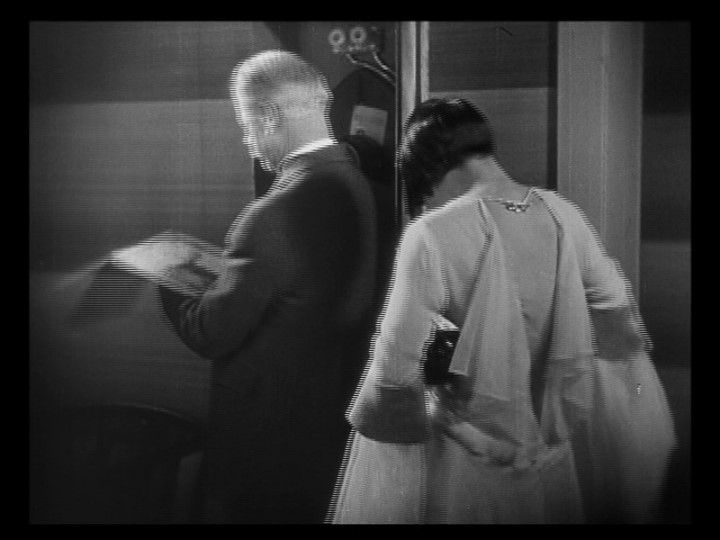
The Domestic version of FAUST on the new MoC set is *not* interlaced, and does not have any combing. Here are some more screenshots:
-
denti alligator
- Joined: Thu Nov 04, 2004 1:36 am
- Location: "born in heaven, raised in hell"
-
denti alligator
- Joined: Thu Nov 04, 2004 1:36 am
- Location: "born in heaven, raised in hell"
-
HerrSchreck
- Joined: Sun Sep 04, 2005 3:46 pm
I really don't know how to answer that one-- combing means a constant "trailing" effect, i e an unstable image. But we all have our tastes & things we're willing to overlook, especially from companies who we feel have served our artistic hunger well over the years. You're stepping aside for CC the way I've been stubbornly and thuggishly stepping aside for Kino over so many of the silents they've been releasing for years that make me so damned happy. You're entitled Dent.
Anyhow what must not be lost here in this nonsense (I don't want to start a schreck-dent duel over nonsense as I have too much respect for you) is I love the CC PANDORA-- the image is very hi bitrate HD-scan, and the presentation and extras were some of the most informative and MOVING as I've ever experienced. It's an excellent excellent package which I wouldn't trade for the world. I just miss that old Janus piano score, though Dave's right, the Raben score works well.
Anyhow what must not be lost here in this nonsense (I don't want to start a schreck-dent duel over nonsense as I have too much respect for you) is I love the CC PANDORA-- the image is very hi bitrate HD-scan, and the presentation and extras were some of the most informative and MOVING as I've ever experienced. It's an excellent excellent package which I wouldn't trade for the world. I just miss that old Janus piano score, though Dave's right, the Raben score works well.
-
Tribe
- The Bastard Spawn of Hank Williams
- Joined: Tue Nov 02, 2004 11:59 pm
- Location: Toledo, Ohio
- Contact:
Shit man, that's good enough for me...HerrSchreck wrote:Anyhow what must not be lost here in this nonsense (I don't want to start a schreck-dent duel over nonsense as I have too much respect for you) is I love the CC PANDORA-- the image is very hi bitrate HD-scan, and the presentation and extras were some of the most informative and MOVING as I've ever experienced. It's an excellent excellent package which I wouldn't trade for the world. I just miss that old Janus piano score, though Dave's right, the Raben score works well.
Denti, and perhaps I misread this in one previous posts way back...but I thought you weren't that impressed with Pandora's Box?
Tribe
-
denti alligator
- Joined: Thu Nov 04, 2004 1:36 am
- Location: "born in heaven, raised in hell"
Tribe, you're right. I think it's highly overrated. It drags. But it's still a fascinating film and one I will return to again (and maybe, again). (I much prefer Diary of a Lost Girl, Love of Jeanne Ney and Freudlose Gasse to PB.)
Schreck, combing is only visible every now and then, and mostly only during scenes with swift movement. If every second looked like that cap it would be unwatchable. This is simply not the case.
Schreck, combing is only visible every now and then, and mostly only during scenes with swift movement. If every second looked like that cap it would be unwatchable. This is simply not the case.
-
HerrSchreck
- Joined: Sun Sep 04, 2005 3:46 pm
-
domino harvey

- Dot Com Dom
- Joined: Wed Jan 11, 2006 6:42 pm
-
foggy eyes

- Joined: Fri Sep 01, 2006 1:58 pm
- Location: UK
This should probably go in another thread, but Sunrise is a sound film. It was Fox's first production to employ their Movietone sound-on-film apparatus, devised in opposition to Warner's Vitaphone sound-on-disc system (for, say, The Jazz Singer). Just listen to Hugo Riesenfeld's synchronised recorded score and the employment of diegetic sound on the marvellous original track.HerrSchreck wrote:That's not neccessarily true zedz... you can record onto a tape spinning at any speed, like ep-lp-sp on vid, the key is to make sure you play back at the same speed you recorded it at. SUNRISE was a genuine silent film, and was shown extensively without soound, so the sound had to be recorded onto the optical track-- part of the original film-- as it was turning at silent films speed.zedz wrote:If it's a synchronised score, then the score is printed on the film and needs to be projected at a standardised speed, right? Which is 24 fps. They couldn't have added the score to the film unless the film was shot at sound speed (and, by 1927, most Hollywood films were, I believe). What is at issue here is the speed of the film, not whether or not it was originally shot silent. Lonesome was shot silent too, but it must have been at 24fps to accommodate its soundtrack and interpolated talkie scenes.
-
HerrSchreck
- Joined: Sun Sep 04, 2005 3:46 pm
I say A B C D E, someone inevitably comes on and says "No-- A B C D E"
Plus, on top of that:
My point is, as the film had to run at the speed they wanted it projected when recording the soundtrack, it had to be running at the same speed it was played back... which was most probably the same playback speed as they wanted action playback in silent theaters.
Don't talk turkey on SUNRISE with me kiddo. The plasma in my very blood.
Plus, on top of that:
Yes-- as I and david said-- Fox had a synchronized optical soundtrack printed on the film (thus the pillarboxing on screens today), but as the changeover to sound had only taken place on a very limited basis by 1927/28, mostly in the largest theaters in major cities, the film was still shown extensively totally silent (or more appropriately, with live accompaniment) in it's roadshow in the heartlands of the globe. Not only SUNRISE, but other synch-scored films like THE MAN WHO LAUGHS, STREET ANGEL, etc etc were treated the same way.davidhare wrote:Re Fox and Movietone - the movietone soundtracks were recorded directly onto the film , unlike the competing Vitaphone system at Warner First National which began as accompanying phonograph recordings. Additionally it's likely Pandora in 1929 would have been filmed with an electrically driven camera (in use from 1927 to replace the hand crankers) so the movie is in all likelhood shot at 24fps.
My point is, as the film had to run at the speed they wanted it projected when recording the soundtrack, it had to be running at the same speed it was played back... which was most probably the same playback speed as they wanted action playback in silent theaters.
Don't talk turkey on SUNRISE with me kiddo. The plasma in my very blood.
-
foggy eyes
- Joined: Fri Sep 01, 2006 1:58 pm
- Location: UK
-
HerrSchreck
- Joined: Sun Sep 04, 2005 3:46 pm