I've been awaiting this for years, and a low-priced BD is the best possible option as far as I'm concerned. Hopefully to sway a few more people, here's Pauline Kael's complete original New Yorker review (a full-blown rave). She discusses large sections of the film's plot too, so I've spoilered the whole thing:
A friend of mine says that when you go to a Kon Ichikawa film "you laugh at things, and you know that Ichikawa is sophisticated enough to make you laugh, but you don't know why you're laughing." I agree. I've just seen Ichikawa's 1983 The Makioka Sisters, which opened in New York for a week's run and will open nationally in April, and although I can't quite account for my response, I think it's the most pleasurable movie I've seen in several months - probably since Stop Making Sense, back in November. The last hour (the picture runs two hours and twenty minutes) is particularly elating - it gives you a vitalizing mix of emotions. It's like the work of a painter who has perfect control of what color he gives you. At almost seventy, Ichikawa - his more than seventy movies include The Key (Odd Obsession), Fires on the Plain, An Actor's Revenge, Tokyo Olympiad - is a deadpan sophisticate, with a film technique so masterly that he pulls you into the worlds he creates. There doesn't seem to be a narrative in The Makioka Sisters, yet you don't feel as if anything is missing. At first, you're like an eavesdropper on a fascinating world that you're ignorant about. But then you find that you're not just watching this film - you're coasting on its rhythms, and gliding past the precipitous spots. Ichikawa celebrates the delicate beauty of the Makioka sisters, and at the same time makes you feel that there's something amusingly perverse in their poise and their politesse. And he plays near-subliminal tricks. You catch things out of the corner of your eye and you're not quite sure how to take them.
The Junichiro Tanizaki novel on which the film is based was written during the Second World War and published in 1948, under the title A Light Snowfall (and it has been filmed twice before under this title - in 1950, by Yutaka Abe, and in 1959, by Koji Shima), but it has become known here as The Makioka Sisters. The women are the four heiresses of an aristocratic Osaka family. Their mother died long ago, and their father, who was one of the big three of Japan's shipbuilders, followed. Tsuruko (Keiko Kishi), the eldest of the sisters, lives in the family's large ancestral home in Osaka and controls the shrinking fortunes of the two unmarried younger girls. The film is set in 1938, and the traditions in which these women were raised are slipping away, along with their money. Tsuruko and the next oldest, Sachiko (Yoshiko Sakuma), have married men who took the Makioka name, but its prestige has been tarnished by the behavior of the youngest of the sisters, Taeko (Yuko Kotegawa), who caused a scandal five years earlier, when she ran off with a jeweller's son and tried to get married, though the Makioka family's strict code of behavior required that Yukiko (Sayuri Yoshinaga), the next to youngest, had to be married first. The scandal was augmented, because the newspaper got things wrong - wrote that Yukiko had eloped, and then, when Tsuruko's husband complained about the error, mucked things up more in correcting the mistake. Taeko still lives in Sachiko's home, along with Yukiko, but she's trying to achieve independence through a career. She wants to start a business, but Tsuruko won't give her her inheritance until she's married, and she isn't allowed to marry. It's Catch-22. She's flailing around, and waiting for the demure Yukiko to say yes to one of her suitors.
Each suitor is brought to a formal ceremony - a miai - where the prospective bride sits across a table from the prospective groom, with members of their families and go-betweens seated around them. At thirty, Yukiko is a veteran of these gatherings, but she has still not found a man to her liking. During the year that the movie spans, there are several of these miai - each a small slapstick comedy of manners. The last, when Yukiko finally meets what she has been waiting for (and the camera travels up the suitor's full height), has a special tickle for the audience, because you can see exactly why Yukiko said no to the others and why she says yes to this one.
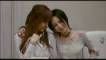
These miai are just about the only formal, structured events; in between them, Taeko gets into highly unstructured emotional entanglements - falling in love with a photographer who becomes ill and dies, taking up next with a bartender, becoming pregnant, sampling a few lower depths, and planning to go to work, which means another scandal. While Taeko wears Western clothes and goes off on her own, the exquisite, subdued Yukiko stays in her sister's house. (The two married women's houses are like theatres-in-the-round, with the four sisters and the servants as each other's audience.) Is Yukiko the priss that her Southern-belle curls and her old-fashioned-girl manner suggest? Not by what you catch in glimpses. Yukiko, who clings to the hierarchic family values of the past, with all the bowing and the arch turning away of the head and the eyes cast down, in scrutable, like Carole Laure in Blier's Get Out Your Handkerchiefs. But we see the come-on in her modesty. That's what's enchanting in the older sisters, too. Taeko, the animated modern girl, the one asserting her sexual freedom, is the least teasing, the least suggestive, but when she's with the others and in a kimono she's lovely. They're beauties, all four of them, with peerless skin tones, and they move as if always conscious that they must be visual poetry. (And they are, they are.)
Yukiko appears to be the most submissive, but she's strong-willed, and she has a sly streak. Living in Sachiko's house, she dresses with the door open to the hall Sachiko's husband passes through. And when she sees him looking at her bare thigh, she covers herself slowly, seductively. Sachiko, who observes what's going on, gets so fussed she starts tripping on her kimono and bumping into things. When she sees her husband kissing Kukiko, she crushes a piece of fruit in her fist and shoves it in her mouth to keep from crying out. And she renews her efforts to find Yukiko a suitable husband.
Ichikawa has said, in an interview, that he took his cue from the book's original title, A Light Snowfall. He said that light snow, which melts away instantly, "expresses something both fleeting and beautiful," and that he looked at the sisters in these terms. And that may help to explain why it's so difficult to pin down the pleasure the film gives. It's like a succession of evanescent revelations - the images are stylized and formal, yet the quick cutting melts them away. It's not as if he were trying to catch a moment - rather, he's trying to catch traces of its passing. When the four stroll among the cherry blossoms in Kyoto, the whole image becomes cherry-tones and they disappear.
Ichikawa's temperament brings something more furtive and glinting to the material than Tanizaki gave it in the novel. (In its spirit, the movie actually seems more closely related to other Tankizaki novels, such as The Key, than it does to this one.) The film builds to its last hour; what's distinctive about the buildup is that the darts of humor don't allow you a full release. Taeko's first bid for independence involves becoming an artist, and her sisters speak of her work in perfectly level, admiring tones. Sachiko even pays for a show at a gallery. Taeko's art is the creation of dolls - exact, lifelike small reproductions of girls in heavy makeup and elaborate gowns, and with eyes that open and close. They could be little Makioka sisters. This is sneak-attack humor, played absolutely straight - Ichikawa is satirizing the material from within. And when this kind of suppressed joke plays right next to sequences such as a display of shimmering golden kimonos that the Makioka girls' father had bought for Yukiko's wedding presents, with one after another placed center screen - a glorious celebration of textures and color - an unusual kind of tension and excitement builds in the viewer.
I don't know enough about the Osaka culture to interpret the film as social criticism or as an elegy to a vanishing form of feminine grace. (Ichikawa himself comes from the Osaka area.) But the actresses are perfectly believable as the works of art that women like the Makioka sisters were trained to be. And it's easy to be entranced with the world that the film creates. (The industrialization of Japan is kept on the periphery.) When the banking company that Tsuruko's husband works for transfers him to Tokyo, and Tsuruko doesn't want to leave the Makioka home - a cool palace of polished wood that seems built on an intimate scale - you don't want to leave it, either. The rich colors, the darkness, the low-key lighting - they're intoxicating. When Tsuroko decides to make the move, and her husband falls to his knees to thank her, it has the emotion effect of a great love scene. But the film's finest moment comes at the very end. It's a variation of Joel McCrea's death scene in Peckinpah's Ride the High Country, when the old marshal falls out of the film frame. Yukiko is going off to be married; she boards the train in soft vanishing snow, and we realize that she meant far more to Sachiko's husband than a casual flirtation. We see him alone, getting drunk, and he looks terrible - he's all broken up. Then images of the four sisters among the cherry blossoms are held on the screen in slow motion that's like a succession of stills. At least there's only Yukiko's head in the center of the screen, and the head of her disconsolate brother-in-law passes across the screen behind her and out of her life.
The horrible thing about Peckinpah's recent death was that he was the most unfulfilled of great directors. Like Peckinpah, Ichikawa has had more than his share of trouble with production executives, but he has weathered it, and there's a triumphant simplicity about his work here. This venerable director is doing what so many younger directors have claimed to be doing: he's making visual music. The themes are worked out in shades of pearl and ivory for the interiors and bursts of color outside - cherry and maple and red-veined burgundy. He's making a movie that we understand musically, and without losing his sense of how corruption and beauty and humor are all rolled up together.
March 11, 1985