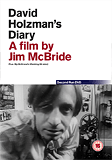
Shot in 1967, David Holzman's Diary is a milestone in contemporary film history. Brilliantly conceived and executed, it manages to simultaneously be very much of its time and very many years ahead of its time. The film tells the story of David Holzman, a young man infatuated with film and film-making. Newly unemployed and beset with doubts and worries, Holzman thinks that filming his everyday existence will 'bring life into focus'. Staged to seem like a documentary of a real person's life, Holzman's filming of his life starts to take over his life.
As a very special bonus extra, this Second Run release also includes director Jim McBride's personal 1969 documentary My Girlfriend's Wedding, where his camera turns on his ‘liberated' English girlfriend and her candid conversations about her life and her reasons for marrying another man.
Special Features
• Includes the first ever release on DVD of Jim McBride's My Girlfriend's Wedding, finally achieving the director's intention for these two films to be shown together.
• Newly filmed interview with director Jim McBride.
• New digital transfer with restored image and sound.
• Booklet featuring an essay on both films by US writer/critic Jonathan Rosenbaum.
• Optimal quality dual-layer disc.
....
Jaime Wolf's essay from the Criterion laserdisc edition:
Jim McBride's David Holzman's Diary, made for less than $3000 over 5 days of principal photography, manages to be 20 years ahead of its time and perfectly of its time. Spiritual forebear to the contemporary low-budget American independent film movement (as well as to This Is Spinal Tap and a subsequent parade of "mockumentaries"), it is also a detailed portrait of the specific time and place geographically known as New York City in the summer of 1967, and psychically felt as that morass of fraught concepts, idealisms, and dogma we call the Sixties. It's hard to imagine how revolutionary the combination of location shooting, available light photography and a handheld camera might once have seemed, but during the 60s the exciting possibilities of an improvisatory narrative structure which promised to capture events as they unfolded were just being explored. The cameras of Rickey Leacock and D.A. Pennebaker, Andy Warhol, Andrew Noren and the Maysles Brothers established a new relationship with their subjects: intimate, revelatory and personal, countering a documentary tradition in which human beings were primarily used to illustrate various social themes. And the very name cinema verite announced that these films had attained the goal of philosophic inquiry: truth. British theorists preferred the term Direct Cinema, implying that it was unmediated, unauthored, Real Life Transmitted Straight To You. Of course, however, it was neither Direct nor True, and these illusions are comically and poignantly exploited in David Holzman's Diary.
Booed at the 1968 San Francisco Film Festival when the end credits revealed it to be fiction, McBride's film illustrates the perils of a too-literal belief in the power of documentary. David Holzman's Diary is the first-person account of a newly unemployed and suddenly very draft-eligible young man, who feels life slipping out of his grasp. Filming himself, he believes, will help him to figure it all out. The ability to project images on a screen, to see them over and over, to edit them together --in short the very medium of film-- will reveal the Truth behind the random events of his existence.
But filming only causes things to become more muddled: his girlfriend leaves him, a friend criticizes him, he begins to do things in order to have material to film. Ultimately his equipment is stolen, leaving him despondent and unenlightened. It is a simple and inexorably logical descent, explicitly dramatizing what film critic Andrew Sarris called the application of the Heisenberg Uncertainty Principle to documentary filmmaking: the inevitable effect of the presence of an observer on the behavior of the observed. Holzman's obsessive cinephilia only exacerbates the situation. In part, he misunderstands his life to the precise degree to which it is not like a movie: bestowing the name of a Visconti heroine on the neighbor who doesn't know he watches (and films) her; quoting from Godard and Truffaut; offering to discuss Vincent Minelli when he runs out of personal material to report. Simultaneously, McBride sends up the masturbatory subtext of such self-involvement. When Holzman encounters the Thunderbird Lady (a serendipitous, unscripted scene during which L.M. Kit Carson became so unnerved that cameraman Michael Wadley took over as David Holzman), a self-proclaimed nude model who asks if he wants to fuck, he responds, "I think I'd rather make films."
And yet for all the self-obsession, the real world constantly intrudes upon the film: the Upper West Side, where Holzman lives; a barrage of images marking an evening spent in front of the television; news reports on the soundtrack, scattered between the hits on 77-WABC AM. These last provide counterpoint to, and even justification for, his neurotic anxiety riots in Newark, escalation in Vietnam, and the lyrical high point of the film, the roll call for a UN vote on an issue which is never disclosed, while Holzman's camera takes slow motion inventory of the inhabitants of a long bench in Needle Park. And happenstance, as in the Thunderbird Lady, an encounter with the police as they assist a robbery victim, or Wadley's acquisition of a new fisheye lens during filming, continually enriches the film in ways its basic script could not anticipate.
At once a fictional narrative within a recognizable documentary setting and a kind of essay on the conditions of filmmaking, David Holzman's Diary stands as one of the few American equivalents to the work which Godard was doing at the time. Unfortunately, the film was more influential than it was widely seen. After playing the festival circuit, David Holzman's Diary was not shown theatrically until 1973. By then cameraman Wadley had changed the spelling of his name to Wadleigh and directed Woodstock, while Carson and McBride had embarked on other projects separately and together. Over the years, their Holzmanesque preoccupations would continue to resurface in a unproduced adaptation of Walker Percy's The Moviegoer, and their co-scripted, McBride-directed 1983 Breathless remake, starring Richard Gere. Back in 1973,
Chuck Kraemer of Boston's Real Paper predicted that David Holzman's Diary would be remembered as "the underground autobiographical cinema verité film of the sixties. . . . Scholars of the nineties will revere it." In 1992 the Library of Congress named the film to its National Film Registry, as one of 50 American films deemed historically significant and worthy of preservation in their original form. Viewed in today's hypermediated environment, against a constantly blurring distinction between truth and fiction, David Holzman's confusions and concerns seem prescient and relevant as ever.